Showing posts with label Media and Hunger. Show all posts

Sunday, March 04, 2018

Albuquerque Journal Editorial Criticizes SNAP-Food Box Proposal

Too many New Mexicans and Americans depend on SNAP to stretch their grocery dollars. Sending out boxes of packaged food nobody wants won’t help them or taxpayers. -Albuquerque Journal Editorial, March 2, 2018
On Friday, March 2, the editorial board of the Albuquerque Journal came out forcefully against a proposal in President Trump's 2019 Budget that would replace current benefits under the Supplemental Nutrition Food Assistance program with food boxes. The Journal joins a chorus of voices,  including SNAP recipients, the Food and Research Action Center, New Mexico Voices for Children, and many others in opposition to the proposal.

Here are the reasons that the Journal gave for opposing the measure. While we disagree that fraud is as big of a problem as the Journal states, we are pleased that the board recognizes the absurdities in the president's proposal.
  • The proposal does not solve the real problems with the $71 billion-a-year SNAP program, the most glaring one being fraud.
  • The proposal doesn’t factor in a family’s food allergies, medical needs or likes or dislikes.
  • The proposal creates an entire bureaucracy around manufacturing, supplying contents for, filling and shipping these food boxes.
  • The proposal uses half of recipients’ benefits for boxes of food that by definition can not be fresh.  The proposal cuts the amount local families spend on food, taking money out of the local economy and reducing the viability of proposals to address the need for more nutritious grocery options in so-called food deserts.
Read full editorial

Thursday, November 16, 2017

A Radio Show on Three Ways to Share the Journey

[Pope Francis] has brought it to our attention and asked us to literally Share in the Journey, Now, we have to find out what that means, and all the ways we are called to do it...  Each of you is in a position to very vividly show us, explain and illustrate how all the people listening, all the people of the Catholic faith, of  any faith, can participate in this. -Mary Woods, host of the Archbishop's Hour on Catholic Radio
The theme of the Archbishop's Hour on Catholic Radio (Archdiocese of Santa Fe) on Tuesday, November 14, was the Share the Journey campaign, a global effort launched by Pope Francis to bring attention to the plight of immigrants and refugees everywhere. "War, exploitation, poverty, natural disasters or the desire for a fairer, better life, are causing people to leave their homes," says Caritas, the global counterpart to Catholic Charities and Catholic Relief Services. "It’s one of the greatest challenges of our time."

"As a result, our world faces not a migration crisis, but a crisis  of global solidarity," Caritas said in a statement on its own Share the Journey site urging the faithful in every country to take part in the campaign. "Be part of a worldwide campaign to reach out to migrants, change perceptions, open hearts and minds."

In the Archdiocese of Santa Fe, the campaign is moving forward on many fronts with the strong support of Archbishop John Wester. Three special guests spoke about their roles in the campaign on the Archbishop's Hour on Catholic Radio on November 14.

Kathy Freeze, Fr. Rafael Garcia, S.J.
Encounter
Kathy Freeze, faith community outreach coordinator at Catholic Charities of Central New Mexico, spoke about her agency's work with refugees and immigrants and the outreach efforts of Catholic Charities to engage the community in the campaign.

"I like the idea of encounter," she said, describing the efforts to encourage people of different parishes to take to engage with immigrants and refugees in our community. "We can tear up the walls of indifference that we have built up," she noted. 

Advocacy
Anne Avellone, director of the Office of Social Justice and Respect Life at the Archdiocese of Santa Fe, spoke about advocacy. She and Rocio Gonzales, director of Hispanic Ministry at the Archdiocese, traveled to Washington with counterparts from around the country to meet with Congress on two crucial issues related to the Share the Journey campaign.

One issue addressed the need to preserve funding for foreign aid in the upcoming federal budget, which is essential for the U.S. do its part to respond to the global refugee and immigrant crisis. "It is crucial to respond to the needs of people on the move, many of whom are desperately poor and displaced."

On the domestic front, Avellone and Gonzales met with staff from Sen. Tom Udall and Rep. Michelle Lujan Grisham  about promoting the rights of immigrants in the Deferred Action for Childhood Arrivals (DACA) program. "We know our immigrants in our community. We know these men and women.  They might be cowoerkers, they might be parishioners, they're certainly neighbors," said Avellone.  "They make a huge contribution to our community."

Debbie Golden, Fr. Graham Golden
Art 
Rev. Graham Golden, O Praem, director of the Office of Christian Discipleship and Religious Vocation for the Norbertine Community at Santa Maria de la Vid Abbey in Albuquerque, discussed the art exhibition that the Norbertine Community is hosting at the Abbey. The exhibit, which features works from 46 artists, was launched with a gallery opening on November 3, that was attended by more than 300 people. The exhibit will close on Dec. 16, with a traditional posada (a reenactment of Mary and Joseph's difficult journey from Nazareth to Bethlehem in search of a warm place to stay the night).

Father Golden, who played a key role in curating the exhibit, noted that the art on display includes both works of immigrants and refugees and pieces from any person in the community who is on some sort of journey. "We felt that the arts were a  good opening to be able to allow for people to safely take risks to step into the world of someone else, to try find where there was some point of intersection between their own lives and their own journey and the very literal journey of immigrants and refugees," he said.

These are only snippets of the very insightful comments from the three guests.  For a more in-depth account of their discussions and comments, listen to the show via This Link  (Fast forward past the preliminary information to Minute 23 to hear the interviews. My thanks to host Mary Woods for supplying the link to the audio).    

Saturday, September 23, 2017

Sharing the Communal Meal

One of our immigrants came to the country and our Catholic Charities received her...She was hungry from her long flight  and it had been a long day and it was in the middle of the day.  She got to a Catholic agency and they had prepared a meal for her. But she wouldn't eat. Finally, they said, "I thought you were hungry"  She said, Well I am. But where are the others?  (She was asked) What do you mean? In my culture, we would never eat alone. Eating is a communal activity to be sure that there is enough for everybody And if you ate alone, that would be a sign that you were hoarding food, that you were thinking only of yourself.
The Most Rev. John C. Wester, Archbishop of Santa Fe, shared this story during our joint appearance on The Archbishop's Hour radio show on Friday, September 22. This is a story he had heard from Sister Marilyn Lacey in San Francisco.

"I've never forgotten that story because of our immigrants have a lot to teach us," said Archbishop Wester, who noted the importance of caring for others and eating together.

Bishop Wester's point is that the imperative to feed the hungry and to seek justice is part of our Catholic Social teaching. "It's a call of the Gospel. It's a call of basic human decency that we would want to share our food," said Archbishop Wester.

The topic of hunger was chosen for this show to promote the Feed the Hungry Day on Saturday, Sept. 30, an opportunity to examine viable ways to address hunger within our diocesan borders and to respond in practical ways. I will be a participant in a panel, and Archbishop Wester will end the day with a Mass.

I had appeared on the Archbishop's Hour previously (in April), so I was very familiar with the format and comfortable with speaking on the radio. As usual, host Mary Woods moderated the conversation with ease and asked the right questions to keep the conversation flowing. We addressed many topics related to food insecurity in New Mexico, the Interfaith Hunger Coalition, the importance of local sourcing, and the need to look at the big picture when addressing hunger. We also discussed this Tuesday's End Hunger Summit.

It was an honor and a privilege to share the airwaves with Archbishop Wester.
Listen Here
(The actual interview starts at about Minute 17)

Mary Woods

Saturday, April 22, 2017

On the Radio

I was fortunate to be the guest on the Archbishop's Hour Radio Show hosted by Mary Woods, which aired on Tuesday, April 18. The show, sponsored by the Archdiocese of Santa Fe, features a variety of guests speaking on a variety of topics. I spoke about Bread for the World, the Lumen Ecclesaie Award I received from the Dominican Ecclesial Institute on March 26, the evolution of the Interfaith Hunger Coalition and my work as managing editor at the Latin America Digital Beat (LADB) at UNM.  Mary sent me a link to the show, which I uploaded to my account on the Kiwi6 site. The actual interview begins at about the 21st minute.
Listen Here

Tuesday, December 06, 2016

Rick Steves Matches Your Gifts to Bread for the World

What is it that gets us involved in recognizing the value of Bread for the World? I happen to be a travel writer. I've spent one-third of my adult life living out of a 9-by-22-by-14 inch carry-on-the- airplane suitcase. I've spent a lot of times far away from the United States looking back at our country. What I find interesting is that we can learn a lot about our country by leaving it and looking at it from another perspective.  -Rick Steves (from his address to participants at Bread for the World's 40th anniversary celebration).
Steves chats with former Sen. Tom Harkin of Iowa
Rick Steves helped us celebrate the passage of the Global Food Security Act with a message on Twitter this summer. The travel writer and television host is a dedicated member of Bread for the World, who supports our organization in many ways. This includes occasional participation in our Lobby Day.

As he does every Christmas season, Steves is offering his holiday package again this year. It's very simple  "Here’s how it works," said the travel writer. "You make a $100 gift to Bread for the World. I will match your donation – and send you my Christmas DVD, coffee-table book, and CD as a thank you. This year, my personal goal is to match all gifts up to $250,000."  Donate to Bread for the World and receive the gifts from Rick Steves

Steves has made extensive use of social media to post the message, including Twitter, Facebook and YouTube. Here are the Twitter and YouTube messages.


"I see Bread for the World not as a charity, but as a service. With our help, they are able to go into the halls of our government and speak up (or “lobby”) for hungry people in our country and around the world. This year, the need is particularly great," said Steves  "Europe is in the midst of the worst refugee crisis since World War II. Parts of Africa are suffering from a horrible drought. And one in five U.S. children still lives in a family that struggles to get enough to eat."

Monday, October 31, 2016

'I Can't Recall any Candidate Campaigning to Reduce Poverty'

Winthrop Quigley is one of those writers whose columns sometimes leave you shaking your head and other times have you nodding in full agreement with the theme and the depth of his pieces. The column in Sunday's Albuquerque Journal fits in the latter category. For, those of us who have involved in one form or another the Vote to End Hunger campaign, Quigley's column could not have stated the issue any better.

The issue of poverty (and hunger) seems to get lost in the electoral campaigns. While that's a problem anywhere in the country, the omission is even worse in New Mexico. Here are a couple of excerpts from Quigley's Oct. 30 column, entitled NM’s biggest problem needs a bigger response
Photo: Mary Singleton
The most intractable problem New Mexico faces is poverty. From low birth-weight babies to violent crime, poverty is either a cause, an effect or a complicating factor in the state’s many dysfunctions. With about as many New Mexicans receiving Medicaid as there are New Mexicans in the workforce, with almost half of our children under the age of four years receiving food stamps, there is evidence the problem is getting worse.

And yet I can’t recall a political candidate campaigning on a platform of reducing poverty. Candidates talk about bringing jobs to the state, cutting or raising taxes, imposing or opposing right-to-work legislation, reforming the schools or making New Mexico more business-friendly. Any one of these approaches might do us some good, but none of them looks at the poverty of our state in its totality.     Read full column

Sunday, October 16, 2016

Writing about the Crisis in Sub-Saharan Africa on World Food Day 2003

Food emergencies are dramatically compounded when large groups of people flee their homes to escape persecution, armed conflict, environmental degradation or famine, often in combination. 

In 2002, the World Food Program's entire $1.2 billion global budget was needed in Africa, largely because of the Ethiopian famine and the political crisis in Zimbabwe.  With escalanting conflicts in Liberia and the Democratic Republic of the Congo and food emergencies in Angola an South Africa, an appalling system of triage has developed. As hunger spreads, crises are weighed against one another, and contributions from donor governments are always behind the curve.
Image adapted from Open Clip Art
Who remembers Albuquerque's now-defunct afternoon newspaper The Albuquerque Tribune? This great newspaper, like many newspapers around the country, was a victim of the changing times: a decline in readership, rising costs and other factors. All of a sudden, there was no room for two newspapers in Albuquerque.

For Jack Ehn, editor of the Insight & Opinion section, the voice of the community was very important. He would often ask representatives of various community organizations to put together Op-Ed pieces on a variety of issues to publish every week.

Here is a joint piece that UNM Prof. Jennifer Moore and I wrote on World Food Day in 2003 Thirteen years ago, we addressed the famine in Ethiopia, a political crisis in Zimbabwe, and a refugee crisis in sub-Saharan Africa. "The needs of sub-Saharan Africa will be best served if we come together as a global community to find long-term solutions to multiple problems in the region," we said in the Op-Ed piece.

So has the situation changed in 2016?  Famine subsided in Ethiopia, but climate change and drought have once again put the East African country in peril. Zimbabwe remains in a state of economic and political crisis. What about the refugee situtation?  This piece in The Washington Post sheds light on the most recent refugee crisis in sub-Saharan Africa where refugees are fleeing from dire conditions in their country to dangerous places. According to the report,  43,000 South Sudanese refugees have fled to Darfur and 100,000 Ethiopians and Somalis traveled by boat to Yemen, and nearly 5,000 citizens of Congo were seeking refuge in the Central African Republic.

So let's repeat what we said in 2003.  "The needs of sub-Saharan Africa will be best served if we come together as a global community to find long-term solutions to multiple problems in the region.

Here is the Op-Ed that Jenny and I wrote in 2003. 


Friday, October 07, 2016

A Bread Member in St. Louis Asks Why Hunger and Poverty Not Part of Debates

"The first presidential and the only vice presidential debate have completely ignored the outrageous reality that one in six people in our country, the richest nation in the world, is regularly hungry or food-insecure. No one, not Hillary Clinton nor Donald Trump nor the debate moderators, have discussed in any substantial way the question of how to address hunger and poverty.

Yet 42 million people in the U.S., including one in seven households in Missouri, struggle with hunger. And 43 million of our citizens, including one in three children in our state, live below the poverty line. As actor and activist Jeff Bridges has rightly said, "If another nation was doing this to our children, we'd be at war."

-Excerpts from a letter to the editor in the St. Louis Post-Dispatch by Clint McCann, a Bread member in Webster Groves, Missouri.

Monday, September 26, 2016

Bread for the World Invites You to Play Bingo During the Debates

Play bingo while you watch the presidential and vice presidential debates!

We want to elect leaders who make ending hunger and poverty a priority, so we are encouraging candidates to talk about these issues.

We invite you to watch the debates and listen if candidates address poverty and hunger.
Download and print Bread’s bingo cards with terms relating to hunger, poverty, and the work needed to end both.

Use a marker and put an X through each word or phrase you hear the candidates say. Five consecutive crosses means that you got bingo!

Play with friends or with others on Twitter by using the hashtag #IVote2EndHunger. Tag @bread4theworld if you get bingo.

A BINGO win for you is also a win for our advocacy, as hearing these words spoken means the candidates are talking about hunger and poverty – something that must be done if we’re to effectively end hunger by 2030.

Presidential and vice presidential debates will air on:
  • September 26
  • October 4 (VP debate)
  • October 9
  • October 19
All debates begin at 9 p.m. EDT and will be televised on all major networks. Join us as we play BINGO and hold the candidates accountable on addressing hunger and poverty.

Wednesday, September 14, 2016

A Hunger Op-Ed Written Fifteen Years Ago in The Albuquerque Tribune

Even though we live in a country with an incredibly high standard of living, there are many in our communities, locally and globally, who do not share in this prosperity. They are nonetheless our neighbors and part of the fabric of our life together, and justice demands that we work both collectively and as individuals to ensure that all people can sufficiently meet the basic needs of life.
Who remembers Albuquerque's now-defunct afternoon newspaper The Albuquerque Tribune? This great newspaper, like many newspapers around the country, was a victim of the changing times: a decline in readership, rising costs and other factors. All of a sudden, there was no room for two newspapers in Albuquerque.

We remember some of the great attributes of "The Trib," including its Insight & Opinion section. For Jack Ehn, editor of this section, the voice of the community was very important. He would often ask representatives of various community organizations to put together Op-Ed pieces on a variety of issues to publish every week.

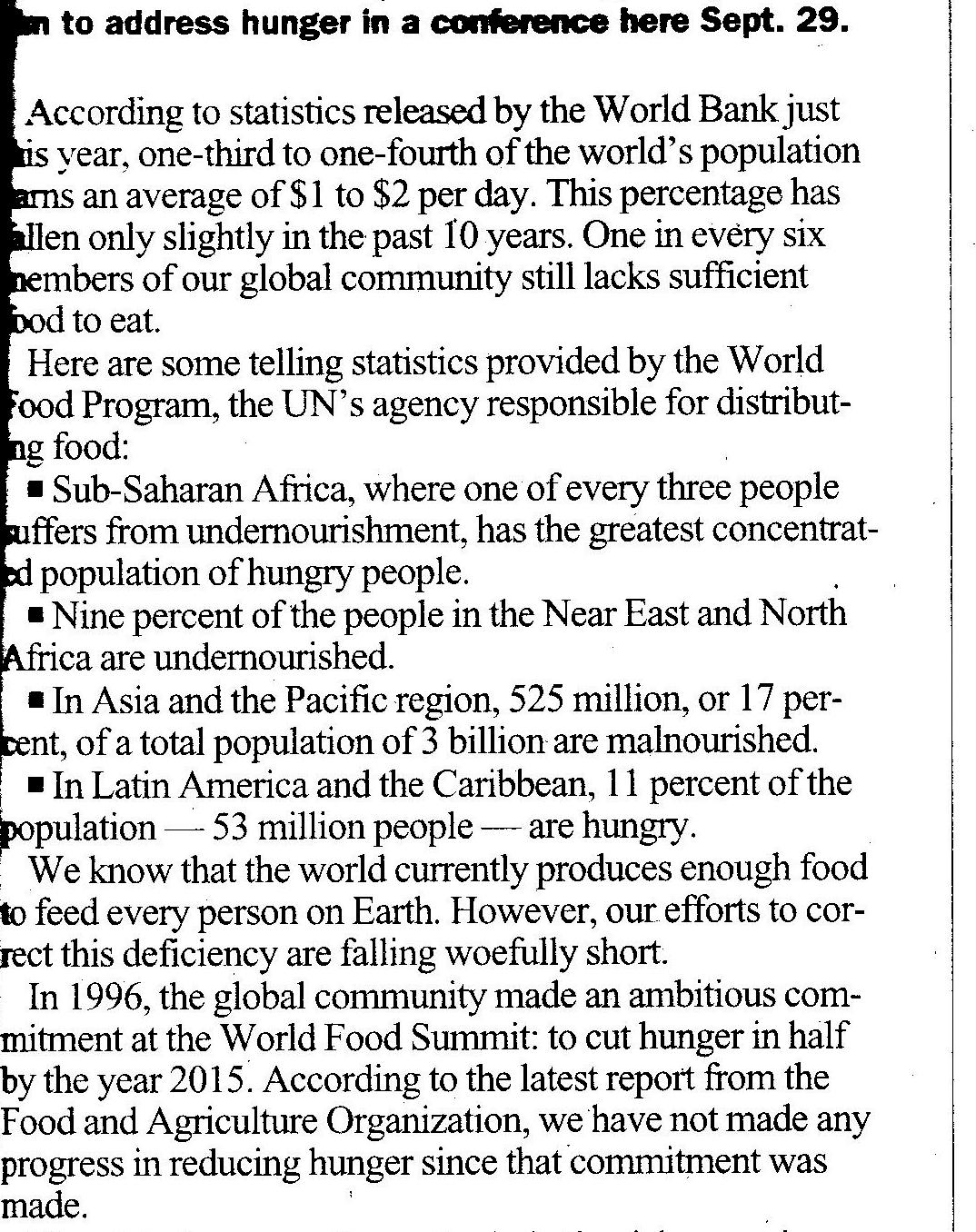
Here is a piece that Ruth Hoffman of the Lutheran Advocacy Ministry-New Mexico (then called the Lutheran Office of Governmental Ministry, LOGM) wrote exactly 15 years ago, on Sept. 14, 2001. We put together the piece, partly to promote a join conference on hunger sponsored by LOGM and Bread for the World on Sept. 29. The keynote speaker was Rev. Arthur Simon, founder of Bread for the World. Here are scanned images of the piece.


Tuesday, July 05, 2016

Syndicated Columnist Brings Attention to Summer Hunger in New Mexico and Elsewhere

“Food banks in Arizona and New Mexico just don’t do summer feeding because there aren’t enough volunteers, there isn’t enough food, and not enough money to get food out to the remote rural areas scattered throughout counties. And I repeatedly hear that in states with drought conditions, fewer crops are being planted, which means less donated fresh fruits and vegetables and more farmworkers who aren’t working enough to sustain themselves. Then the farmworkers end up turning to food banks in greater numbers just to get by.” Ross Fraser, director of media relations for Feeding America
Nationally syndicated columnist Esther J. Cepeda alluded to New Mexico in her column entitled "Hunger Never Takes a Holiday. " The comments about New Mexico and Arizona were part of a quote from Ross Fraser, director of media relations for Feeding America.

In a piece posted on June 24, Roadrunner Food Bank also addressed the issue of summer hunger. "In New Mexico alone, on a year-round basis, more than 136,000 children and 358,000 people overall don’t know where their next meal will come from, according to Map the Meal Gap 2016. Imagine the loss these children and families feel when the support nets of free and reduced-price school meals end for a 2-3 month period," said Matthew Young in an article entitled Why Solving Summer Hunger Matters.

RRFB made a similar argument two years ago. " For struggling families, the summer is a time of dread.  Their children no longer have access to the subsidized school meal programs. This means that struggling parents must come up with a way to provide those additional meals while school is out," said Donna Marlow in a piece entitled Summer Time Stress and Worry.

Fortunately, there are 900 sites in New Mexico that offer access to children during the summer months via a USDA supported program. This goes a long way to alleviate hunger in our state during May, June, July and August.  However, this is probably not enough.

In her column, Cepeda alludes to the many creative ways that food banks and other providers around the country use to get food to people (including the ice cream truck in Las Vegas, Nevada). 

Cepeda notes that citizens around the country have stepped forward to provide food donations to the food banks during the summer months. But distributing the donations becomes a challenge. There are fewer volunteers during the summer months, and the logistics of setting up sites to distribute food to an increasingly large population of working poor has created additional difficulties.

Quoting Charlotte Tidwell, executive Antioch Consolidated Association for Youth and Family Inc. in Fort Smith, Arkansas, Cepeda suggests that increasing monetary donations during the summer months would help food banks around the country partially address this issue.

"Every dollar counts. If you have a few to spare, consider feeding hungry fellow Americans your act of patriotism this weekend," Cepeda said in her column published a few days before the Independence Day holiday in large newspapers like The Albuquerque Journal, The Denver Post, The Washington Post, The Salt Lake Tribune, and The Commercial Appeal (Memphis), and smaller newspapers like The Desert Sun (Palm Springs, California), The Taunton Daily Daily Gazette (Taunton, Massachusetts), and The Janesville Gazette (hometown newspaper in Wisconsin for House Speaker Paul Ryan).

Wednesday, June 22, 2016

My Two Cents on Hunger in New Mexico

Hunger in New Mexico, the Interfaith Hunger Coalition, Bread for the World and Lobby Day are among the topics I discussed with Jim Gannon, host of the Catholic Charities weekly show "Dignity in the Community" on Channel 32 (KAZQ). This interview was taped on June 15 and aired on June 20. This is a 30-minute show, with my interview accounting for about 15 minutes

Thursday, June 16, 2016

Catholic Charities Interview Show Features Discussions on Hunger

Jim Gannon chats with Manuel Casias and Rev. Jack Bunting
Tune into Channel 32 KAZQ on the next two Monday evenings for Dignity in the Community, an interview program sponsored by Catholic Charities.  The show airs at 8:00 p.m.

On June 20, Carlos Navarro will discuss the Interfaith Hunger Coalition and Bread for the World with host Jim Gannon. On June 27, Rev. Jack Bunting and Manuel Casias will offer a tribute to Genevieve Ryskiewicz, a Felician Sister who founded St. Felix Pantry in Rio Rancho. Sister Genevieve passed away earlier this month. The Felician Sisters were strong supporters of Bread for the World.

Both shows were taped on Wednesday, June 15.The videos will be uploaded on this blog.

Friday, June 10, 2016

Ruth Hoffman Op-Ed: Human Services Department Could do Better Job

On June 9, the Albuquerque Journal published an opinion piece from Ruth Hoffman, director of the Lutheran Advocacy Ministry-New Mexico, about the state Human Services Department (HSD). The opinion piece was a response to recent and past coverage about how the HSD has not only failed to support low-income residents of New Mexico, but in many cases, prevented assistance from reaching those who deserve and need it. (A former HSD secretary once said "there was no hunger" in New Mexico).

Ruth Hoffman
"Here in New Mexico, we have long struggled with taking care of our most vulnerable families. Recent reports that state workers at the Human Services Department were being pressured into denying emergency SNAP (food stamps) to hungry people and families are very disturbing. For over two decades, a federal court has found HSD’s track record for basic processing of medical and food assistance benefits to be in violation of federal law.

Government is one of the ways that we can work together to address the needs of our communities, and it can make a positive difference in people’s lives. But when government doesn’t work or fails to do its job, it can cause a lot of pain. Just ask a family of four in Hobbs. State workers left them without Medicaid coverage for seven months because HSD had failed to send a renewal notice or to check information the family had already given them.

Or an elderly man from Alamogordo with no income who had his SNAP assistance terminated last August because state workers forgot to send him a legally required notice. After going three weeks without food assistance, his benefits were reinstated, but only after the man went to an Income Support Division office to submit a new application for food assistance.

Whether it involves Medicaid or SNAP, these stories and others point to an unacceptable problem at HSD of improperly denying families needed services and failing to notify recipients about delays. Seniors and low-income families are on their own to figure out how to resolve these issues. Indeed, according to a study by the New Mexico Center on Law and Poverty, HSD failed to send Medicaid clients the required renewal forms 50 percent of the time. Over 65 percent of the time, they failed to alert families about delays in their SNAP applications or about ways to resolve the delays."

Read the full Op-Ed in the Albuquerque Journal

Friday, May 20, 2016

Sharing the Airwaves with a Distinguished Group of Activists

"Food benefits have been a hot topic of conversation in New Mexico, and across the country, over the past year. The Martinez administration sought to implement new work requirements for some adults this year, but a judge ruled  in March that those changes won't go into effect until December.  The New Mexico Center for Law and Poverty wants the federal courts to bring in someone from outside the department to takeover processing of applications for some HSD programs, including food benefits."   -introduction to text related to call-in show
On May 19, 2016, KUNM, an affiliate of NPR in Albuquerque, chose the subject of food benefits, specifically the Supplemental Nutrition Assistance Program (SNAP) as its topic of discussion. The two principal guests on the show were Sovereign Hager, Supervising Attorney for NM Center on Law and Poverty and Miles Conway, Communication Coordinator for Council 18 AFSCME.  Joey Peters, reporter for NM Political Report offered background on a controversial issue where a group of workers in the Human Services Department testified earlier this month that their bosses changed applications for food stamps in order to prevent people from gaining access to emergency assistance. HSD officials invoked the Fifth Amendment more than 100 times last week when called to testify in court about the allegations.

A few of us were asked to provide insight on how state policies affected different communities of people in the state. They included Gordon Yawakia, Prevention Coordinator at the Albuquerque Indian Center; Brooke Tafoya, Director of Operations for A New Day Youth and Family Services, and Reed Russell, social services manager at Albuquerque Health Care for the Homeless. In my case, I (Carlos Navarro, State Coordinator for Bread for the World) spoke about the faith community's view on hunger and poverty in New Mexico. I come in at about 16th minute mark of the show.  There were also some good questions from the listening audience, and Sarah Gustavus did a masterful job of hosting. Read more on the background related to the report.  Listen to the Audio

Tuesday, May 17, 2016

Back on the Radio

The last time I was on KUNM's call-in show, the host was Arcie Chapa, and I was in studio with a couple of distinguished guests: Kari Bachmann, a nutritionist from New Mexico State University and Mark Winne, an author and community food activist. At that time, I spoke about the passage of the Hunger-Free Communities Act of 2007,  which received strong bipartisan support (including then Sen. Pete Domenici of New Mexico).

Nine years later, here I am on the radio again to give a faith perspective about food assistance and food stamps, along with another respective member of the anti-hunger movement, Sovereign Hager of the New Mexico Center on Law and Poverty. And the host is Sarah Gustavus. (Sovereign will get the bulk of the minutes on the show, as well she should).

If you're in Albuquerque tune in on KUNM 89.9 on the dial on Thursday, May, 19, at 8:00 a.m. Or if you prefer (or are anywhere in the world), tune in on the KUNM app on your smartphone. Here is a preview that Sarah wrote ahead of the show. Below are a couple of tweets from Bread for the World this morning.

Monday, April 18, 2016

Dave Miner Promotes Forum on Hunger and System Change

Dave Miner is a tireless anti-hunger advocate. So, it was very fitting that he was the one interviewed on this television segment about an upcoming event in Indianapolis. The event, entitled "Changing the World 101: Ending Hunger as a Case Study for System Change," is co-sponsored by Christian Theological Seminary (CTS), Bread for the World and Second Helpings Food Bank, as well as a few other leaders seeking social change. The event is scheduled for this evening, Monday, April 18, 7-9 p.m. at the CTS campus.

One of the presenters is Dr. Matthew Myer Boulton,  who serves on the Bread board along with Dave. Matthew, who is president and professor of theology at CTS, will share the theological perspective on system change and feeding the hungry. Click on this link for more information about the forum, including the full line-up of speakers. The event is free, but registration is required.


Monday, March 28, 2016

Vote to End Hunger: 'Will this Legislation Help Put Food on the Table?'

Imagine if legislators asked of every bill, every time, Will this create a job?” “Will this help put food on the table?” “Will this make families more secure?” So much clutter of the session could be removed, to focus on improving the state from the ground up.  Editorial on Feb. 21, 2015, in The New Mexican (Santa Fe)
The New Mexican newspaper asked that question in an editorial published more than a year ago but relevant today and probably in the future. The Santa Fe daily made the comment as the New Mexico State Legislature was in the midst of its 60-day session. The editorial raised the question in the context of the traditional addresses to the legislative body by the five members of the federal Congressional delegation. 

The question posed by The New Mexican is very much in the spirit of the Vote to End Hunger, which seeks to make hunger a political priority. "Vote to End Hunger is a broad coalition of individuals and organizations all committed to ending hunger in the U.S. and around the world by 2030, We believe that it will take the combined public and political will to do this and are working together to elevate the issue of hunger with candidates during the 2016 election cycle." 

Bread for the World is one of seven members of the steering committee for the Vote to End Hunger Coalition. The others are The Alliance to End Hunger, Feeding America, the Food Research and Action Center, Meals on Wheels, No Kid Hungry and RESULTS.

The editorial in The New Mexican included quotes from our three members of the House and Sen. Tom Udall. Sen. Martin Heinrich had not yet addressed the legislature when the editorial was published, but his comments were carried later by the Las Vegas Times.

The New Mexican singled out comments from Rep. Michelle Lujan Grisham, who is a member of the Subcommittee on Nutrition of the House Agriculture Committee.

“It’s time that you declare war on poverty in New Mexico. It is time that the New Mexico Legislature flat-out declare war,” Lujan Grisham said, reminding everyone that poverty is the underlying issue with every problem in the state. “There’s not a single member here, from the House or the Senate, Republican or Democrat, who doesn’t have poverty issues that you’re working to address in the neighborhoods that you represent. There’s not a single elected leader here today who doesn’t have a hungry child or a school with a nutrition program that’s in trouble.”

All three members of the House are running for reelection in November, so it's relevant to include their comments from 2015 in the context of the Vote to End Hunger campaign.

Rep. Ben Ray Lujan: “As a state and a country, we cannot reach our full potential without a vibrant middle class...I am not naïve. I know that for too many New Mexicans, this vision feels like it’s slipping away. I’ve sat across from many kitchen tables in many homes across New Mexico and looked into many parents’ eyes and seen the hurt and fear as they struggle to provide the next meal for their children.”

Rep. Steve Pearce: He spoke of ways to diversify and revive our state economy, including efforts to boost the technology, agriculture and perhaps the timber industry. “What people want is not complex at all. They just want financial security and independence."

According to the New Mexico Secretary of State's office, businessman  Richard Priem is challenging Rep. Lujan Grisham in Congressional District 1. In District 2, Merrie Soules, an employee of General Motors' Packard Electric Division, is challenging Rep. Steve Pearce. In District 3, three candidates will face each other--Rancher Michael Glenn Lucero, ski tech Jerald Steve McFall and Air Force veteran Michael Romero--in the New Mexico June 7primary election for the right to challenge Rep. Ben Ray Lujan in the general election on Nov 8.
We also include comments from Sen. Tom Udall and Sen. Martin Heinrich from 2015.  Neither of our two senators is facing re-election this year.

Sen. Tom Udall:“Thirty percent of New Mexico children and 44 percent of Native American children live below the poverty line.We should work together to improve that. No American who works full time should be in poverty.”

Sen. Martin Heinrich: We need to take a holistic approach to addressing the needs of children along with their parents. Leaving either the child or the parent behind decreases a family’s chance at success. Imagine if we were able to bring all these resources together, working as one to support the family. 

Saturday, January 09, 2016

Al Jazeera Report Highlights Nutrition Crisis in Navajo Nation

One way the U.N. hopes to end hunger: encourage sustainable food production among indigenous peoples by 2030. On the Navajo Nation, some tribal citizens are already on that track. “When we raise our own sheep, we’re able to sustain ourselves,” said Aretta Begay. “We’re able to feed our own family, whether it’s big or small.” But progress in Navajo Nation, with its high poverty rates and long-standing lack of access to nutritious food, will be an uphill battle.  article in Al Jazeera America

Source: Diné Policy Institute. Map by Alex Newman/Al Jazeera America.
The problem of hunger and food insecurity in the Navajo nation has been well documented. With fewer than a dozen grocery stores to serve nearly 300,000 residents in an area about the size of South Carolina, access to nutritious food is almost non-existent.

"Gas stations and trading posts fill the vast spaces in between those stores, selling foods loaded with salt, sugar, fat and preservatives. According to the Diné Community Advocacy Alliance, a Navajo think tank, 80 percent of food sold in the Navajo Nation could be considered junk," said a report in Al Jazeera America. "One in three residents is diabetic or prediabetic, and recent studies show that heart disease is the second-leading cause of death among tribal citizens living on the reservation."

In a  recent report to Congress, eentitled “Addressing Child Hunger and Obesity in Indian Country,” researchers found that Native American children had “approximately twice the levels of food insecurity, obesity and Type 2 diabetes relative to the averages for all U.S. children of similar ages,” said Al Jazeera America.

The Navajo nation has attempted to address the problem by proposing a tax on junk food in 2014 and eliminating an existing tax on fruits and vegetables. However, making junk food more expensive only solves the problem partially. The supply side of the equation is also important. Even if fruits and vegetables are less expensive, how do you ensure that you increase availability? Some residents like Aretta Begay grow a small vegetable garden and raise churro sheep to feed their families.“We have a huge problem with having access to good, quality food,” she tells Al Jazeera America. “We don’t have access to grocery stores.”

Providing the resources for personal and community gardens would go a long way toward addressing the problem. The dilemma is common not only to the Navajo nation but to many Indian reservations are rural areas around the country.

Fortunately, the recently announced Global Goals for Sustainable Development, and in particular Goal 2 of Zero Hunger, open the door for our public officials at all levels to find creative solutions to address the problem of a lack of food access.

"The question of food access could soon be getting renewed focus," said the Al Jazeera America report. "Starting in January, the United States will be aiming to reach the United Nations’ new Sustainable Development Goals. One of the priorities is ensuring access to nutritious food. In Indian Country, achieving that goal is a long way off."

The Al Jazeera report--written by Tristan Ahtone in Red Mesa, Ariz.,and Jolene Yazzie in Lupton, Ariz., with photos by Jolene Yazzie--is very comprehensive, offering statistics, anecdotes, graphics and other valuable information. (One resident who was interviewed for the article allowed the reporters to look into their refrigerator. Check out the full article to see what was found in the fridge).

Saturday, November 14, 2015

Franciscan Sister Wins Food Netwok's Chopped' Contest, Seeks to Bring Attention to Issue of Hunger

"Perhaps being on national TV and winning this competition will bring some attention to the issue of hunger and to the reality that God's love is so strong and so big, he can take this little nun from Chicago who never went to culinary school to compete. ... Literally nothing is impossible with God." -Franciscan Sister Alicia Torres
Sister Alicia Torres, 30, is one of the new generation of Catholic nuns. She has her own Twitter account and she appeared on the Food Network's reality cooking show Chopped--and won!

Sister Alicia, who lives and works at the Mission of Our Lady of  the Angels on the west side of Chicago, was one of four chefs cooking with the typical makings of a conventional Thanksgiving dinner—turkey, green beans, potatoes and cranberries—on the special volunteer edition of the show.

In the appetizer segment of the contest, Torres transformed leftovers into Mexican-style quesadillas.For the entree, Sister Alicia made a Mediterranean-style dish with curry turkey, a sweet potato cranberry hash and a dipping sauce with goat cheese and green beans.

Here is what she wrote on Twitter on the day of the contest.
Sister Alicia is a member of the Franciscan Sisters of the Eucharist, which serve the Mission of Our Lady of the Angels, located in Humboldt Park, one of the poorest neighborhoods in Chicago. "With the economic crisis, families and seniors in the area do not have the necessary resources for sufficient heat and nutritious meals," the mission said on its website. 

The mission  distributes food and clothing to residents of Humboldt Park on Tuesday mornings. The first Saturday of the month, the mission also serves as a model of how to efficiently run a mobile food pantry. The mobile pantry provides food and clothing for approximately 300 families.

Sister Alicia's victory brought a prize of $10,000 for Our Lady of the Angels. More importantly, it provided her the opportunity to shine the spotlight on hunger and poverty on the west side of Chicago and in many places in the U.S. "Perhaps being on national TV and winning this competition will bring some attention to the issue of hunger and to the reality that God's love is so strong and so big, he can take this little nun from Chicago who never went to culinary school to compete. ... Literally nothing is impossible with God," Sister Alica said in an interview with The Chicago Tribune.

And here is a video from an interview with Sister Alicia on WGN television in Chicago.


Siser Alicia was featured in the film Light of Love in 2013, a movie by the Imagine Sisters Movement, in which she discusses her religious calling.