Nearly 2,500 organizations from across the country signed on to a letter urging
the Senate to boost SNAP benefits in the next coronavirus relief
package.
The letter asks for a 15 percent boost in the Supplemental
Nutrition Assistance Program (SNAP) maximum benefit, an increase in the
SNAP minimum monthly benefit from $16 to $30, and a suspension of SNAP
time limits and rules changes that would cut SNAP eligibility and
benefits.
Read press release from the Food Research and Action Center (FRAC)
Among the national organizations singing the letter are Bread for the World, MAZON: A Jewish Response to Hunger, the Evangelical Lutheran Church in America (ELCA), Islamic Relief USA, the Episcopal Church, Challah for Hunger, 1,000 Days, A Place at the Table, Meals on Wheels America, Children's Defense Fund, and hundreds more.
The New Mexico signators include some participants in the Food, Hunger, Water and Agriculture Policy Work Group, including Agri-Cultura Cooperative Network, Feeding Santa Fe, Inc., New Mexico Center on Law and Poverty, New Mexico First, New Mexico Healthy Soils Working Group, Roadrunner Food Bank, and the Food Depot.
Here is an excerpt
June 18, 2020
The Honorable Mitch McConnell
Senate Majority Leader
U.S. Senate
U.S. Senate S-230,
U.S. Capitol Building
Washington, DC 20510
The Honorable Chuck Schumer
Senate Minority Leader
U.S. Senate S-221,
U.S. Capitol Building
Washington, DC 20510
Dear Majority Leader McConnell and Minority Leader Schumer,
Our nearly 2,500 undersigned national, regional, state, and local organizations urge immediate action to address the twin challenges of COVID-19 — protecting individuals and communities against hardship and jump-starting a strong economic recovery. SNAP benefit boosts can help limit the depth and duration of the human and economic tolls this crisis threatens to exact.
COVID-19 has exacerbated already too high levels of food insecurity in America. According to the Urban Institute, in the early weeks of the pandemic, one in five U.S. adults experienced food insecurity
Also, in the early weeks of COVID-19, Labor Department data document that one of every four workers filed for unemployment insurance; the April unemployment rate hit 14.7 percent; and the combined rate of unemployed, discouraged, and part-time for economic reasons workers spiked above 22 percent.
Sufficient and timely federal government action is needed to prevent even more human suffering and lost productivity in the short and longer terms.
SNAP is a proven countercyclical tool. Each $1 of SNAP benefits during a downturn generates between $1.50 and $1.80 in economic activity. Participants spend those benefits quickly, with positive impacts felt up and down the food chain — from farmers and food producers, to grocery retailers, stock clerks, and local economies.
The lines for food at emergency feeding sites offer a picture of the human suffering that data can only begin to explain. This crisis demands a response that is commensurate with its scope and seriousness. For every one meal provided through the Feeding America food bank network, SNAP can provide nine meals on the normal rails of commerce. SNAP boosts must be an important part of an effective, comprehensive response to COVID-19.
Here is the full letter and see the full list of signators
Showing posts with label health and poverty. Show all posts
Thursday, June 18, 2020
Friday, June 12, 2020
Study Tracks Food Insecurity in New Mexico, U.S. During Health Crisis
The COVID-19 emergency has resulted in a dramatic increase in food insecurity in every one of our 50 states, although the extent of the increase varies by state.
According to a study put together by the Institute for Policy Research (IPR) at Northwestern University in Illinois, using data from, the Census Household Pulse Survey (CHHPS), food insecurity during COVID-19 is almost 2.15 times what it was prior to the onset of the national health emergency.
"More than 1 in 10 households reported receiving free food in Hawaii and New Mexico," said the IPR study, which contains data for each of the 50 states.
"Mississippi and Louisiana recorded the highest estimates of food insecurity during COVID-19, at 31.6% and 30.1%, respectively. Vermont, with 14.1% food insecure, is the only state with a food insecurity rate below 15%," said the study.
Below are a few numbers from a table contained in the report. The middle column illustrates the dramatic increase in need in New Mexico. According to the study, the projected rate of food insecurity in our state was just below 15% in February of this year. The rate for the April-May period was recordeded at 27.6%.
New Mexico
Loss of Jobs
A parallel IPR report linked the increased food insecurity in large measure to the loss of jobs during the pandemic. "The COVID-19 health emergency has led to a sharp economic slowdown, with soaring unemployment and spikes in need as illustrated by news reports of miles-long lines at food pantries," said the report.
"We find that food insecurity has doubled overall, and tripled among households with children. Food insecurity is elevated across all states, with some states experiencing extremely high rates and/or increases in food insecurity. Across the nation, 7% of households reported receiving free food during the prior week," added the IPR.
"During the COVID-19 health emergency, the rate of food insecurity for households with children more than tripled to 29.5%," said the report. "Approximately half of this increase can be explained by the increase in the unemployment rate.”
See the report for a more complete discussion of the IPR methodology.
According to a study put together by the Institute for Policy Research (IPR) at Northwestern University in Illinois, using data from, the Census Household Pulse Survey (CHHPS), food insecurity during COVID-19 is almost 2.15 times what it was prior to the onset of the national health emergency.
"More than 1 in 10 households reported receiving free food in Hawaii and New Mexico," said the IPR study, which contains data for each of the 50 states.
"Mississippi and Louisiana recorded the highest estimates of food insecurity during COVID-19, at 31.6% and 30.1%, respectively. Vermont, with 14.1% food insecure, is the only state with a food insecurity rate below 15%," said the study.
Below are a few numbers from a table contained in the report. The middle column illustrates the dramatic increase in need in New Mexico. According to the study, the projected rate of food insecurity in our state was just below 15% in February of this year. The rate for the April-May period was recordeded at 27.6%.
|
|
A parallel IPR report linked the increased food insecurity in large measure to the loss of jobs during the pandemic. "The COVID-19 health emergency has led to a sharp economic slowdown, with soaring unemployment and spikes in need as illustrated by news reports of miles-long lines at food pantries," said the report.
"We find that food insecurity has doubled overall, and tripled among households with children. Food insecurity is elevated across all states, with some states experiencing extremely high rates and/or increases in food insecurity. Across the nation, 7% of households reported receiving free food during the prior week," added the IPR.
"During the COVID-19 health emergency, the rate of food insecurity for households with children more than tripled to 29.5%," said the report. "Approximately half of this increase can be explained by the increase in the unemployment rate.”
See the report for a more complete discussion of the IPR methodology.
Saturday, March 28, 2020
Responding to Food Challenges in New Mexico During a Health Crisis
![]() |
| Chart: House Speaker Brian Egolf's Office |
Gov. Michelle Lujan Grisham issued the stay-at-home order on March 23. As of March 27, the state had reported 191 cases where patients have tested positive for COVID-19, according to the New Mexico Political Report.
While the magnitude of the challenge is not as high here in New Mexico as it is in states like New York, Washington, California, Michigan and Louisiana (among others), the need for social distancing is a necessary prescription to stem potential problems down the road, including the possibility of overtaxing our heath care system.
Finding Food
One of the biggest challenges for New Mexico and other states with high levels of food insecurity is ensuring that food is available to all residents. This is not necessarily an easy task. News of the crisis diminished food supplies around the state. The natural tendency to hoard food during a time of crisis means that items like canned goods and other non-perishables are not as readily available to the food banks.
“People are going out and purchasing a lot of the items that would typically come to the food bank.” Roadrunner Food Bank spokeswoman Sonya Warwick said in an interview with the Albuquerque Journal on March 22.
Broad Coalition Discusses Strategy
Rep. Melanie Stansbury and New Mexico First have helped bring together a broad statewide coalition to help find solutions to our challenges and coordinate a response.
On March 27, Rep. Stansbury convened a meeting via telephone, in which about 50 people participated. Many participants were already involved in a broad movement to craft and promote legislation to address hunger in our state in the near future and over the long term.
I won't name all the participants but want to note the participation of key players, including staff from Sens. Tom Udall and Martin Heinrich and Rep. Deb Haaland and several state government agencies (Health, Public Education, Human Services, Indian Affairs) as well as Gov. Lujan Grisham's office.
State Reps. Phelps Anderson (Chaves, Lea & Roosevelt), Joy Garratt (Bernalillo) and Rudy Martinez (Doña Ana, Grant & Sierra) and representatives from Speaker Brian Egolf offce, as well as officials from the City of Albuquerque, and Grant County (Silver City) took part.
The food banks from around the state were represented, including Roadrunner Food Bank, the Food Depot (Santa Fe), ECHO (Four Corners), The Community Food Pantry (Gallup), and the Food Bank of Eastern New Mexico (Clovis). Other direct food providers also added their two cents to the conversation.
The rest of the participants included advocacy groups (New Mexico Appleseed and the New Mexico Center on Law and Poverty), agriculture-related groups (the New Mexico Farmers Marketing Association and the New Mexico Food and Agriculture Policy Council). Ellen Buelow and I represented the Interfaith Hunger Coalition.
(Thank you to Lilly Irvin-Vitela from New Mexico First for taking great notes)!
![]() |
| Logo for The Community Pantry (Gallup) |
How did we coordinate all the input?
First, it was important to get the big picture and the challenges. This information came from the food banks and others engaged in direct service.
In addition to tight food supplies, the state's network of food banks has reported other challenges, such as a loss of traditional volunteers (many of whom are vulnerable seniors) and a reduction in operations for food-providing agencies (who are trying to keep employees and the public safe).
Furthermore, there are increased costs for transportation, a lack of sufficient cold storage capacity, the potential increase in demand due to an economic downturn, among other challenges.
Moving Forward
After getting the big picture, the participants decided to create four task forces: 1) Volunteer Mobilization 2) Food Supply 3) Funding Coordination. 4) Coordinated Communication You will be hearing more on each of these areas in the near future
Additionally, multiple efforts will be occurring simultaneously, such as connecting producers with food providers, creating support systems for local and tribal communities, tracking and consolidating information on what advocacy and other groups are doing.
The statewide response will be led by Patty Keane, Gov. Lujan Grisham's coordinator for hunger initiatives, with help from many other people.
![]() |
| Photo: Roadrunner Food Bank |
While specifics are still in the works for the broader effort, there are existing volunteer opportunities in place. Here are a couple of suggestions. Please Note: This is only a partial list.
Roadrunner Food Bank
Meals on Wheels (Albuquerque and Rio Rancho)
Meals on Wheels (Santa Fe)
Food Banks: ECHO in Farmington (505-326-3770), The Community Food Pantry in Gallup (505-726-8068), Food Bank of Eastern New Mexico in Clovis (575-763-6130), The Food Depot in Santa Fe (505-471-1633).
Stay Informed
Check out Resource and Information pages from
Share New Mexico
Catholic Charities
City of Albuquerque
City of Las Cruces (Youth and Senior Citizens)
City of Santa Fe
State of New Mexico
Friday, March 13, 2020
Interfaith Hunger Coalition Postpones March Meeting
![]() |
| Kurt Rager |
Because of health concerns related to the outbreak of the
COVID-19
virus, the steering committee of the Interfaith Hunger Coalition
has postponed our next gathering, originally scheduled for Tuesday,
March 24. We are working with our featured presenter, Kurt Rager,
director of the Lutheran Advocacy Ministry-New Mexico, to reschedule the
event later this year.
In addition to updates from Kurt about LAM-NM's legislative agenda for this year, we were also scheduled to review other legislative initiatives related to hunger. A representative from New Mexico Appleseed was scheduled to tell us about House Bill 10, which eliminated co-pays for school lunches and breakfasts for many low-income students.
This brief summary contains a couple of updates to the legislative summary sent on March 5, including an appropriations request for nonperishable food products for New Mexico food banks, and a correction to the item on child care assistance. (The original intent was to eliminate co-pays, but the allocation was insufficient to do so).
Responding to the Outbreak
We are tracking initiatives designed to ensure that the crisis response does not prevent anyone from continuing to have access to food. One major concern is that the closure of schools would leave students who rely on subsidized or free school lunches without access to food. (This week, authorities announced that all schools in the state would be closed for three weeks, starting on March 16)..
Local authorities are considering measures to ensure that children continue to have access to food. And local agencies are doing what they can to assist in this effort. "Roadrunner Food Bank will continue food distributions at school sites as long the schools have staff that can continue them during the closures," said one food bank administrator. "Things are moving fast and new variables are happening every hour it seems. But, right now, our plan is continue distributions of food where we have partners that are willing and able to continue."
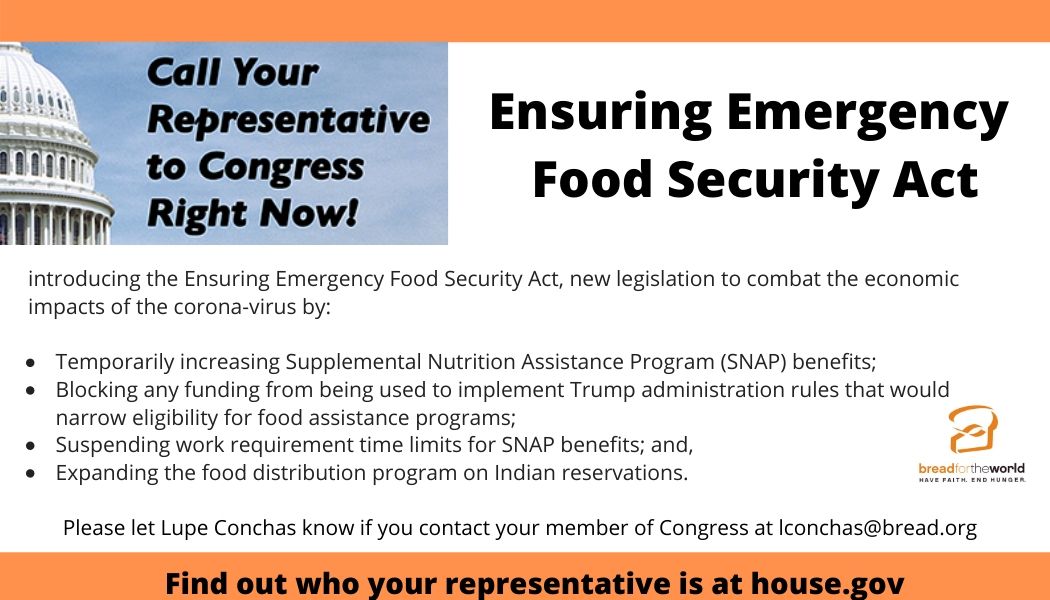
At the federal level, Rep. Deb Haaland of New Mexico is one of three legislators who introduced the Ensuring Emergency Food Security Act. Advocates around the country are asked to contact their federal representatives to support this initiative. (See Graphic Below).

Partner Events Postponed or Cancelled
The following events organized by or on behalf of our endorsing congregations or organizations have been cancelled or postponed.
March 13-14 (Postponed, Date TBA): What needed gifts do faith communities bring to climate action? A retreat with Dr. Larry Rasmussen hosted by New Mexico Interfaith Power and Light, First Congregational Church. Friday: 6:30-8:30 p.m. Saturday: 9:00-12 Noon. Sliding scale donation according to means $10-$50 (no one turned away).
March 14 (Cancelled): Bread for the World-New Mexico Offering of Letters, Saturday, March 14, All Saints Lutheran Church, 9:30 a.m. to 12:00 Noon. Here is more information.
March 28 (Cancelled): Circo for Community and Justice. Support the New Mexico Conference of Churches, enjoy music by the Peace Pipes and celebrate the awarding of the annual Turquoise Award to an outstanding community leader. At St. John's United Methodist Church. Get Tickets: $35 for individuals, $300 for table of 10.
No Announcement Yet on the Following Events (Watch for Updates)
April 4: Pull for the Pantry. A rowing and fitness fundraiser to benefit The Storehouse. Orangetheory Albuquerque Fitness -Westside. 6361 Riverside Plaza Ln, Albuquerque, New Mexico 87120. You can also “Pull for the Pantry” by forming your own team. Invite friends and family to sponsor you, and join us at Orangetheory Fitness to row 5 meters for every dollar you raise. Donate or Form a Team
April 21-23: 10th Annual Farm to Cafeteria Conference, hosted by National Farm to School Network and Farm to Table in New Mexico. Albuquerque Convention Center. More information here Register now
June 24 Annual New Mexico KIDS Count Conference, hosted by New Mexico Voices for Children
In addition to updates from Kurt about LAM-NM's legislative agenda for this year, we were also scheduled to review other legislative initiatives related to hunger. A representative from New Mexico Appleseed was scheduled to tell us about House Bill 10, which eliminated co-pays for school lunches and breakfasts for many low-income students.
This brief summary contains a couple of updates to the legislative summary sent on March 5, including an appropriations request for nonperishable food products for New Mexico food banks, and a correction to the item on child care assistance. (The original intent was to eliminate co-pays, but the allocation was insufficient to do so).
Responding to the Outbreak
We are tracking initiatives designed to ensure that the crisis response does not prevent anyone from continuing to have access to food. One major concern is that the closure of schools would leave students who rely on subsidized or free school lunches without access to food. (This week, authorities announced that all schools in the state would be closed for three weeks, starting on March 16)..
Local authorities are considering measures to ensure that children continue to have access to food. And local agencies are doing what they can to assist in this effort. "Roadrunner Food Bank will continue food distributions at school sites as long the schools have staff that can continue them during the closures," said one food bank administrator. "Things are moving fast and new variables are happening every hour it seems. But, right now, our plan is continue distributions of food where we have partners that are willing and able to continue."
At the federal level, Rep. Deb Haaland of New Mexico is one of three legislators who introduced the Ensuring Emergency Food Security Act. Advocates around the country are asked to contact their federal representatives to support this initiative. (See Graphic Below).

Partner Events Postponed or Cancelled
The following events organized by or on behalf of our endorsing congregations or organizations have been cancelled or postponed.
March 13-14 (Postponed, Date TBA): What needed gifts do faith communities bring to climate action? A retreat with Dr. Larry Rasmussen hosted by New Mexico Interfaith Power and Light, First Congregational Church. Friday: 6:30-8:30 p.m. Saturday: 9:00-12 Noon. Sliding scale donation according to means $10-$50 (no one turned away).
March 14 (Cancelled): Bread for the World-New Mexico Offering of Letters, Saturday, March 14, All Saints Lutheran Church, 9:30 a.m. to 12:00 Noon. Here is more information.
March 28 (Cancelled): Circo for Community and Justice. Support the New Mexico Conference of Churches, enjoy music by the Peace Pipes and celebrate the awarding of the annual Turquoise Award to an outstanding community leader. At St. John's United Methodist Church. Get Tickets: $35 for individuals, $300 for table of 10.
No Announcement Yet on the Following Events (Watch for Updates)
April 4: Pull for the Pantry. A rowing and fitness fundraiser to benefit The Storehouse. Orangetheory Albuquerque Fitness -Westside. 6361 Riverside Plaza Ln, Albuquerque, New Mexico 87120. You can also “Pull for the Pantry” by forming your own team. Invite friends and family to sponsor you, and join us at Orangetheory Fitness to row 5 meters for every dollar you raise. Donate or Form a Team
April 21-23: 10th Annual Farm to Cafeteria Conference, hosted by National Farm to School Network and Farm to Table in New Mexico. Albuquerque Convention Center. More information here Register now
June 24 Annual New Mexico KIDS Count Conference, hosted by New Mexico Voices for Children
Friday, October 05, 2018
A Campaign to Bring Health Care to All New Mexicans
The local organizers of the Health Security for New Mexicans Campaign are recruiting congregations and people of faith to join the effort to bring health care to all New Mexicans. The campaign is promoting the The Health Security Act, which would enable New Mexico to set up its own health care plan.
Established in 1992, the Health Security for New Mexicans Campaign is a broad and growing coalition of over 145 statewide and local organizations representing diverse interests. Its members and supporters include consumer, labor, community, health professionals, human rights, faith-based, and environmental organizations; business owners; farmers and ranchers; and groups advocating for low-income New Mexicans and the homeless. The Campaign’s mission is to establish a system of guaranteed, comprehensive, and affordable health care coverage for all New Mexicans.
Become Involved
There are several ways to become involved in the campaign.
A Presentation: If your congregation is not already engaged in the effort, campaign volunteers can make a presentation to members of your faith community In Albuquerque, contact Ester Griego (esterg15@gmail.com) 505 463-5343 to arrange for a volunteer to speak to your congregation. Outside of Albuquerque, contact Dana Millen 505 856-8359 or Mary Feldblum 505.897.1803.
Advocate in the State Legislature: As an individual, you are asked to contact your state representatives and senators during the 2019 Legislative Session urging him/her to support the Health Security Act. (You can also contact them before the session to put the issue on their radar). Find My Legislator
Stay informed about the latest developments in the campaign by signing up for e-mail alerts.
Details of the Campaign
The Health Security Plan will:
Established in 1992, the Health Security for New Mexicans Campaign is a broad and growing coalition of over 145 statewide and local organizations representing diverse interests. Its members and supporters include consumer, labor, community, health professionals, human rights, faith-based, and environmental organizations; business owners; farmers and ranchers; and groups advocating for low-income New Mexicans and the homeless. The Campaign’s mission is to establish a system of guaranteed, comprehensive, and affordable health care coverage for all New Mexicans.
Become Involved
There are several ways to become involved in the campaign.
A Presentation: If your congregation is not already engaged in the effort, campaign volunteers can make a presentation to members of your faith community In Albuquerque, contact Ester Griego (esterg15@gmail.com) 505 463-5343 to arrange for a volunteer to speak to your congregation. Outside of Albuquerque, contact Dana Millen 505 856-8359 or Mary Feldblum 505.897.1803.
Advocate in the State Legislature: As an individual, you are asked to contact your state representatives and senators during the 2019 Legislative Session urging him/her to support the Health Security Act. (You can also contact them before the session to put the issue on their radar). Find My Legislator
Stay informed about the latest developments in the campaign by signing up for e-mail alerts.
Find out about the Campaign and the Health Security Plan.
Details of the Campaign
The Health Security Plan will:
- automatically cover most New Mexicans
- offer a comprehensive set of health care services no less than what is currently offered to state employees
- provide freedom of choice of health care provider and facility (no networks), even across state lines
- -simplify administration, since providers will be dealing mostly with just one plan
- The Plan will be administered by a geographically representative citizens’ commission of consumers, business owners, and health care providers. The commission’s meetings will be open to the public, and its finances will be subject to public scrutiny.
- The Plan will be paid for by using existing public dollars, along with employer contributions and premiums based on income (both with caps).
- The Plan will provide comprehensive primary coverage, but individuals and employers may purchase supplemental private insurance policies if they wish to.
Thursday, April 05, 2018
A Webinar on Starting a Summer Meals Program at Your Hospital
Time: 1pm- 2pm EST (11am-Noon MST)
Date: April 11th, 2018
Speaker Bios
Derrick Lambert leads the summer meals strategy within the No Kid Hunger Center for Best Practices. Prior to joining Share Our Strength in 2016, Derrick worked as a Program Manager with Hunger Free Vermont, where he worked with state agency staff, school districts and statewide partners to initiate and expand implementation of a range of federal child nutrition programs, with a special focus on summer meals. Derrick has a Master’s Degree in International Political Economy from the University of Kent (England) and a Bachelor of Arts in Political Science from Union University. Derrick is also a former educator, having spent four years teaching at public secondary and post-secondary institutions.
Debbie Petitpain, is a registered dietitian with Sodexo at the Medical University of South Carolina in Charleston. As the Wellness Dietitian in the Office of Health Promotion, she develops programs to advance health on MUSC campus and in the community. In 2016, she received a Hero of Everyday Life award for her work establishing the first hospital-based USDA Summer Meal Program in the Southeast with the Kids Eat Free at MUSC program, which has provided over 13,000 free summer meals to kids in the first 3 years.
![]() |
| Leigh Caswell at Health & Food Conference in #ABQ in 2015 |
![]() |
| from PHS website |
Saturday, December 30, 2017
Masquerade for Medicine Supports AOC, East Central Ministries Clinics
The University of New Mexico's Physician Assistant Class of 2019 invites the public to a charity gala on Saturday, January 20, 2018, 7:00 p.m. to Midnight. The event will be held at Casa Esencia at Hotel Albuquerque, 800 Rio Grande NW in Old Town.
Proceeds will benefit One Hope Centro de Vida clinic (a project of East Central Ministries) and the Albuquerque Opportunity Center clinic.
Tickets are $42 for VIP attendees (VIP event from 7:00-9:00 p.m.)$32 for the General Public. (Public event begins at 9:00 p.m.)
Donate or Buy Tickets
UNM Students receive a $10 discount
Prices increase after January 13: VIP $47, GA $37
At the Door VIP: $50, GA $40
For more information contact
Aline Gonzales
505 272.0882
agonza03@salud.unm.edu
Proceeds will benefit One Hope Centro de Vida clinic (a project of East Central Ministries) and the Albuquerque Opportunity Center clinic.
Tickets are $42 for VIP attendees (VIP event from 7:00-9:00 p.m.)$32 for the General Public. (Public event begins at 9:00 p.m.)
Donate or Buy Tickets
UNM Students receive a $10 discount
Prices increase after January 13: VIP $47, GA $37
At the Door VIP: $50, GA $40
For more information contact
505 272.0882
agonza03@salud.unm.edu
Friday, November 03, 2017
A Vigil for Social Justice at the St. Paul Lutheran Church Labyrinth
On May 21, we began with a 3-day fast, joining millions of people around the world who were praying for an end to famine, praying in advance of the release of the president’s budget, and in preparation for advocacy actions. We continue to fast and pray on the 21st of each month throughout this 115th Congress through the end of 2018. We chose the 21st of the month because that is the day when SNAP (formerly food stamps) benefits for most families run out. It is the hungriest week of the month. -from "For Such a Time as This" campaign, led by Bread for the World and leaders of several religious denominations and organizations.
![]() |
| Immigration Vigil at St. Paul Labyrinth |
Vigil organizers invite all people of faith and conscience in Albuquerque to participate in the social justice-oriented vigil. "This will all be very informal," said Westergaard
The labyrinth is open year round for use by individuals. Other communal events have been held here too, such a vigil for immigration rights in February
Fasting as Prayer
Some of the people of faith around the country who participate in vigils on the 21st including fasting, perhaps skipping lunch or foregoing dinner later that evening. (Bread advocate David Miner of Indianapolis fasted for 16 days).
As people of faith, we are called to show solidarity with vulnerable people and communities around the world. Therefore, our prayers urge our elected leaders to make budget decisions that preserve funding for foreign assistance, maintain the integrity of health care and domestic nutrition programs and protect vulnerable communities from the negative impacts of climate change.
"There are no easy answers or strategies. But there is our call to go deeper in our faith, to center ourselves in God instead of news cycles, to pray for God’s wisdom and presence, to fast in order to help focus our hearts and minds, and to be ready to advocate — to speak the truth to power — for those whom Jesus calls 'the least of these'," said Rev. Jim Wallis, president of Sojourners and a leader in the campaign.
| from People's Climate March in ABQ, April 2017 |
What about the Act or Advocacy aspect of the vigil? Like all the groups and communities praying on Nov. 21, the folks gathered at St. Paul Lutheran will center their efforts on climate change (although all the other issues remain very much in our hearts and minds).
Here is what the ELCA, led by Presiding Bishop Rev. Elizabeth Eaton, says about the November action. "ELCA congregations and community organizations across the country work tirelessly to help when disaster strikes, most recently in Texas, California, Puerto Rico and the Virgin Islands. To prepare our nation for the future, our federal government must invest in research, urban planning and building infrastructure designed for the climate challenges of the next 100 years."
The Episcopal Public Policy Network with support from Most Reverend Michael Bruce Curry, presiding bishop and primate, Episcopal Church, has a similar message. "As the earth’s climate continues to transition and threaten communities, we answer the call this month by supporting action for federal investment to make our nation, communities, and public services more resilient and better prepared in the face of increasingly common and destructive natural disasters and changing weather patterns."
The campaign includes many partners in the Christian community (Willow Creek Community Church; Christians Churches Together in the USA; the National African American Clergy Network; Bishop Richard Pates of the Roman Catholic Archdiocese of Des Moines, Iowa; the Christian Methodist Episcopal Church and others), but is actually an interfaith action. The campaign is supported and promoted by Anwar Khan, CEO, of Islamic Relief USA and the Alliance to End Hunger, which represents groups like Jewish Council for Public Affairs.
MAZON:A Jewish Response to Hunger, even though not officially a part of the campaign, the organization is doing its part to raise some of these important issues. More than 1,500 constituent groups of MAZON contacted Congress in July to urge legislators to make a responsible choice when making budget decisions. “Our message to you is clear: there is no way to keep the promise of prosperity for all Americans, including families with children, women, seniors, people with disabilities, communities of color, and others who are being left behind in the 21st century economy, without significantly increasing investments in public education, affordable housing, health and nutrition, public transit, roads and bridges, clean air, clean water, clean energy, child care, and other means of making investments in communities that also create good jobs.”
Wednesday, June 28, 2017
A Close-Up Look at Poverty, Education, Gender Equity in Liberia
Columnist and author Nicholas Kristoff invited university students to apply for his win-a-trip contest. The prize was not an ordinary trip. The winner would accompany Kristoff on a reporting trip to cover global poverty and social justice issues. The winner would blog about his or her experiences on the New York Times website, with the opportunity to participate in videos as well. "My aim is to generate interest in neglected global issues with the contest, and get more people writing about these issues," said Kristoff, who has organized this program since 2006."National and international campaigns have played their part in influencing this culture change. Several parents [in Liberia] quoted to me a famous slogan: When you educate one woman, you educate the whole nation...The slogan, unlike many marketing schemes, isn’t much of an exaggeration. Educating women has immense benefits for society. Girls with an education have fewer children, raise their kids to be healthier, make stronger contributions to the economy, earn more money, spend that money more wisely, empower their countries and more... Around the world today, there are essentially as many girls enrolled in primary schools as boys — a fact worth celebrating."Aneri Pattani in The New York Times Blog
The winner of the contest this year was Aneri Pattani, who recently graduated with a journalism degree from Northeastern University in Boston.
Here is a video that Kristoff posted via Facebook Live in late June. Kristoff and Pattani chat about their journey to Liberia. They discuss the experience of seeing up close the challenges of a lack of infrastructure and adequate health care in poor countries. Kristoff addressed the issue in his Sunday column and Pattani blogged about everything she experienced, including the some positive changes she saw in the area of education.
Wednesday, April 26, 2017
Catholic Archdiocese Supports Santa Fe's Proposal to Tax Sugary Drinks to Fund Early Childhood Programs
![]() |
| Wikimedia Commons |
(Santa Fe-based food activist and author Mark Winne expressed his own thoughts about the food movement and soda taxes in a blog post on March 8, 2017).
The Archdiocese of Santa Fe, which has jurisdiction over Santa Fe and Albuquerque, came out in support of the soda tax. Here is a statement released by the archdiocese.
(April 19) The Archdiocese of Santa Fe endorses the proposed soda tax by the City of Santa Fe in order to fund early childhood programs. New Mexico ranks number one in the United States for children living in poverty and second highest for children living in hunger. Because of the New Mexico State Senate’s lack of action to fund early childhood programs, municipalities are left with few choices.
The soda tax is a good attempt to address the dire conditions in which our children are living. In good conscience, we cannot let our children stagnate in the plight they are in, with some of the worst wellbeing outcomes in the nation. Until the New Mexico State Senate passes the constitutional amendment for early childhood, municipalities must seek funding for essential programs.
The very same business associations that opposed the constitutional amendment for early childhood, which is not a tax, now oppose a tax to fund these children's programs. The business associations leave no option. We must put our children first. If the State fails to address this, then we commend municipalities for taking action to address the wellbeing of our children.
Saturday, March 18, 2017
Santa Fe Proposes to Tax Sweetened Beverages to Fund Early Childhood Education
![]() |
| Photo: Wikimedia Commons |
Mayor Javier Gonzales estimates the soda tax would raise about $10.6 million a year. However, Santa Fe's daily newspaper The New Mexican points out that the estimate appears to be much higher than revenue estimates in other cities that have approved similar taxes. Regardless, Gonzales believes the revenues would enable the city to send 1,200 more 3- and 4-year-olds to early education programs at no cost to their families.
There is some opposition to the tax. a coalition called Better Way for Santa Fe & Pre-K suggests that the tax is regressive and harmful to certain businesses. "It’s a tax that places a larger share of the tax burden on Santa Feans least capable of paying it. Stores and restaurants in Santa Fe would be hurt by this tax. They’d have to pass it on to customers, many of whom will shop and eat outside city lines to avoid the tax. That will cost people who work here their jobs and income," says the organization.
Conversely, The Santa Fe Food Policy Council and other organizations offered public testimony in support of the tax.
In a recent blog post, author and food activist Mark Winne noted that raising funds for Pre-K is just one part of the equation. The other important aspect of the proposal is health and nutrition.
"As I look at this flurry of soda taxing activity around the nation, I have to ask myself, why are we suddenly emboldened to take on Coke, Pepsi, and the nation’s other sugar pushers? Do we want to raise municipal revenue, reduce the consumption of sugar-sweetened beverages, or really improve human health?"
"The evidence on the deleterious health effects of sugar is virtually ironclad. When a 20-ounce bottle of Coca-Cola contains 65 grams of sugar, and health experts tell us that we shouldn’t consume more than 50 grams per day (25 grams being the more desirable level); when our obesity and overweight rates have risen two- to three-fold since 1994 due in large part to an overconsumption of calories, a disproportionately large share of which are derived from beverages; and when dental caries, diabetes, and host of other human illnesses are linked to the overconsumption of sugar, we shouldn’t have to waste any more time making the case against sugar."
Read Winne's full piece, entitled Should the Food Movement Embrace Soda Taxes?
Friday, March 17, 2017
Trump Budget Removes the Wheels from Meals on Wheels
The need is growing rapidly, and federal funding has not kept pace. The network is already serving 23 million fewer meals now than in 2005, and waiting lists are mounting in every state. At a time when increased funding is needed, we fear that the millions of seniors who rely on us every day for a nutritious meal, safety check and visit from a volunteer will be left behind. -Statement from Meals on Wheels AmericaA few weeks ago, we posted a video created by Albuquerque Involved, featuring Shauna Frost, executive director of Meals on Wheels in Albuquerque, who said the organization serves over 500 people a day locally. Many of those clients have special medical needs, and Meals on Wheels prepares the meals accordingly. "We basically serve food and friendship, and we've done that for the past 45 years," Frost said in the video (which we reposted at the end of this blog piece).
The work of Meals on Wheels in Albuquerque and elsewhere is in major jeopardy. On Thursday, President Donald Trump released his Budget Blueprint, also known as the “skinny budget,” to Congress with a plan to release further details in the coming months. The blueprint focuses on discretionary spending levels for Fiscal Year 2018, and makes investments in defense programs, paid for through deep cuts to non-defense discretionary (NDD) programs, such as Meals on Wheels.
"The portions of the President’s Budget that have been released so far call for the elimination of a number of federal programs, including the Community Services Block Grant (CSBG) and Community Development Block Grant (CDBG), on which some local Meals on Wheels programs rely to deliver nutritious meals, safety checks and friendly visits to our nation’s most vulnerable seniors," said Meals on Wheels America. Here is a post that the organization sent on Twitter on Thursday.
Cuts of any kind would be devastating for millions of vulnerable seniors. Our #SkinnyBudget statement: https://t.co/R2MkmuitBR #Budget2017— Meals on Wheels (@_MealsOnWheels) March 16, 2017
A Place at the Table denounced the cuts. "Support for working Americans is...on the chopping block, and will almost certainly be the next target," said Tom Colicchio, a leader in the anti-hunger organization. "There has never been a time when it’s more important to stand together and demand our leaders take action."
"Our leaders need to fight to end hunger now, not cut vital nutrition programs," said Colicchio. "The last thing policymakers should be doing right now is making life harder for people who don't have enough food to eat. Let’s make sure they know where we stand."
A Place at the Table is providing this link for people to send a message to Congress.
And here is a repost of the video of Meals on Wheels Albuquerque.
Tuesday, March 07, 2017
Initiative on Local Produce for Schools Falls Short in Legislature
The following is an update from Pam Roy, director of the New Mexico Food and Agriculture Policy Council
HB208, NM Grown Fresh Fruits an Vegetables for School Meals
sponsored by Representative Hall and Speaker Egolf
SB379, NM Grown for School Meal Programs
sponsored by Senator Pat Woods
"The House Appropriations Committee did not recommend it for funding in House Bill 2 and amendments. Thus, the Senate would have to take the appropriation request under consideration through an amendment process that required finding an "offset" - finding funds from within current state budgets that could be transferred to this program with the support of the agency. Though we attempted this process, the amendments were not accepted. Thus, no funding has been allocated to this program through this legislature.
It is possible there will be a Special Session which could provide another opportunity. This being said, the Public Education Department or other agency would need to be willing to be "home" to and administer the program. This is truly disappointing, yet we will continue to work to make this a permanent program within an agency.
We have leadership support through the NM Department of Agriculture to assist us in bringing the various parties together to build on our plan and progress and we have champion legislators who will continue to support our efforts. Thank you to everyone who has is committed to this program!
The good news is that we are formalizing the NM Farm to School Network as an outcome of the NM Food and Farms Day initiative. There is much to look forward to and we want to thank the many schools, school food service, farmers, and community organizations for making this program so vibrant!"
Other agriculture and food-related legislation is still pending. Here are more details
HB208, NM Grown Fresh Fruits an Vegetables for School Meals
sponsored by Representative Hall and Speaker Egolf
SB379, NM Grown for School Meal Programs
sponsored by Senator Pat Woods
"The House Appropriations Committee did not recommend it for funding in House Bill 2 and amendments. Thus, the Senate would have to take the appropriation request under consideration through an amendment process that required finding an "offset" - finding funds from within current state budgets that could be transferred to this program with the support of the agency. Though we attempted this process, the amendments were not accepted. Thus, no funding has been allocated to this program through this legislature.
It is possible there will be a Special Session which could provide another opportunity. This being said, the Public Education Department or other agency would need to be willing to be "home" to and administer the program. This is truly disappointing, yet we will continue to work to make this a permanent program within an agency.
We have leadership support through the NM Department of Agriculture to assist us in bringing the various parties together to build on our plan and progress and we have champion legislators who will continue to support our efforts. Thank you to everyone who has is committed to this program!
The good news is that we are formalizing the NM Farm to School Network as an outcome of the NM Food and Farms Day initiative. There is much to look forward to and we want to thank the many schools, school food service, farmers, and community organizations for making this program so vibrant!"
Other agriculture and food-related legislation is still pending. Here are more details
Monday, November 21, 2016
'Poverty and Food Insecurity: Bad for Children in New Mexico'
![]() |
| Photo: UNM Advocacy in Pediatrics |
Wednesday, November 30, 2016Registered dietitian nutritionists (RDNs) play a vital role in providing nutritious foods to all children, especially children in poverty, who receive a large proportion of their daily nutrition through school breakfast and lunch programs. These same children are at risk for many other consequences of poverty and poor nutrition. Dr. Chilton's talk will review how he believes pediatricians and RDNs should be involved in advocating both for an end to child poverty and in detecting consequences of poverty and poor nutrition, with suggestions as to how to provide help with those consequences.
6:30pm – 8:00 pm
Barbara and Bill Richardson Pavilion
First Floor Conference Room at UNM Children's Hospital (opposite the information desk and next to the Mediation Room)
Light refreshments will be provided
Non-perishable food will be accepted for donation to Roadrunner Food Bank
Dr. Chilton served in the Peace Corps in Nepal in 1985. Here is a YouTube interview with Dr. Chilton.
The Karen Sadeghian Memorial Scholarship will be awarded.
Friday, April 01, 2016
Groups Launch Campaign to Promote New Mexico-Grown Fresh Produce for School Meals
By Pam Roy
The New Mexico Food and Agriculture Policy Council, Farm to Table and partners hosted a "New Mexico Grown Fresh Fruit and Vegetables for School Meals" Strategic Planning day to determine the potential of the program and commitments by partners to further develop the program over the next three years and beyond.
Close to 50 stakeholders from across the state reaffirmed their commitments and brought new ideas and energy to the program now being called "New Mexico Grown". The group created a NM Grown Three Year Vision and action plan with four priority areas:
Many thanks to the New Mexico Department of Agriculture and USDA Farm to School Program for their support of the "New Mexico Grown" program!
(Pam Roy is executive director and co-founder of Farm to Table and convener of the New Mexico Food and Agriculture Policy Council)
The New Mexico Food and Agriculture Policy Council, Farm to Table and partners hosted a "New Mexico Grown Fresh Fruit and Vegetables for School Meals" Strategic Planning day to determine the potential of the program and commitments by partners to further develop the program over the next three years and beyond.
Close to 50 stakeholders from across the state reaffirmed their commitments and brought new ideas and energy to the program now being called "New Mexico Grown". The group created a NM Grown Three Year Vision and action plan with four priority areas:
- values-driven public policy;
- integrated community wellness;
- asset based economic development; and
- coordinated infrastructure.
Many thanks to the New Mexico Department of Agriculture and USDA Farm to School Program for their support of the "New Mexico Grown" program!
(Pam Roy is executive director and co-founder of Farm to Table and convener of the New Mexico Food and Agriculture Policy Council)
Wednesday, March 16, 2016
Greg Henneman Coming to Albuquerque for Workshop on Urban Ministry
![]() |
| Rev. Donna McNiel & Rev. Greg Henneman |
Greg worked as associate pastor at Central United Methodist Church in Albuquerque for five years. As part of his ministry at Central UMC, he help found the Community of Hope, an opportunity for the housed and unhoused communities to share a meal and worship on Sunday afternoons.
In 2014, he left Albuquerque to take on the role of coordinator of the HEAL (Healthy Eating and Living) Initiative of Community Development for all People in Columbus, Ohio. "This embodiment of compassion is my goal in ministry," Greg says in his Looked with Compassion blog. "As much as I enjoy feeding people who are hungry, I have seen people’s lives changed because they were treated with the dignity and respect of a child of God."
We invite you to attend Greg's workshop on Saturday, April 9, from 9:00 a.m. to Noon, at the office of the New Mexico Conference of Churches, 1019 2nd St. NW, Albuquerque (map). If you plan to attend, please RSVP to hugginsnmcc@mail.com (so they know how many chairs to set up). More information in the poster below.
- See more at:
http://www.umcmission.org/explore-our-work/missionaries-in-service/missionary-profiles/henneman-greg#sthash.uqFGotaX.dpuf
Subscribe to:
Posts (Atom)