The New Mexico Food and Agriculture Policy Council, one of the participants in a broad coalition to address hunger in New Mexico, on Wednesday released a great summary of the NM State Legislature's special session.
The Legislature met on June 18-20 to adjust the state budget, which took a hit because of the health emergency caused by the COVID-19 pandemic. Because of decline in revenues and plunge in oil prices, the Legislature was charged with adjusting the budget for the 2020-2021 fiscal year, which began on July 1.
The budget became official on June 30 when Gov. Michelle Lujan Grisham signed the final appropriations bill HB1, General Appropriations Act and issed the Governor's Message, which provides guidance to all agencies as to budget cuts and redirection of specific priorities of the Governor.
Just prior to the Special Session, the NMFAPC submitted a letter to legislators who had sponsored the NMFAPC's priority legislation requesting that they hold programs whole and minimize cuts. The NMFAPC alsopartnered with New Mexico First and the broad anti-hunger coalition to share collective priorities with all New Mexico legislators and the Office of the Governor.
Here are some excerpts from the NMFAPC report, courtesy of Pam Roy.
Budget mandated cuts of 4-6% for agencies
The majority of the NMFAPC priorities stayed within agency budgets yet will see cuts of four to six percent depending on the agency. The priority agriculture programs administered by the NM Department of Agriculture, including support for farmers' markets and local promotion programs, Soil and Water Conservation Districts program funds, and the healthy soils program, will be subject to the NMDA four percent cuts.
Pilot fund does not survive
Unfortunately, the Agriculture and Natural Resources Pilot Fund of $1.8 million did not survive the cuts. NM State University faces a four percent cut across all programs. Our priorities to continue funding for the NM Cooperative Extension Services and Experimental Stations are within the NMSU budget.
Special Programs Preserved
New Mexico Grown Fruits and Vegetables for School Meals appropriation of $400,000 and the Elimination of Co-pays for School Breakfast and Lunch of $650,000 were maintained in the NM Public Education Department budget. They will be subject to the agency percent cuts. This is a relief, as the Legislative Finance Committee had recommended cuts of 50 percent to both programs.
Reduction in Special Senior Fund
The new Kiki Saavedra Senior Dignity Fund was sanded by $1 million leaving a balance of $6.3 million to initiate a wide variety of programs that will benefit seniors across New Mexico. It is our request that the New MexicoGrown Fruits and Vegetables for Senior Meal Programs be considered for a modest amount of funding to launch a statewide program, building on the successful pilot program just completed.
Summary: The NMFAPC looks forward
to working with the full NMFAPC and agencies to make sure budget cuts are
equitable and no priority programs get cut. Most important is the work ahead of
us into 2021and beyond.
Showing posts with label New Mexico State Legislature. Show all posts
Thursday, July 02, 2020
Friday, June 19, 2020
NM Special Session: Urge Legislators to Preserve Critical Funding
Here is the text of a message that New Mexico First sent out for the special session. The requests are based on priorities identified by the Food, Hunger, Water, and Agricultural Policy Workgroup and New Mexico Food and Agriculture Policy Council.
Our volunteer legislators and committed public servants at the Legislative Finance Committee have been presented with tough decisions during very trying times. We sincerely appreciate and respect their service on behalf of New Mexico. Before the session, a coalition of coalitions and multi-stakeholder groups worked together to identify policy and funding priorities in light of the pandemic.
The Food, Hunger, Water, and Agricultural Policy Workgroup and New Mexico Food and Agriculture Policy Council and members of our coalition/council have affirmed the need to support the following priorities. Please act now and contact your legislators and encourage policymakers to consider alternatives to the Legislative Finance Committee's recommendation to cut these critical programs.
Investing in Healthy Food Systems
We are also concerned about recommended cuts in funding to some of the critical infrastructure that bolsters agriculture in New Mexico through programs like the NM Cooperative Extension Services and Agricultural Experimentation Stations.
At a time when national supply chain issues have impacted access to food, investing in healthy local food systems is critical and while a 4% cut is less than some other proposed cut, short-sighted at a time when agriculture needs more support than ever as a critical part of our economy and as a social determinant of public health. Similarly, the proposed cuts to the NM Department of Agriculture can affect support for farmers' markets and promotion programs, Soil and Water Conservation Districts, and the healthy soil program. Cuts to these programs can impact the ability to leverage federal and philanthropic investments, risking significant progress that has been achieved to build local markets and sustain our natural resources to support food production.
School Meals
LFC's recommendation to step back from the Elimination of Co-pays for School Breakfast and Lunch with a less significant investment than the $650K appropriated during the regular session is profoundly concerning. With childhood hunger increasing, this recommendation is counter to our shared commitments to address child hunger.
NM Grown Fruits and Vegetables for School Meals: Legislature Appropriations: $400K: LFC recommended a decrease to $204K (bottom of p. 19), which is a big cut. We know that the NM Public Education Department has commitments to 58 School Food Authorities for the $400K (if it can be maintained) to start purchasing NM grown fruits and vegetables for school meals over the coming months. NM PED received more than $750K in requests. As we know, this is an economic driver for farmers who have already planted their fields in preparation to sell to schools and senior centers. School districts are shifting the ways they prepare and provide school meals, yet they are still planning to buy local produce to incorporate into meal programs.
Meals for Seniors
We are very excited about the Kiki Saavedra Senior Dignity Fund that the Legislature appropriated $7.3M. We see that the LFC has recommended a $1M decrease. We hope this program will be maintained even if there is a cut. As a state with one of the fastest-growing senior populations, and we are seeing so many more needs for seniors through the lens of COVID-19, we look forward to the Kiki Saavedra Program being of benefit to many. We believe this is the right type of funding to help build the NM Grown Fruits and Vegetables for Senior Meal Programs. We just finalized a three-county (Sandoval, Socorro, and San Juan) pilot project with the Aging and Long Term Services Department, senior centers, and farmers. Even amid COVID-19, 15 senior centers served 6,160 meals weekly (curbside and home-delivered), incorporating $50,000 of New Mexico grown produce in the meals. A small request of the Kiki Fund could really benefit the growth of this program across the state!
Our volunteer legislators and committed public servants at the Legislative Finance Committee have been presented with tough decisions during very trying times. We sincerely appreciate and respect their service on behalf of New Mexico. Before the session, a coalition of coalitions and multi-stakeholder groups worked together to identify policy and funding priorities in light of the pandemic.
The Food, Hunger, Water, and Agricultural Policy Workgroup and New Mexico Food and Agriculture Policy Council and members of our coalition/council have affirmed the need to support the following priorities. Please act now and contact your legislators and encourage policymakers to consider alternatives to the Legislative Finance Committee's recommendation to cut these critical programs.
Investing in Healthy Food Systems
We are also concerned about recommended cuts in funding to some of the critical infrastructure that bolsters agriculture in New Mexico through programs like the NM Cooperative Extension Services and Agricultural Experimentation Stations.
At a time when national supply chain issues have impacted access to food, investing in healthy local food systems is critical and while a 4% cut is less than some other proposed cut, short-sighted at a time when agriculture needs more support than ever as a critical part of our economy and as a social determinant of public health. Similarly, the proposed cuts to the NM Department of Agriculture can affect support for farmers' markets and promotion programs, Soil and Water Conservation Districts, and the healthy soil program. Cuts to these programs can impact the ability to leverage federal and philanthropic investments, risking significant progress that has been achieved to build local markets and sustain our natural resources to support food production.
School Meals
LFC's recommendation to step back from the Elimination of Co-pays for School Breakfast and Lunch with a less significant investment than the $650K appropriated during the regular session is profoundly concerning. With childhood hunger increasing, this recommendation is counter to our shared commitments to address child hunger.
NM Grown Fruits and Vegetables for School Meals: Legislature Appropriations: $400K: LFC recommended a decrease to $204K (bottom of p. 19), which is a big cut. We know that the NM Public Education Department has commitments to 58 School Food Authorities for the $400K (if it can be maintained) to start purchasing NM grown fruits and vegetables for school meals over the coming months. NM PED received more than $750K in requests. As we know, this is an economic driver for farmers who have already planted their fields in preparation to sell to schools and senior centers. School districts are shifting the ways they prepare and provide school meals, yet they are still planning to buy local produce to incorporate into meal programs.
Meals for Seniors
We are very excited about the Kiki Saavedra Senior Dignity Fund that the Legislature appropriated $7.3M. We see that the LFC has recommended a $1M decrease. We hope this program will be maintained even if there is a cut. As a state with one of the fastest-growing senior populations, and we are seeing so many more needs for seniors through the lens of COVID-19, we look forward to the Kiki Saavedra Program being of benefit to many. We believe this is the right type of funding to help build the NM Grown Fruits and Vegetables for Senior Meal Programs. We just finalized a three-county (Sandoval, Socorro, and San Juan) pilot project with the Aging and Long Term Services Department, senior centers, and farmers. Even amid COVID-19, 15 senior centers served 6,160 meals weekly (curbside and home-delivered), incorporating $50,000 of New Mexico grown produce in the meals. A small request of the Kiki Fund could really benefit the growth of this program across the state!
Thursday, June 04, 2020
Islamic Group Donates 9.000 Pounds of Food to Diné Relief
Working with New Mexico State Reps. Abbas Ahkil of Albuquerque and Anthony Allison of Fruitland, the Islamic Circle of North America donated 9,000 pounds of food to the Northern Diné COVID-19 Relief Effort.
The ICNA organized the food donation on May 25, which arrived in Shiprock that evening in a semi-trailer. "We want to make sure people have food," Salina Imam of the Arizona chapter of the ICNA told the Farmington Daily Times. "They don't have to go hungry."
The food will help the Diné relief organization continue with its efforts to reduce the spread of COVID-19 by delivering care packages to families in need in the Navajo nation in the safest way possible.
"As of June 1, the Navajo Nation reported 5,250 positive COVID-19 cases, 1,745 recoveries and 241 deaths. In the Shiprock area last month, three siblings who buried their mother, father, and brother were forced to watch the burial services remotely because they, too, were infected with the disease," Rolling Stone magazine said in a June 3 article.
"In mid-May, the Navajo Nation surpassed New York and New Jersey for the highest per-capita coronavirus infection rate in the US -- another sign of Covid-19's disproportionate impact on minority communities," CNN said in a May 18 report.
"With coronavirus running rampant on Navajo, it has been up to local community members to help with items and supplies so elders and young families don’t have to go to the store and put themselves at risk. But if volunteers aren’t careful, they risk becoming vectors themselves," The Navajo Times said in a recent article.
The ICNA organized the food donation on May 25, which arrived in Shiprock that evening in a semi-trailer. "We want to make sure people have food," Salina Imam of the Arizona chapter of the ICNA told the Farmington Daily Times. "They don't have to go hungry."
The food will help the Diné relief organization continue with its efforts to reduce the spread of COVID-19 by delivering care packages to families in need in the Navajo nation in the safest way possible.
"As of June 1, the Navajo Nation reported 5,250 positive COVID-19 cases, 1,745 recoveries and 241 deaths. In the Shiprock area last month, three siblings who buried their mother, father, and brother were forced to watch the burial services remotely because they, too, were infected with the disease," Rolling Stone magazine said in a June 3 article.
"In mid-May, the Navajo Nation surpassed New York and New Jersey for the highest per-capita coronavirus infection rate in the US -- another sign of Covid-19's disproportionate impact on minority communities," CNN said in a May 18 report.
"With coronavirus running rampant on Navajo, it has been up to local community members to help with items and supplies so elders and young families don’t have to go to the store and put themselves at risk. But if volunteers aren’t careful, they risk becoming vectors themselves," The Navajo Times said in a recent article.
Tuesday, June 02, 2020
NM State Legislature Urged to Address Hunger During Special Session
Special Session & FY21 Emergency Relief & Recovery Funding Priorities
The Food, Hunger, Water and Agriculture Policy Work Group recently sent a letter to each member of the New Mexico House and Senate ahead of the special session, which has been scheduled for Thursday, June 18. Legislators will attempt to adjust the state budget to account for the negative financial impact caused by the outbreak of COVID-19. By some estimates, the financial crisis caused a $2.4 billion drop in state revenues.
The work group, coordinated by New Mexico First, seeks to preserve funding for crucial feeding programs for school kids, seniors, agriculture, food banks and working families. (The members of the work group, which includes the Interfaith Hunger Coalition, are listed at the bottom of this post)
The work group started efforts to address hunger in New Mexico last summer, months before the pandemic occurred. We attained some modest gains during the 2020 regular session of the State Legislature, including a measure to eliminate co-pays for almost 12,500 students at 185% of the federal poverty level. When the pandemic-related emergency occurred the work group convened quickly to create a plan of action.
'Critical Needs'
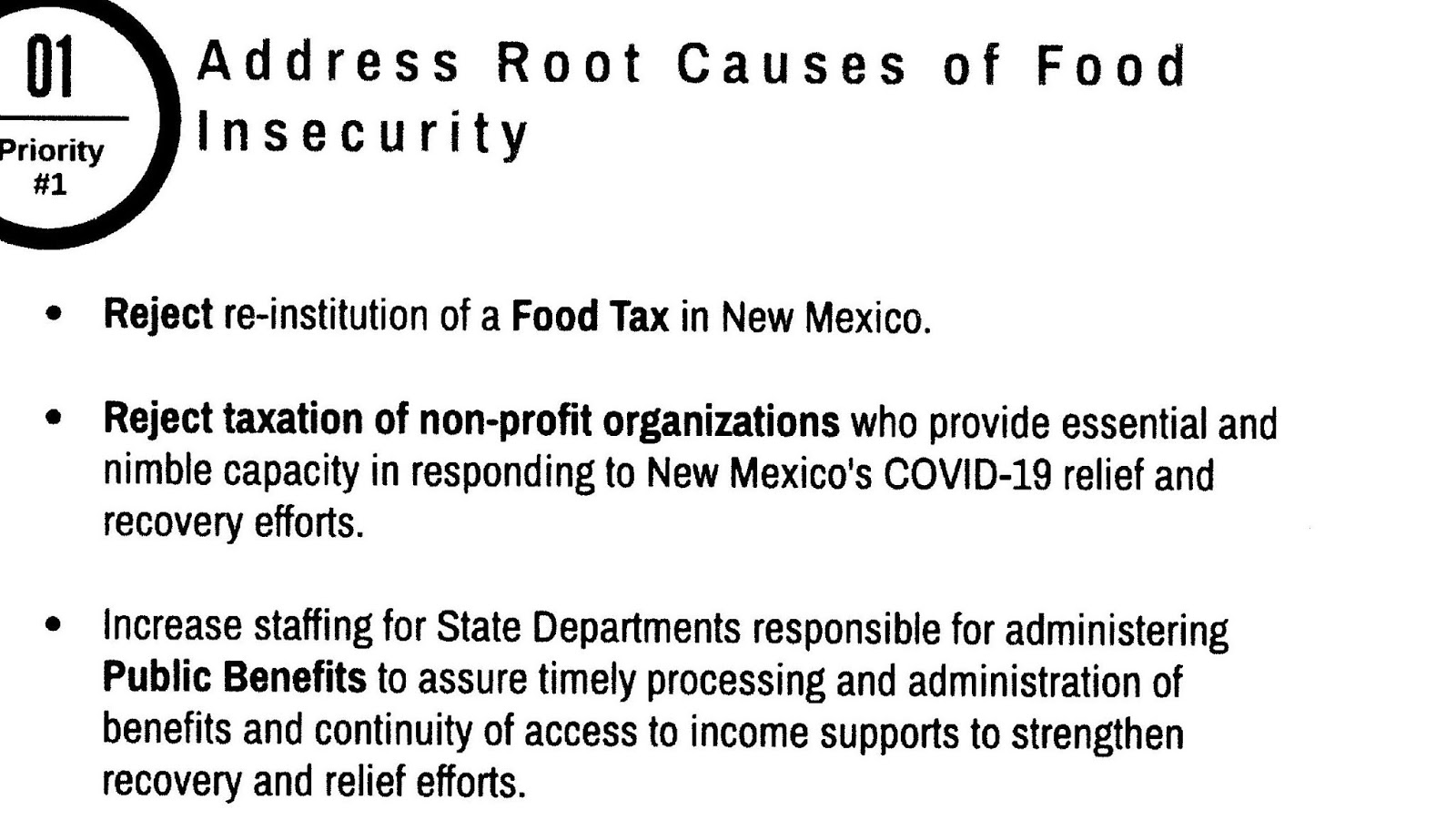
"We are urgently requesting that you prioritize policy and funding solutions create access to healthy food and water while strengthening our State's food system, Addressing the root causes of insecurity, protecting and investing in the emergency food and water relief efforts, and bolstering local agriculture and food systems are critical needs.
Below are snapshots of a consensus-backed blueprint, compiled in consultation with the Legislative Hunger Caucus.
*Maintain and expand investment to $500K in ALTSD to Support the Purchase of NM Grown Fruits and Vegetables for Senior Meals Programs.
The Food, Hunger, Water and Agriculture Policy Workgroup is comprised of a group of bipartisan policy makers, agricultural producers, the emergency food sector, faith leaders, researchers/academics, and public policy advocates.
The participating groups are Agri Cultura Cooperative Network, Center for Health Innovation, Delicious New Mexico, Farm to Table, Indigenous Life Ways, Interfaith Hunger Coalition, McKinley Collaborative for Health Equity, National Young Farmers Coalition, New Mexico Association of Conservation Districts, New Mexico Association of Food Banks, New Mexico Center on Law and Poverty, New Mexico Farmers' Marketing Association, New Mexico First, New Mexico Food and Agriculture Policy Council, New Mexico Social Justice and Equity Institute, New Mexico Voices for Children, South Valley Economic Development Center, The Montibon Company, Think New Mexico, Village of Los Ranchos de Albuquerque
The Food, Hunger, Water and Agriculture Policy Work Group recently sent a letter to each member of the New Mexico House and Senate ahead of the special session, which has been scheduled for Thursday, June 18. Legislators will attempt to adjust the state budget to account for the negative financial impact caused by the outbreak of COVID-19. By some estimates, the financial crisis caused a $2.4 billion drop in state revenues.
![]() |
| Work group at 2020 legislative session |
The work group started efforts to address hunger in New Mexico last summer, months before the pandemic occurred. We attained some modest gains during the 2020 regular session of the State Legislature, including a measure to eliminate co-pays for almost 12,500 students at 185% of the federal poverty level. When the pandemic-related emergency occurred the work group convened quickly to create a plan of action.
'Critical Needs'
"We are urgently requesting that you prioritize policy and funding solutions create access to healthy food and water while strengthening our State's food system, Addressing the root causes of insecurity, protecting and investing in the emergency food and water relief efforts, and bolstering local agriculture and food systems are critical needs.
Below are snapshots of a consensus-backed blueprint, compiled in consultation with the Legislative Hunger Caucus.
The Food, Hunger, Water and Agriculture Policy Workgroup is comprised of a group of bipartisan policy makers, agricultural producers, the emergency food sector, faith leaders, researchers/academics, and public policy advocates.
The participating groups are Agri Cultura Cooperative Network, Center for Health Innovation, Delicious New Mexico, Farm to Table, Indigenous Life Ways, Interfaith Hunger Coalition, McKinley Collaborative for Health Equity, National Young Farmers Coalition, New Mexico Association of Conservation Districts, New Mexico Association of Food Banks, New Mexico Center on Law and Poverty, New Mexico Farmers' Marketing Association, New Mexico First, New Mexico Food and Agriculture Policy Council, New Mexico Social Justice and Equity Institute, New Mexico Voices for Children, South Valley Economic Development Center, The Montibon Company, Think New Mexico, Village of Los Ranchos de Albuquerque
Saturday, March 28, 2020
Responding to Food Challenges in New Mexico During a Health Crisis
![]() |
| Chart: House Speaker Brian Egolf's Office |
Gov. Michelle Lujan Grisham issued the stay-at-home order on March 23. As of March 27, the state had reported 191 cases where patients have tested positive for COVID-19, according to the New Mexico Political Report.
While the magnitude of the challenge is not as high here in New Mexico as it is in states like New York, Washington, California, Michigan and Louisiana (among others), the need for social distancing is a necessary prescription to stem potential problems down the road, including the possibility of overtaxing our heath care system.
Finding Food
One of the biggest challenges for New Mexico and other states with high levels of food insecurity is ensuring that food is available to all residents. This is not necessarily an easy task. News of the crisis diminished food supplies around the state. The natural tendency to hoard food during a time of crisis means that items like canned goods and other non-perishables are not as readily available to the food banks.
“People are going out and purchasing a lot of the items that would typically come to the food bank.” Roadrunner Food Bank spokeswoman Sonya Warwick said in an interview with the Albuquerque Journal on March 22.
Broad Coalition Discusses Strategy
Rep. Melanie Stansbury and New Mexico First have helped bring together a broad statewide coalition to help find solutions to our challenges and coordinate a response.
On March 27, Rep. Stansbury convened a meeting via telephone, in which about 50 people participated. Many participants were already involved in a broad movement to craft and promote legislation to address hunger in our state in the near future and over the long term.
I won't name all the participants but want to note the participation of key players, including staff from Sens. Tom Udall and Martin Heinrich and Rep. Deb Haaland and several state government agencies (Health, Public Education, Human Services, Indian Affairs) as well as Gov. Lujan Grisham's office.
State Reps. Phelps Anderson (Chaves, Lea & Roosevelt), Joy Garratt (Bernalillo) and Rudy Martinez (Doña Ana, Grant & Sierra) and representatives from Speaker Brian Egolf offce, as well as officials from the City of Albuquerque, and Grant County (Silver City) took part.
The food banks from around the state were represented, including Roadrunner Food Bank, the Food Depot (Santa Fe), ECHO (Four Corners), The Community Food Pantry (Gallup), and the Food Bank of Eastern New Mexico (Clovis). Other direct food providers also added their two cents to the conversation.
The rest of the participants included advocacy groups (New Mexico Appleseed and the New Mexico Center on Law and Poverty), agriculture-related groups (the New Mexico Farmers Marketing Association and the New Mexico Food and Agriculture Policy Council). Ellen Buelow and I represented the Interfaith Hunger Coalition.
(Thank you to Lilly Irvin-Vitela from New Mexico First for taking great notes)!
![]() |
| Logo for The Community Pantry (Gallup) |
How did we coordinate all the input?
First, it was important to get the big picture and the challenges. This information came from the food banks and others engaged in direct service.
In addition to tight food supplies, the state's network of food banks has reported other challenges, such as a loss of traditional volunteers (many of whom are vulnerable seniors) and a reduction in operations for food-providing agencies (who are trying to keep employees and the public safe).
Furthermore, there are increased costs for transportation, a lack of sufficient cold storage capacity, the potential increase in demand due to an economic downturn, among other challenges.
Moving Forward
After getting the big picture, the participants decided to create four task forces: 1) Volunteer Mobilization 2) Food Supply 3) Funding Coordination. 4) Coordinated Communication You will be hearing more on each of these areas in the near future
Additionally, multiple efforts will be occurring simultaneously, such as connecting producers with food providers, creating support systems for local and tribal communities, tracking and consolidating information on what advocacy and other groups are doing.
The statewide response will be led by Patty Keane, Gov. Lujan Grisham's coordinator for hunger initiatives, with help from many other people.
![]() |
| Photo: Roadrunner Food Bank |
While specifics are still in the works for the broader effort, there are existing volunteer opportunities in place. Here are a couple of suggestions. Please Note: This is only a partial list.
Roadrunner Food Bank
Meals on Wheels (Albuquerque and Rio Rancho)
Meals on Wheels (Santa Fe)
Food Banks: ECHO in Farmington (505-326-3770), The Community Food Pantry in Gallup (505-726-8068), Food Bank of Eastern New Mexico in Clovis (575-763-6130), The Food Depot in Santa Fe (505-471-1633).
Stay Informed
Check out Resource and Information pages from
Share New Mexico
Catholic Charities
City of Albuquerque
City of Las Cruces (Youth and Senior Citizens)
City of Santa Fe
State of New Mexico
Tuesday, March 03, 2020
Promoting Anti-Hunger Legislation in a 30-Day Session
The Interfaith Hunger Coalition is part of a broad movement
to craft and promote legislation to address hunger in our state in the
near future and over the long term. We spent weeks discussing a strategy
to put forth a three-prong
proposal with legislative initiatives that we thought had a chance of
gaining approval in this year's 30-day session (which focused on
budgetary matters).
One significant measure became law (eliminating lunch co-pays for low-income children), while other important initiatives received allocations via House Bill 2, the overall funding mechanism approved by the House, or by other means.
A
few other measures proposed by organizations participating in our
coalition were approved in committee or by one legislative body and not
the other, and therefore were not enacted. The above picture, which
includes some members of our broad coalition, was taken after a hearing
of the Health and Human Services Committee, which approved House Bill 75 on a Do Pass basis.
Success Stories
1. Eliminating Reduced-Price Co-Payments for School Breakfast and Lunch Programs:
House Bill 10,
co-sponsored by Rep. Melanie Stansbury and Rep. Willie Madrid,
allocated $650,000 to the NM Public Education Department (NMPED). The
measure would eliminate co-pays for almost 12,500 students at 185% of
the federal poverty level. This measure, crafted by New Mexico
Appleseed, was signed into law on March 3 by Gov. Michelle Lujan
Grisham. (See above picture).
2. New Mexico Grown Fruits and Vegetables for School Meals Program
$400,000 to the NM Public Education Department. This measure was included in House Bill 2.
3. Senate Memorial 3 and Senate Memorial 10 (sponsored by Sen. Nancy Rodriguez) passed:
Working group to develop recommendations to glean unharvested farm produce for food assistance programs (NMDA to host)
Working group to develop recommendations on donating school meals food to students (a food waste issue) (NMPED to host)
4. New Mexico Food & Agriculture Omnibus Appropriations (House Bill 253) Sponsored
by Reps. Stansbury, Candy Sweetser, Gail Armstrong, Rebecca Dow, and
Kelly Fajardo: The approval of this omnibus legislation sets a precedent
for a broad anti-hunger measure (similar to the federal Farm Bill)
that our coalition hopes to promote in tje 2021 session. This initiative
provided these important allocations.
-
$150,000 to the New Mexico Department of Agriculture (NMDA) to develop
and promote market opportunities for farmers, ranchers, and agribusiness
in NM (key sponsor Representative Gail Armstrong)
- $200,000 to NMDA to assist the soil and water conservation districts
- $200,000 to the New Mexico State University for experimental station facilities
- $100,000 to the NMSU for 4-H programs
5. -$1.485 million for HSD to create a "Heat and Eat" assistance program for 68,000 families eligible for SNAP benefits was funded at the level requested by the executive.
6. -$3.7 million for HSD to upgrade Employment and Training Program for SNAP recipients who are able-bodied adults without dependents was funded. This would prevent 27,000 New Mexicans from losing SNAP benefits.
7. Child Care Assistance - The budget is $5 million greater than last year's operating budget. This is far less than the $20 million requested by the executive budget.The increase allows eligibility to remain at current levels, and allow for some increases in enrollment.
8. The Legislative Hunger Caucus
The Legislative Hunger Caucus, convened by Rep. Joanne Ferrary and Rep. Melanie Stansbury, held its first meeting during the session. Several representatives and one senator were present at the Jan. 31 meeting, including Rep. Natalie Figueroa of Albuquerque, Rep. Phelps Anderson of Roswell, Rep. Dan Baronne of Taos, Rep. Stansbury of Albuquerque, Rep. Karen Bash of Albuquerque, Rep. Ferrary of Las Cruces and Sen. Bill Tallman of Albuquerque. The caucus was launched publicly on Feb. 6 with brief speeches from Rep. Ferrary and Rep. Rebecca Dow of Truth or Consequences. The caucus will discuss potential anti-hunger issues to bring before the State Legislature.

5. -$1.485 million for HSD to create a "Heat and Eat" assistance program for 68,000 families eligible for SNAP benefits was funded at the level requested by the executive.
6. -$3.7 million for HSD to upgrade Employment and Training Program for SNAP recipients who are able-bodied adults without dependents was funded. This would prevent 27,000 New Mexicans from losing SNAP benefits.
7. Child Care Assistance - The budget is $5 million greater than last year's operating budget. This is far less than the $20 million requested by the executive budget.The increase allows eligibility to remain at current levels, and allow for some increases in enrollment.
8. The Legislative Hunger Caucus
The Legislative Hunger Caucus, convened by Rep. Joanne Ferrary and Rep. Melanie Stansbury, held its first meeting during the session. Several representatives and one senator were present at the Jan. 31 meeting, including Rep. Natalie Figueroa of Albuquerque, Rep. Phelps Anderson of Roswell, Rep. Dan Baronne of Taos, Rep. Stansbury of Albuquerque, Rep. Karen Bash of Albuquerque, Rep. Ferrary of Las Cruces and Sen. Bill Tallman of Albuquerque. The caucus was launched publicly on Feb. 6 with brief speeches from Rep. Ferrary and Rep. Rebecca Dow of Truth or Consequences. The caucus will discuss potential anti-hunger issues to bring before the State Legislature.
Good News, Bad News
1. TANF (Temporary Assistance for Needy Families) Transition Bonus -The budget appropriates $1.8 million to this program, but instead of the general fund dollars requested by the executive, it uses federal dollars. "This is problematic and unworkable, because the federal funds will place TANF reporting requirements on program participants which are difficult to comply with when you have a full time job," said Tim Davis of the New Mexico Center on Law and Poverty. "This means the program will be difficult to administer and will likely result in a low participation rate."
2. No allocations were approved for the New Mexico Grown Fruits and Vegetables for Senior Meal Programs and for the expansion of the New Mexico Senior Market Nutition Program via House Bill 2. However, the House and Senate unanimously approved the Kiki Saavedra Senior Dignity Fund (House Bill 225), which could provide some funding for these senior nutrition programs.
Almost There
A number of important measures proposed by our coaltion did not get a full vote on the floor, although some were approved in committee.These initiatives are likely to come up again in the 2021 session or funded through other vehicles.
1. House Bill 75 and House Memorial 6 would have allocated $200,000 to the Human Services Department (HSD) to develop a Hunger Task Force to study hunger, malnutrition, food production and distribution in our state.
2. House Bill 69 proposed $100,000 for pilot program to fight college hunger.
3. House Bill 340 requested $500,000 for nonperishable food product for New Mexico Food Banks. Reported by Health and Human Services Committee with Do Pass recommendation. Sent to House Appropriations and Finance Committee.
4. According to New Mexico Voices for Children, it appears that a request for $200,000 for Tax Help New Mexico was not included in the final budget. The measure would have restored funding for tax preparation help fro people of low income.
Other important measures
House Bill 148
to increase the Working Families Tax Credit passed the house floor. The
final vote in the House was 45-23.The measure went to the Senate
Finance Committee, which took no action.
Other important measures
House Bill 148
to increase the Working Families Tax Credit passed the house floor. The
final vote in the House was 45-23.The measure went to the Senate
Finance Committee, which took no action.
Thursday, February 13, 2020
Tweets on Hunger in New Mexico
There has been a lot of activity in Santa Fe related to hunger-related issues during the legislative session. Here are some tweets from members of the executive and legislative branch that deal directly or indirectly with this activity. The first set of tweets address child hunger, which has become a priority during Gov. Michelle Lujan's administration.
The second set of tweets were posted about Food and Farms Day on Feb. 6, which celebrated people and organizations that have made a difference in promoting agriculture and addressing food insecurity. The banner of the Interfaith Hunger Coalition is prominent in the tweets posted by Agriculture Secretary Jeff Witte and Public Education Secretary Ryan Stewart. I also posted a link to the comments by Rep. Joanne Ferrary and Rep. Rebecca Dow on the launch of the Legislative Hunger Caucus.
#FRAC’s just released 2019 #SchoolBreakfast Scorecard shows NM is 3rd in the nation for meeting low-income kids’ breakfast needs, thanks to a robust #BreakfastAftertheBell Program that has been strengthened under @GovMLG’s leadership. https://t.co/a6Ar4o7UlC #endNMhunger #nmpol— Patty Keane (@PKeaneRD) February 13, 2020
Eliminating hunger in our schools is essential to closing the opportunity gap for our students. HB 10, sponsored by Rep. @WillieMadrid3 and Rep. @MelanieforNM, makes school meals accessible to more students, so that our kids are able to focus on learning. 👍 pic.twitter.com/iZdkgsVYMV— New Mexico PED (@NMPED) February 5, 2020
Officially on to late night debates! Thought I’d take a moment to share one of the great joys of the last couple of weeks—working with Rep. Madrid and the Gov’s office on HB10 to address childhood hunger by extending school lunch programs to over 12,500 kids across the state. pic.twitter.com/sYFX5l2CX5— Melanie Stansbury (@MelanieforNM) February 13, 2020
New Mexico Secretary of Agriculture Jeff Witte presented this year’s Farmers’ Market of the Year Award to the Tucumcari Farmers’ Market at the eighth annual New Mexico Food & Farms Day and School Nutrition Awards Ceremony at the State Capitol Building. pic.twitter.com/KTspzjC3Px— NM Department of Ag (@NMDeptAg) February 6, 2020
Congratulations to our school nutrition programs and our farm to school programs for your incredible work! #EndChildhoodHunger @nmped #GadsdenISD #ZuniPublicSchools pic.twitter.com/K6bkCtMH1x— Ryan Stewart (@rstew42) February 6, 2020
BreadNM Blog: Launching the Legislative #Hunger Caucus in #NewMexico #NMStateLegislature https://t.co/JjeScfyAIJ— Carlos Navarro (@CNinABQ) February 7, 2020
Thursday, February 06, 2020
Launching the Legislative Hunger Caucus
The Legislative Hunger Caucus was only an idea two years ago when I brought it up at the End Hunger Summit in Albuquerque in the fall or 2017. This concept of bringing legislators of both political parties and both
chambers of the New Mexico State Legislature to discuss, craft and
prioritize solutions to hunger in New Mexico became an official
"priority" through a memorial that was approved during the 2019 legislative session.
The caucus is now a reality with the leadership of Rep. Joanne Ferrary and Rep. Rebecca Dow in the House and Sen. Michael Padilla in the Senate. Rep. Ferrary hosted a meeting of interested legislators on January 31.
The caucus became public on Food and Farms Day at the State Legislature, an event sponsored by the New Mexico Food and Agriculture Policy Council. Reps. Ferrary and Dow offered their visions for ending hunger in New Mexico (see below). Their comments were brief because they had to return to committee meetings.
Of course, the ongoing effort to address hunger in New Mexico is broader than the state legislature. At the End Hunger Summit in 2017, I also broached the concept of bringing citizen organizations and legislators together to address hunger in New Mexico. This citizen-legislative partnership was contained in the language of a memorial introduced in the 2018 legislative session.
Thanks to efforts by Rep. Melanie Stansbury, a broad coalition is now in place to help propose legislation that would address many aspects of hunger. This coalition, which will work closely with the Hunger Caucus, has offered a set of proposals for the short 30-day session in 2020. The proposals will be much broader during the long 60-day session in 2021, including a possible omnibus bill (similar to the federal Farm Bill) that brings together many efforts to address hunger via a single legislative piece. Stay tuned!
The caucus is now a reality with the leadership of Rep. Joanne Ferrary and Rep. Rebecca Dow in the House and Sen. Michael Padilla in the Senate. Rep. Ferrary hosted a meeting of interested legislators on January 31.
The caucus became public on Food and Farms Day at the State Legislature, an event sponsored by the New Mexico Food and Agriculture Policy Council. Reps. Ferrary and Dow offered their visions for ending hunger in New Mexico (see below). Their comments were brief because they had to return to committee meetings.
Of course, the ongoing effort to address hunger in New Mexico is broader than the state legislature. At the End Hunger Summit in 2017, I also broached the concept of bringing citizen organizations and legislators together to address hunger in New Mexico. This citizen-legislative partnership was contained in the language of a memorial introduced in the 2018 legislative session.
Thanks to efforts by Rep. Melanie Stansbury, a broad coalition is now in place to help propose legislation that would address many aspects of hunger. This coalition, which will work closely with the Hunger Caucus, has offered a set of proposals for the short 30-day session in 2020. The proposals will be much broader during the long 60-day session in 2021, including a possible omnibus bill (similar to the federal Farm Bill) that brings together many efforts to address hunger via a single legislative piece. Stay tuned!
Sunday, February 02, 2020
Anti-Hunger Initiatives Moving Foward in 2020 Legislative Session
![]() |
| Coalition Celebrates Passage of HM6 and HB75 |
A broad coalition of organizations and foundations, brought together by Rep. Melanie Stansbury, has looked at short-term goals and also considered the long-term vision, which is to create omnibus legislation (similar to the federal farm bill) that makes connections among the different factors that address hunger. That proposal is something that we will promote fully in the 2021 session.
HB253: A Good Precedent
An important bipartisan omnibus bill co-sponsored by three Republicans (Rep. Rebecca Dow, Rep. Gail Armstrong and Rep. Kelly Fajardo) and two Democrats (Rep. Stansbury and Rep. Candy Sweetser) was introduced in the current legislative session.
The initiative, House Bill 253 and a companion measure proposed by Sen. Pete Campos (Senate Bill 177), supports a broad range of agricultural programs via an allocation to New Mexico State University. While the measure is not as broad as the one we envision for 2021, this bill brings together many related elements into one legislative initiative.
"New Mexico First, the NM Food & Agriculture Policy Council, and a coalition of organizations and agencies worked diligently over a weeks time to create a budget comprised of a dozen agriculture related programs that will benefit farmers, ranchers and consumers," the New Mexico Food and Agriculture Policy Council said in relation to HB253.
![]() |
| See Full Document |
The effort to address hunger in New Mexico in a coordinated manner was the result of weeks and months of consultation by various is initiative was the result of joint efforts by members of our coalition. To prepare for the 2020 legislative session, we put together a document listing three areas of work during the 2020 session. Because of the short nature of the session, our important bills had to be pre-filed.
At the top of our list were House Memorial 6 and House Bill 75. The two measures are actually related to the first priority, which was to ensure that we obtained data-informed decision-making to guide our plans to address hunger in New Mexico. HM6 asks the Secretary of Human Services convene a task force to assess data and recommend was to remove barriers to food acces. HB75 appropriates the funds for the Human Services Department to conduct the task specified in HB6.
On Jan. 31, the Health and Human Services Committee approved HM6 and HB75 on a Do Pass basis, which is an affirmative recommendation to move the measure to the next committee or to the floor of the full House.
Supporting Local Food Systems, Low-Income Families
The second set of priorities proposed funding for different programs that would enhance our local food systems and promote resiliency in local agriculture. The New Mexico Food and Agriculture Policy Council, the New Mexico Farmers Marketing Association and others offered recommendations on this set of proposals.
The third set of priorities proposed funding for measures that would increase the monthly food budget for low-income families in our state. New Mexico Voices for Children, the New Mexico Center on Law and Poverty and New Mexico Appleseed offered recommendations in this area.
![]() |
| Sen. Nancy Rodriguez poses with coalition members |
There was also some activity in the Senate. Senate Memorial 3, which was supported by the NFAPC and the New Mexico Assocation of Food Banks. requested that the Department of Agriculture covene a working group to develop recommendations on gleaning unharvested farm produce as another means to address food insecurity in New Mexico.
SM3, which was proposed by Senator Nancy Rodriguez, was approved by the Senate Rules Committee on Jan. 31.
![]() |
| Design Adapted by Brenda Sinfield |
The Interfaith Hunger Coalition first proposed the idea of a Legislative Hunger Caucus at the End Hunger Summit in 2017. Former Rep. Sarah Maestas Barnes and three other legislators (including Rep. Joanne Ferrary) introduced a Memorial in 2018 that proposed a hunger council comprised of legislators and community organizations. A Memorial in 2019, proposed a separate Legislative Hunger Caucus and reaffirmed the existence of the Hunger Council.
Which brings us to the 2020, session, when the Hunger Council is finally becoming a reality. Several legislators, mostly members of the House, attended the first meeting of the Hunger Caucus on Friday, January 31. The meeting was convened by Rep. Ferrary and Rep. Melanie Stansbury.
Rep. Phelps Anderson, Rep. Daniel Barrone, Rep. Karen Bash, Rep. Natalie Figueroa and Sen. Bill Tallman were the other legislators who attended the meeting.
Other legislators who expressed support for the caucus but were unable to attend because of scheduling conflicts included Rep. Rebecca Dow, Rep. Gail Armstrong, Rep. Debbie Armstrong, Rep. Liz Thomson, among others. Sen. Michael Padilla, Sen Liz Stefanics, Sen. Pete Campos and Sen. Nancy Rodriguez have also supported the goals fo the caucus. We have no doubt that the list of legislators participating in the caucus will grow.
While Friday's meeting represented a first step for the caucus to become a reality, the actual public launch date will occur on Thursday, Feb. 6, as part of the awards ceremony hosted by the New Mexico Food and Agriculture Policy Council's Food and Farms Day in the Rotunda of the State Capitol Building.
Sunday, December 22, 2019
The Next Step Toward Ending Hunger in New Mexico
![]() |
| Photo via Rep. Melanie Stansbury |
Reflecting over five months of work by food and hunger experts, organizations, and legislators—House Memorial 6 and House Bill 75 call for a task force and study to look at systemic hunger, food, and agricultural issues in New Mexico. So proud of this important work and grateful for everyone who made it happen! -Rep. Melanie Stansbury, Dec 20, 2019
A couple of dozen people have gathered in the conference room at Roadrunner Food Bank on random days over the past five months to discuss strategies and specific steps to begin to address hunger in New Mexico in a more systematic manner. Several organizations and coalitions, including our own Interfaith Hunger Coalition, were part of this dialogue. It wasn't necessarily the same people in the room at every meeting, and some engaged in the conversation via a conference call. The participation was broad, and so were the proposals.
Rep. Melanie Stansbury coordinated the effort, with other legislators participating in the process. Rep. Joanne Ferrary, Rep. Karen Bash, Rep. Bill Pratt and Sen. Michael Padilla were among those who engaged in the dialogue Other legislators have provided input, including Rep. Gail Armstrong and Sen. Liz Stephanics.
The effort incorporated the ongoing plan to create a legislative Hunger Caucus in the New Mexico State Legislature to address hunger-related issues. The idea of the council/caucus grew out of a plan proposed by the IHC (spelled out in Legislative Memorials in 2018 and 2019). The caucus will be coordinated by Rep. Ferrary, with the assistance of Rep. Rebecca Dow, Sen. Michael Padilla and others. The caucus will be launched officially as part of the Food and Farms Day organized by the New Mexico Food and Agriculture Policy Council (NMFAPC) on February 6.
A Broad Conversation
So who else was at the table? Roadrunner Food Bank, the Food Depot, Feeding Santa Fe, and Meals on Wheels, brought the perspective of direct service providers. The NMFAPC/Farm to Table, the New Mexico Farmers Marketing Association, Thornburg Foundation and New Mexico First ensured that our agriculture system was viewed as part of the solution. The NMFAPC also offered proposals on school nutrition, as did New Mexico Appleseed.
The New Mexico Center on Law and Poverty and New Mexico Voices for Children presented proposals intended to create a space for the needs of low-income and working families. Hunger among college students was also a topic of conversation, with University of New Mexico faculty and staff engaging in the conversations. Additionally, a representative of Cullari Communications from Dallas also offered good insights. (Allison Griffin flew in from Dallas for every meeting!). Representatives of Gov. Michelle Lujan Grisham's administration were also at the table, including Patty Keane (the governor's recently appointed coordinator for hunger initiatives).
Some organizations that focus on health issues, including the Alzheimer's Association, the Center for Health Innovation,and Health Action New Mexico have offered input, as has the North Central New Mexico Economic Development Agency.
A Plan for the 2020 Legislative SessionThe participants took a short- and longer-term approach. We drafted our first set of proposals with the knowledge that coming 30-day session, which will focus on budgetary and funding issues.
The initiative piggy-backed on some of the proposals that some of the participating organizations were already drafting for the coming legislative session, including the NMFAPC, the NM Center on Law and Poverty and NM Voices for Children. New Mexico First helped put the proposals in a single document that was presented to members of the Legislative Finance Committee in early December.
The proposal incorporates three broad areas:
- The creation of a comprehensive study to give us the most up-to-date information (which would help us move forward in a more efficient way);
- support and enhance local food systems and local agriculture; and
- move to increase the monthly food budget for low-income families in our state.
Taking the Long-Term View
Participants are also hoping to set up a structure that will address hunger in a longer-term and broad approach, beginning with the 2021 60-day State Legislative session. In one of our early meetings, the discussion centered on the promotion of an omnibus bill, similar to the federal Farm Bill, that would take a broad look at hunger-related issues. More importantly, it would ensure that our approach takes into account the interconnections among the various areas that affect hunger in New Mexico.
Our efforts are only in their initial stages, but we have laid down the groundwork to begin to reverse the pervasive hunger problems that have affected New Mexicans for many generations.
Tuesday, March 26, 2019
Legislators Speak Out in Favor of Hunger Council and Hunger Caucus
The hunger council was created during the 2018 legislative session (via House Memorial 90), and HM65 requests that he council "continue its work on a single, statewide plan for ending hunger in New Mexico." This year's memorial also requests the formation of a "hunger caucus to support legislation aimed at ending hunger in New Mexico."
We have transcribed the specific comments from representatives of both parties who spoke in support HM65 on the House floor on March 5. The full House approved the memorial in a unanimous vote.
You can watch the proceedings in this video posted on the State Legislature's website, The portion of the session dealing with HM65 is about 24 minutes, starting at 12:53:09 p.m. and ending with the vote at 1:17:28 p.m.
Here is a lightly edited transcription. We have added links to organizations or programs that some of the legislators mentioned in their comments.
At about 12:53 p.m. on March 5, the House clerk read the full text of HM65. The reading was followed by an introduction of members of the Hunger Council, who have been working on this effort for a couple of years by Rep.Joanne Ferrary and Rep. Rebecca Dow, lead sponsors of the memorial.
Ellen Buelow (Interfaith Hunger Coalition), Joy Dinaro (Interfaith Hunger Coalition), Carlos Navarro (Interfaith Hunger Coalition), Brenda Sinfield (Interfaith Hunger Coalition), Allison Griffin (Collari Communications Global), Alissa Barnes (Roadrunner Food Bank), Eva Gonzales (AARP-New Mexico), Patty Keane (UNM Prevention Research Center), Mag Strittmatter (Roadrunner Food Bank) and Amber Wallin (New Mexico Voices for Children), were recognized.
These legislators stood up to express support for HM65.
Rep. Andrea Romero, Santa Fe (Santa Fe County)
I began my career in food security, working in Mozambique Africa (Project RX) moving into D.C. at the International Food Policy Research Institute. As we well know, hunger doesn't just mean not having access to food, caloric food. Communities in New Mexico often are not just food deserts, but have an inability to access nutritious food. That means you can get a bag of chips, or you can drink a soda, but that doesn't mean that you're getting the quality of food that you need to sustain, to think well, to thrive and to live a good live.
I was so fortunate to grow up with my mom and my dad who cooked in the kitchen, who knew the difference between different vegetables, and we were able to have a garden and to really understand where it came from. And I think it's so important that we're connecting the dots with everyday hunger needs, not just for that which is food, but for that which is nutritious foods, and teaching not only our parents but our kids how to be able serve themselves sustainably with the food we have available. New Mexico could be and should be the breadbasket for the United States. So many of us are working on this from an agricultural perspective. This is just so exciting coming together to support this important legislation.
![]() |
| HM65 Co-Sponsor |
You will find in your place an apple with an explanation of malnutrition attached to it. And also a plate that the apple is sitting on. And these plates were made for us by children. I would like to read the plate that is in my place. My plate is written in pencil, and it says, "I need a food backpack for home because we run out of food. We don't have food stamps and have about 10 people in our house." So there are many children throughout New Mexico who are in this situation. I rise in support of this memorial.
Rep. Bill Pratt, Albuquerque (Bernalillo County)
I rise to remind the members that diet has a very important impact on health and health care costs. Poor diet means poor health. A better diet means better health and lower health care costs.
(Note: Dr. Pratt has been a physician and orthopedic surgeon for 50 years).
![]() |
| HM65 Lead Sponsor |
(Grant, Hidalgo, Sierra Counties)
I want to stand up and say a special thank you to Roadrunner Food Bank. They make such an impact across the state. And if your community is like my community, when the Roadrunner Food Bank truck arrives, people are lined up around the building and fill the inside of the building to get the 20 pounds of free food. And it really does go a long way to getting fresh nutritious foods into the homes in our communities.
I also want to mention our senior meal sites across the state. They are so critically important. And to thank our senior members who established those and have been advocates of those. I knew they were important before I ran for office: the companion programs, the foster grandparent programs, going and seeing the seniors working out in the fitness center, and in the computer lab, and just camaraderie and the relationships that were built from the senior meal sites.
It wasn't until I was campaigning, and I was knocking and doors that I realized what it it really meant for food security for our most vulnerable seniors. A little 90-year old lady invited me into her home to show me her refrigerator and her pantry, and to tell me that that meal came from a senior meal site, and that it was a home delivery, and that person who delivered that meal to her was her friend.
(Campaigning in) the next block, someone who is bedridden with no extended family would tell me how important the senior meal sites were to them and they had no other way to have food delivered to them, and the person that delivered the food was their friend.
I just want to thank the many members of this body who have been advocating for our senior meal sites. I hope that we find a solution during this session to make sure that these are viable and remain available in our communities. (Note: The New Mexico Aging & Long Term Services Department offers this partial list of sites that provide home-delivered meals as well as locations where seniors can go for meals).
Rep. Gail Armstrong, Magdalena
(Catron, Socorro, Valencia Counties)
I too rise in support of your memorial. Myself and Sen. (Liz) Stefanics have carried legislation (SB84) for gardens for senior meal sites and for New Mexico grown fruits and vegetables to get into our senior meal sites. I rise in support of feeding New Mexico, from children to the elderly and everyone in between.
Rep. Candy Spence Ezzell, Roswell (Chavez County)
I'm in full support of this. We have to be very cognizant that we in America, and in our state, have people that are hungry. I kind of feel like a slob at times whenever I note that I have plenty of food in my pantry, and in my freezer and in my refrigerator, and there are some that don't...I want to commend the efforts of Pastor Mark Green (Harvest Ministries) in the Roswell area. He is fantastic. I have worked with him on several projects regarding this. I get calls from my constituents all the time, saying "hey, there's a family living such and such and know that they are in dire straights right now." I know that all I have to pick up the phone and call Mark Green, and he does follow through.
We have a group of women in the Dexter-Hagerman area called Loaves and Fishes that do the same thing. In our rural areas especially, it is very important that people that are aware of those that are hungry. It's also very important for me that our senior centers are also able to feed our elders. Sometimes, that may be the only meal they get that day--either tat our senior centers or through the meals on wheels project.Take a look around you, let's help those who are hungry, let's help those kids that are going to bed on an empty stomach. We need to be very cognizant of the fact that there are those in need in our state, and it makes me very sad.
![]() |
| HM65 Co-Sponsor |
I just want to stand up and talk about the people who are frequently affected by this, and it's our seniors, our kids and people with disabilities. Frequently those are the people that are on very, very fixed incomes. My son has social security disability, and luckily he has us. What he gets in a month is a little over $700, and if you think about of a place to live and food and everything else on $700 a month, it doesn't go very far. I think back a few years ago when we had a (Cabinet) secretary who said "there is no hunger in New Mexico." She was wrong. She was very wrong. I wish she wasn't. But she was. As long as we have people in power saying things like that, we're never going to make any progress...
Even if you don't see hunger, it is all around you. People (might) say, "she's really overweight, she can't be hungry." That's not true. The cheapest foods are the most fattening foods. Because someone may be overweight doesn't mean that they are eating the right foods, that they're getting enough to eat. They're eating what is filling. And I will tell you a quick story--our governor, when she was in DC (Congress), took the SNAP Challenge. We talked during that time. She said she had eaten more ramen during that time than she did even when she was in college. If you've been to DC, you can't buy anything for under $10. It's great that we have someone on the fourth floor who has lived with the SNAP diet and knows how really diffficult that is.
Rep. Randal Crowder, Clovis (Curry County)
I rise in support of your memorial. I will tell you that I have had probably more calls and more work to help get funding back to our community to help pay for senior meals than almost anything in my past four years. I think a lot of our citizens get their best meal of the day when they go to the senior site to get their meal. I have been through there many times, and there's literally hundreds of people there. We have one senior site in Clovis.
I really appreciate you bringing this forward. Hopefully, we will be able to get the funding all straightened out for all our senior sites, and have adequate funding for meals for our seniors and for our home delivery services. I really thank you for bringing this forward.
Rep. Phelps Anderson, Roswell (Chaves, Lea, Roosevelt Counties)
I rise to support this resolution. I think New Mexico for far too long has had hunger as part of our our social economic cultural fabric. I salute you for bringing this memorial to the front because we're all here to do good work. The work we do could not be better in this area, or more important.
![]() |
| HM65 Lead Sponsor |
Thank you everyone for your comments and all of the memorial sponsors. We had mentioned the SNAP Challenge. (There is a copy) on your desk. If you'd like to take it--probably once you get home because we're all so busy not getting to eat anyway. This SNAP Challenge is something that I think makes everything become real to us.
Also, there is an invitation for all of our members to join the Hunger Caucus. We didn't get to reach to everyone before we printed this, we wanted to get everyone to realize how important this is. Please join our caucus as founding members.
I just wanted you to know that the Senate this morning has also cast the same memorial. Thank you to our volunteers who have put in so much of their time to support their communities, and working with distributions, with food banks and seniors, and it's just wonderful the work that you've done. I move (for approval) of House Memorial 65 And I ask for unanimous consent.
Speaker:
We are in final passage of House Memorial 65.
The vote is now open
The vote is now closed by a vote of 70 in the affirmative and zero in the negative.
House Memorial 65 has passed the house.
Note: We are still in the process of compiling the names of the representatives and legislators that signed up for or committed to be part of the Legislative Hunger Caucus. We will post a list at later date.
Subscribe to:
Posts (Atom)