LORD GOD, I pray for our Governor, the members of our New Mexico State Legislature, and other elected leaders. May they be moved to make ending hunger in our state a priority. Grant them clear minds and generous hearts to sustain and improve those programs that provide help and opportunity to many people. Amen. -Adapted from Bread for the World's Daily Prayers for an End to Hunger
After a productive day at the State Legislature, fellow Interfaith Hunger Coalition advocate Joy Dinaro and I were waiting at the Santa Fe Depot Railrunner station to catch the 4:15 p.m. train back to Albuquerque.
As we stood on the platform minutes before the train opened its doors to passengers, Joy spotted a woman she knows called Felis, with whom she has served on prison ministry. Felis had traveled to Santa Fe with a friend to celebrate that friend's birthday.
As Joy introduced me to Felis, she mentioned my role as volunteer state coordinator for Bread for the World in New Mexico. Felis' eyes lit up, and she proceeded to tell us a wonderful story about how she connected in a small way with our anti-hunger organization. Felis and her companion had visited the nearby Santuario de Guadalupe. On the resource table, they spotted a single copy of Bread for the World's brochure Daily Prayers for an End to Hunger. "Even though it was the only one left, I just had to have it," said Felis, who was looking for a prayer resource to use during Lent. And the timing was right for her to find the brochure because the following day was Ash Wednesday.
In retrospect, the appearance of a set of prayers on hunger was appropriate for those of us who had just spent time in the State Legislature, where Legislative Memorials were introduced reconfirming the creation of Hunger Council and Hunger Caucus to put a priority on addressing all aspects of hunger and finding long-term and broad solutions to the problem that has affected our state for so long. A few of us were on hand, when the House Memorial was read on the House floor on Tuesday. More on that later.
I adapted the prayer for Tuesdays from Prayers to End Hunger in this post as a response to our successful day in Santa Fe, as well as to mark the beginning of Lent (especially in the context of how Felis found that lone brochure at the Santuario de Guadalupe).
If the central message of Christmas is Peace on Earth, the same words are more than appropriate for the Easter season. The symbol of peace came to me a
couple of times during a work-related trip to Miami during Holy Week.
As
I was wandering around the streets of Miami Beach on Tuesday, I came
across a wonderful monument on the grounds of Temple Emanu-El. The
monument, entitled the Dove of Peace, was designed by architect Ken
Treister and erected on the site in 2010. (Peace is also a central theme during Passover).
"...he sent forth the dove out of the ark,
And the dove came to him at eventide;
and lo in her mouth an olive leaf freshly plucked;
so Noah knew that the waters were abated off the earth."
-Genesis 8:10-11
The second sign of peace I encountered on Holy Week was a message on a wall near an escalator in the north terminal at Miami International Airport. I noticed the sign as I was searching for my gate to take me back to Albuquerque on Thursday.
According to a note in the airport website, PEACE & LOVE is a social sculpture exploring the politics of hope through the universal language of flowers. The artists are Roberto Behar & Rosario Marquardt.
"The piece reminds us of the power of flowers and of flowerpower. Flowers become words; words become desire, and together, an expression of better things to come." -Miami International Airportwebsite
I conclude this post with two videos from the Urban Way of the Cross on Good Friday in Albuquerque. Both videos are well-known pieces in the tradition of Taizé, Bendigo al Señor and Come and Fill Our Hearts
Los Peregrinos: En el nombre del cielo,
yo os pido posada,
pues no puede andar,
mi esposa amada...Los Hosteleros:Aquí no es mesón,
sigan adelante,
no les puedo abrir,
no vaya a ser un tunante...Los Peregrinos: No sean inhumanos
Dennos caridad
Que el dios de los cielos
Se lo premiará...Los Hosteleros:Ya se pueden ir,
y no molestar
Porque si me enfado
Los voy a apalear... See Full Text of Song in Spanish and in English (scroll down to pages 5-9 for words and sheet music).
A posada, a Mexican tradition of holding a novena to reenact a search for shelter by Joseph and Mary, was the perfect way to commemorate the closing of the art exhibit featuring works by immigrants, refugees as well as anyone who is on some form of spiritual search in Albuquerque. The closing event was held on Dec. 16, the same day that posadas traditionally begin. A tradition for many neighborhoods in Mexico is for families to take turns hosting the posada on each of the nights through Christmas eve.
Artistic Expressions at the Abbey
The posada at Santa Maria de la Vid Norbertine Abbey in the South Valley of Albuquerque provided a last opportunity for local residents to view the expressions on canvass and on cloth from more than 40 local artists.
The evening began with traditional vespers for the Norbertine community, followed by the singing of Villancico para Pedir Posada (Searching for an Inn Carol) where Joseph and Mary are requesting lodging at an inn. The singing was led by a group from Our Lady of the Most Holy Rosary Catholic Community (see video below) The first couple of stanzas are at the top of this blog post and the final stanzas are below the video.
The villancico was followed by a Mass, presided by Norbertine Father Graham Golden, who was one of the main curators of the exhibit. The art show opened with a big reception on November 3. There was also a radio show to promote the exhibit as well as the Vatican's global Share the Journey campaign to support immigrants and refugees everywhere. Archbishop John Wester and the Archdiocese of Santa Fe launched the campaign locally with a Mass at Cathedral Basilica of St. Francis in Santa Fe on Sept. 27.
New Mexico-style posole
After Mass, the public was invited to partake in posole cooked the New Mexican style (with red chile). The ladies who made the posole probably had their own recipe to make the delicious stew. Here is a recipe from Bueno Foods in Albuquerque. The use of red chile is what gives gives this dish its New Mexico flavor. There are many different types of pozole in Mexico (where the word is spelled with a z instead of an s) In Mexico, other foods are served at the post-posada party (and yes, a posada is a great opportunity to celebrate the season with your neighbors and friends). What I remember from my days in Mexico City was that our hosts often served a corn-meal based beverage called atole and/or Mexican hot chocolate.
'Dale, dale, dale...No pierdas el tino'
Additionally, as is the custom in many Mexican households, children were given the opportunity to break open a piñata filled with candy and other goodies. And yes, there is a song (more of an a capella chant) that accompanies the breaking of the piñata. This is basically a song that encourages the youngsters to hit their mark (the piñata). Otherwise, they lose their way. Dale, dale, dale...No pierdas el tino...Porque si lo pierdes...Pierdes el camino
In Mexico, the youngsters are blinfolded. (There was no blindfold for the local kids in Albuquerque)
Here is the video of most of the villancico. I apologize for the grainy nature of the video. My recording equipment is not very sophisticated, particularly during recordings with little light. The sound is very good. The words of the last stanzas (after the video) indicate a happy resolution in the search for shelter by the Holy Family.
Los Hosteleros:Eres tú José Tu esposa es María Entren peregrinos.. No los conocíaLos Peregrinos: Dios pague señores Nuestra caridad Y os colme el cielo De felicidadTODOS… Dichosa la casa Que abriga este día A la virgen pura La hermosa María. Entren Santos Peregrinos, Reciban este rincón, que aunque es pobre la morada, os la doy de corazón.
In many ways, this was an ordinary pre-Thanksgiving weekend with gratitude and our responsibility to our neighbors as the central theme. But there were reminders that our traditional holiday is also a time to look outward, not just inward; to take into account the big picture, not just the tradition. As Rev. Angela Herrera, pastor at First Unitarian Church in Albuquerque noted at an interfaith celebration on Sunday, "Thanksgiving is complicated."
On Friday, we were reminded that there are parallels between Thanksgiving and Ramadan. At an early Thanksgiving dinner hosted by the Turkish community in Albuquerque, Necip Orhan (director of the Dialogue Institute-Turkish Raindrop House) pointed out that a central purpose of fasting during the Muslim holiday is to remind us to be grateful for the gifts of our Creator and to be mindful of those who do not have access to the same gifts. A feast follows a day of full fasting (including water) However, there was no fasting on this Friday. There was a mingling of traditional Thanksgiving food and Turkish side dishes. There was turkey, mashed potatoes and pumpkin pie, but there were also Turkish side dishes and baklava.
On Sunday, we considered the connections between Thanksgiving and Sukkot, a Jewish holiday that celebrates the gathering of the harvest and the protections bestowed upon the community by the Creator. Every year, the U.S. Thanksgiving holiday comes just weeks after the celebration of Sukkot in synagogues around the country. "We get to celebrate Thanksgiving twice," said Rabbi Harry Rosenfeld of Congregation Albert, which was one seven congregations that came together that day for an interfaith Thanksgiving service.
Adult and children's choirs of five churches (Presbyterian, Unitarian Universalist, United Church of
Christ, ELCA-Lutheran, Disciples of Christ) and two synagogues (Reform
and Conservative) came together for this celebration of gratitude, unity and a commitment to social justice. The performed songs like Ode to Joy, Would You Harbor Me, and Let the Heavens be Glad.
While the social justice aspect is not common in most Thanksgiving celebrations at home and in our congregations, this particular gathering put an emphasis on our responsibilities as communities of faith to the immigrants in our country, particularly those who are facing threats of deportation. As Rev. Herrera reminded us, immigration is a civil offense in our legal code, and the current administration wants to make it a criminal offense.
The handbell choir from Monte Vista Christian Church
Even though the spirit of gratitude to the Creator should continue the focus of our celebration during this holiday, our responsibility to neighbor should be as much a big part of our celebration. "God's justice transcends national and tribal boundaries," said Rev. Herrera.
We were also urged to keep in mind of some of the myths that surround the Thanksgiving holiday, particularly the truth that our country was founded on the genocide of Native American people. As Rev. Herrera noted, as people of faith, it is our duty to" complicate" Thanksgiving.
And yet, gratitude remains a central part of our holiday, as the concluding song of of the interfaith service reminds us. Kehilah kedoshah, kehilah kedoshah...Lai dai dai...It's how we help. It's how we give. It's how we pray. It's how we heal. It's how we live....
Rev. Ryan Roberts & Rev. Breonna Roberts offered the benediction
San Francisco School of Theology offers daily reflections during Lent. The prayer for March 9, 2017, based on Deuteronomy 30:15-20, was put together by Bentley Stewart, a graduate of SFTS and Director of Student Life for Disciples Seminary Foundation (DSF) in Northern California, Here is an excerpt, followed by the link to the full reflection.
Choose Justice Now. Choose to bend the moral arc of the universe. Choose to offer cups of water to the thirsty. Choose to thirst for justice. Choose to share the food you have. Chose to hunger for righteousness. Choose hospitality. Choose solidarity with the refugee. Choose to enter the prison cell and demand that all our relatives be set free. Choose to sit at the bedside as your loved one chooses their living right up into their dying. Choose to plant a garden that can hold your grief and feed your body and soul. Choose to consider the lilies of the field....
Choose to reject the notion that you have to have a perfect offering. Choose to ring the bells that still can ring. Choose to dance. Yes relatives, choose to dance. Choose to dance your weeping until your tears run dry. Choose to dance to remember that we are bodies. Choose to dance to remember that God chose to be a body. Choose to be God’s body. Choose to care tenderly for God’s body. Choose Heaven. Choose Earth. Choose water. Choose wind. See full reflection
Betty Anne Donnelly, who served on the board of Bread for the World with me for several years, helped launch Catholic Women Preach, an innovative project designed to address some of the most pressing
challenges facing the Church today by responding to Pope Francis’ call
for broader and more active engagement of the baptized in the preaching
mission of the Church. "This project is a deeply faithful, hopeful and
joyful initiative intended to build up the Church," says Catholic Women Preach.
The messages are presented in text and/or video. This message, based on the readings for the Fifth Sunday in Ordinary Time (Isaiah 58:7-10, 1 Corinthians 2:1-5, and Matthew 5:13-16) come from Krisanne Vaillancourt Murphy, who works in the Church Relations Department of Bread for the World. "By beginning to remove the blinding, stifling oppression within us, we can more readily recognize oppression around us," is the essence of her message.
An Adaptation of Verse and Voice (for Jan. 18, 2017) from Sojourners
verse of the day
[God] will regard the prayer of the destitute, and will not despise their prayer.
- Psalm 102:17 voice of the day
... there is nothing a blessing is better suited for than an ending, nothing that cries out more for a blessing than when a world is falling apart.
This blessing
will not fix you,
will not mend you,
will not give you
false comfort;
it will not talk to you
about one door opening
when another one closes.
It will simply
sit itself beside you
among the shards
and gently turn your face
toward the direction
from which the light
will come,
gathering itself
about you
as the world begins
again.
God, hear our prayers, even when our faith is so strained that we can't bear to move our lips to call your name. Provide us solace. Display your grace.
Oh you who believe! Fasting is prescribed to you as it was
prescribed to those before you, that you many learn piety and
righteousness"Q 2:183
Is not this the fast that I choose to loose the bonds of injustice, to undo the thongs of the yoke, to
let the oppressed go free and and to break every yoke? Is it not to
share your bread with the hungry, and bring the homeless poor into your
house; when you see the naked, to cover them, and not to hide yourself
from your own kin? Isaiah 58: 6-7
This material fast is an outer token of the spiritual
fast; it is a symbol of self-restraint, the withholding of oneself from
all appetites of the self, taking on the characteristics of the spirit,
being carried away by the breathings of heaven and catching fire from
the love of God.” – -Selections from the Writings of Abdu’l-Baha, pp. 69-70.
Laity who receive and observe the vows known as the Lay Bodhisattva
Precepts stop eating at noon on six days of each month. The purpose of
their limiting food intake is manifold: out of compassion for those
suffering from starvation, they "give by reducing their share." Further,
they respect the Buddha's practice of moderation and eat less on those
days. The fasting observance is related to several liturgical practices
observed on the six fasting days: they recite their precept codes,
recite scriptures and increase their hours of meditation on those days. Fasting: A Buddhist Prespective
On June 28, the Turkish community in Albuquerque invited participants in the Interfaith Hunger Coalition to share in an Iftar (end fast) meal. Necip Orhan, a community leader, explained to us the importance of fasting from food and water during the Muslim holy month of Ramadan.
"Ramadan is a time to awaken compassion and solidarity with others and
in particular with the poor. We are urged to be more liberal in giving
during Ramadan and are required at the end of fasting to give
Sadaqatul-Fitr, an amount to enable all to share in the spirit of
warmth, affection and brotherhood.Ramadan is above all an opportunity to
reorient oneself to the Creator and the natural path of goodness and God-consciousness." An excerpt from AbdulWahid Hamid's IslamThe Natural Way.
For most of us, the concept was not at all difficult to grasp: fasting becomes the focal point of our spiritual practice during Yom Kippur, Ash Wednesday and Good Friday, the 19-Day Fast. In Judaism, Christianity, Buddhism, the Baha'i tradition, there are two outcomes: to
become closer with the Creator and to raise awareness about those who
are suffering hunger and thirst (and do something about it).
"It is easy to talk about the world's problem
of hunger. We can feel sorry that millions of people go to bed hungry
each day. But not until one can actually feel it in one's own body is
the impact truly there. Compassion based on empathy is much stronger and
more consistent than compassion based on pity," Rabbi Allen Maller wrote in How Fasting Connects Islam And Judaism
There were more than 50 participants (including host families) in the Iftar meal on Tuesday, June 28
Fasting helps us become aware of our excesses, which has the effect of
creating gratitude, reduced consumption and a recognition that a power
outside ourselves controls our destiny .Interfaith Conversations has great perspective on fasting in the Christian, Jewish and Muslim traditions. Religious Fasting Traditions (a blog post by William Eden) takes a broad overview of fasting across a range of faith communities, including differences among Christians.
Political fasting (a hunger strike) has also been used as a tool of protest against an injustice, often to bring attention to violations of individual or collective rights or to the sufferings of others. The most important important teacher of this concept was Mahatma Gandhi, who often combined concern about people and issues with self-purification. Ambassador Tony Hall, one of the founders of the Circle of Protection, reminds us that people of faith engaged in public fasts must remember that God is at the center of their sacrifice.
"A fast has to be first unto God to humble ourselves and unleash God.
Your faith is also unleashed when you struggle against injustice.
Fasting, when done with the right heart and the right motive, may
provide a key to unlock doors when other keys have failed. When you set
aside the needs of your body and seek God with all your heart, you're
saying, "God, I mean business, and I'm not going to let go unless you
answer!" Fasting gives an edge to your prayers -- a power. And it says I
do not intend to take no for an answer."
The Langar
Three of the guests who attended the Iftar meal belong to the Albuquerque Sikh Gurudwara. While there is little emphasis on fasting in the Sikh tradition, the Sikhs have a wonderful practice, the langar community meal..The concept of equality is at the center of the langar (kitchen). For Sikhs, eating together in this way is expressive of the equality
and oneness of all humankind. At the same time, it strengthens the Sikh
sense of community. Visitors and guests are readily and warmly included
in the great hospitality of the Sikh tradition. There are no rituals observed in the langar and everyone eats together. All the food is vegetarian so that no religious group is offended.
"We are taught two things: that we are dependent on the constant need for a greater power, and how little gratitude we have shown all this while in the midst of enjoying the abundance of food. We eat and drink in abundance, but rarely thank the Provider. Often we waste, carelessly spend and spoil ourselves without any sense of guilt or responsibility, despite being aware that millions out there suffer from unimaginable hunger and poverty. Raudah Mohd Yunus, Express-Tribune Blogs
"This Mother's Day the biggest choice I’ll be making will be whether to take mum out for afternoon tea or cook her dinner. But for refugee mothers, caring for their families this week will mean making choices with life or death consequences. At our mother and baby centres on the island of Lesvos, refugee mothers tell us daily about the horrific choices they face. As we prepare to celebrate mothers and the amazing sacrifices they make every day, it saddens me that refugee mums are being forced to make dangerous choices, not out of greed, or stupidity, but because they are fleeing harm and death." -Natalie Curtis, describing the five most common ‘choices’ refugee mothers tell us they are making to protect their children. Read more in Action Aid blog
Photo by Sam Tarling for CRS
Abir, a mother who fled the violent conflict in Syria, holds her daughter Nejwa at a tent settlement where they live in the Bekaa Valley. Lebanon has more than 1.1 million refugees, the highest number per capita in the world. More than 70% of them are women and children. Catholic Relief Services (CRS) and its partner The Good Shepherd Sisters provide food and essential living supplies. Read more in CRS' Tribute to 12 mothers
Photo: ONE
Mothers are so important in the fight against poverty and preventable disease. That’s because when women rise out of poverty, they are more likely to take their families, communities, and even whole countries with them. That's why, here at ONE, we think that every day should be Mother's Day! In Zimbabwe, Edith Fuyane is one of more than 1,000 urban farmers in the community of Bulawayo who have formed groups to support their own nutrition and that of the city as a whole. In a country where almost 60 percent of children under 5 suffer from anaemia, the importance of access to fresh food is huge. Read More from ONE
Photo: Bread Blog
"One in every four children around the world is chronically malnourished — a preventable condition. As a mother, that bothers me.
That is why I'm asking you to join me by signing a Mother's Day card asking congressional leaders to invest in nutrition.
By investing $230 million this year in global nutrition programs for mothers and children, we can be on course to end hunger by 2030."-Elaine VanCleave, a Bread for the World activist in Nashville. Read more in Bread Blog
Photo: Wikimedia Commons
Did you know that Mother’s Day is not some phony day made up by a greeting card company? It really is rooted in the peace movement!It goes back to the horror of the American Civil War and the Franco-Prussian War. Julia Ward Howe was an American pacifist and suffragette who created a “Mothers’ Day for Peace” on June 2, 1872. She believed women bore much of the loss and hardship of war. The Women’s International Peace Association agreed, and decided to observe a day of peace. Read more from Ceasefire.ca
Photo: Carlos Navarro
There is a long tradition of mothers’ movements, from the Mothers of Plaza de Mayo who stood up the military dictatorship in Argentina during the dirty war in the ‘70s and the similar movements that sprouted up around Latin America at the time to protest the disappearances of loved ones. In 1989 a mother and philosophy professor whose son was shot and killed by troops during the protests at Tiananmen Square started the group Tiananmen Mothers to protest the government’s suppression of the events of the uprising. And then in the late ‘90s Israeli women who had lost their sons in the ongoing conflict with Lebanon banded together to form Four Mothers and demand an end to their involvement with the country.
When Israel finally did withdraw from Lebanon, these mothers, which swelled to a group of hundreds who regularly protested outside the Defense Ministry in Tel Aviv, were celebrated as being a major force in the ending of the 18-year-long conflict. Read More in The Sisterhood blog
A landslide. That term is most appropriate to describe the support that H.R. 1567, the Global Food Security Act, received in a vote in the House of Representatives on Tuesday, April 12. A total of 370 members of the House, including our own Reps. Michelle Lujan Grisham and Ben Ray Lujan, cast a Yea vote in support of this very important measure, which goes a long way to address global hunger. The measure was approved in a truly bipartisan landslide. A huge majority of Republicans (201) and all the Democrats who voted (169) supported the initiative. There were 33 Republicans who cast a Nay vote, and 30 other Democrats and Republicans, including our own Rep. Steve Pearce, who did not vote. The measure now goes to the Senate, which will consider S.1252
House members, no doubt, received a lot of emails and phone calls from their constituents. This was due in part to strong advocacy for H.R. 1567 from a number of organizations. Here are some messages that were put out on Twitter after the bill passed.
The bill requires the President to coordinate the development and implementation of a comprehensive strategy to accomplish the objectives of promoting global food security, resilience, and nutrition consistent with national food security investment plans. The President must coordinate the efforts of relevant departments and agencies in implementing the Global Food Security Strategy by establishing monitoring and evaluation systems, coherence, and coordination across relevant departments and agencies; and platforms for regular consultation and collaboration with key stakeholders. By October 1, 2016, the President must submit the strategy to Congress, including a detailed description of how the United States intends to advance the objectives and agency-specific implementation plans. The bill authorizes the President to provide foreign assistance to implement the strategy and prevent or address food shortages. The President must ensure that assistance to implement the strategy is provided under established parameters for a system to monitor and evaluate the progress and impact of the strategy, including by providing specified reports to Congress and the public.
A little over a year ago, Rep. Jim McGovern, a Democrat from Massachusetts, and Rep. Lynn Jenkins, a Republican from Kansas, joined forces to relaunch the
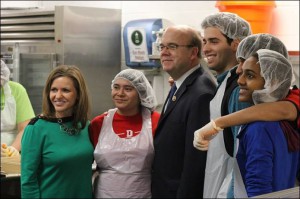
bipartisan House Hunger Caucus. The two representatives chose the DC Central Kitchen to announce that the caucus was back.
The next step was to recruit other members of the House to join in the effort. So Rep. McGovern and Rep. Jenkins put together a Dear Colleague Letter inviting all 435 members of the House of Representatives (as well as six non-voting members) to join the caucus.
Dear Colleague:
We invite you to join us as members of the newly re-established House Hunger Caucus. The House Hunger Caucus is a bipartisan forum for Members and staff to discuss, advance and engage the House's work on national and international hunger and food insecurity issues. Ending hunger at home and around the world is a popular idea, but it is a goal that, for a variety of reasons, has yet to be accomplished. There are many programs, plans, and organizations dedicated to ending hunger, just as there are governmental programs that are successful but underutilized in some cases. In addition, corporations and small businesses are active in fighting hunger, as are churches, faith-based organizations, and other non-profit organizations. Specific functions of the House Hunger Caucus include:
Bring awareness to national and international hunger and food insecurity issues,
Serve as a forum for Members and staffs to receive information through briefings, hearings and meetings about hunger and food insecurity issues
Create a coalition of Members to support legislative initiatives and funding requests that help address hunger and food insecurity
Serve as a vehicle for local, state and national hunger non-profits to communicate to Congress about hunger and food insecurity issues
Enhance public and private partnerships to support hunger and food insecurity initiatives
Create a forum for academic discussion of long term solutions to hunger and food insecurity issues
We are concerned about the number of people who go hungry every day and this Caucus re-established to address this important issue. We are committed to working together in a bi-partisan way and we hope you will join us in addressing these serious matters as a member of the House Hunger Caucus.
A year later, nearly one-fifth of the House of Representatives (83 voting members and three non-voting members) have joined the House Hunger Caucus. The list includes New Mexico Rep. Michelle Lujan Grisham from the First Congressional District and Rep. Ben Ray Lujan from the Third Congressional District. These representatives elected to address hunger and food insecurity in a very intentional way and deserve our gratitude. If your representative is on this list, please send him or her a note of thanks for "Voting to End Hunger."
Our deep gratitude to Jennifer Chandler, chief of staff for Rep. McGovern, for supplying the list of members of the House Hunger Caucus.
Is it not to share your bread with the hungry,
and bring the homeless poor into your house;
when you see the naked, to cover them,
and not to hide yourself from your own kin?
Then your light shall break forth like the dawn,
and your healing shall spring up quickly;
your vindicator shall go before you,
the glory of the Lord shall be your rearguard.Isaiah 58: 7-8
George set the tone for the Seventh Station by reading a few verses from Isaiah 58. Kathy followed with a reflection on child hunger in New Mexico. One in three children in our state are at risk of hunger. When children are hungry, this means that families are hungry. That is not right. School teachers are having to reach into their own pockets to feed hungry children in their classrooms. That is not right. Albuquerque's Urban Way of the Cross was not just about stating the problem, but also about telling stories of redemption. So, we celebrated those same teachers--Sonya Romero, Marvin Callaghan and many of their colleagues--who used their own resources so children would not go hungry. Kathy asked pilgrims on this walk to think of one word: change. What can we change structurally to ensure that children in our state no longer have to go hungry?
Sonya Romero Smith
Connecting the Dots
The 2016 Urban Way of the Cross was also about connecting the dots. There are deep connections among the issues that we addressed.
The clearest connection was between Station Four (Poverty Matters) and Station Seven. It was by coincidence that Sonya Romero Smith was offering the reflection on child poverty. She spoke about how she had to provide a home for two children who would have gone homeless. Kathy made sure to connect the dots, mentioning the link between Sonya's reflection and our reflection on hunger.
The pilgrims on the walk also heard reflections about the challenges of women who had been in prison; immigrant children at the detention center in Artesia, New Mexico; veterans; and people who suffer from homelessness.
To state the problem and talk about the challenges was necessary. That's what Good Friday is all about. The stories of redemption were also important. That's what Easter is all about. The biggest lesson this day is that Good Friday and Easter are intricately interrelated. This was a day about connecting the dots. Our journey ended with a dab of oil on our foreheads and a personal prayer.
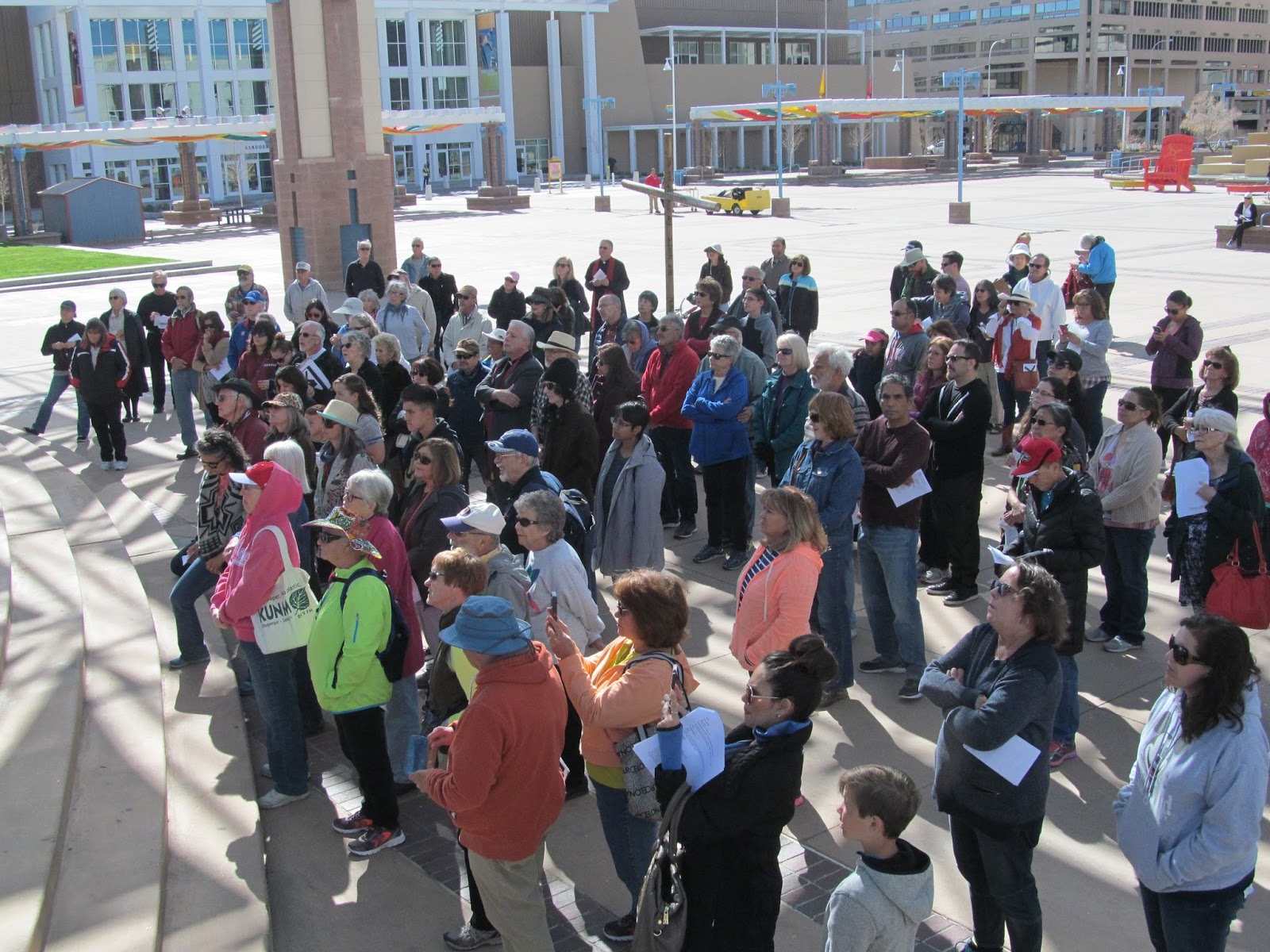
Here pictures of some of the pilgrims who walked on the 2016 Good Friday journey through downtown Albuquerque:
“I would rather see health care in the grocery store than in the pharmacy.” -David Perry, program director, Zenger Farms, Portland, Oregon
“Food should be considered a treatment option for our patients,” -Lee Hammerling, MD, chief medical officer and chief physician executive, ProMedica, Toledo, Ohio
Food Prescription programs make it easier for low-income patients and
their families to access the fresh fruits and vegetables they need in
order to ensure that they are eating balanced, healthy diets. The
programs generally begin with a partnership between a hospital and a
local farmer’s market or CSA (community supported agriculture) to increase access for people who need access to nutritious food to improve their health.
"Although Food Prescription programs are relatively new, pilot programs
have shown promising results in improving health outcomes in communities
where they have been implemented," wrote Molly Miller in an article published by Stakeholder Health in 2014.
According to Miller, there is already some evidence that the food prescription programs are working. She notes that the The Fresh Prescription Program, which seeks to build partnerships between the local food system, the
healthcare system, and low-income patients in the Detroit area, has shown some signs of promise. See above video about the Community Health and Social Services (CHASS) Center.
Roadrunner Food Bank Opens Healthy Foods Center
Produce at Railyard Market
In Albuquerque, Roadrunner Food Bank has launched a food prescription pilot program in partnership with five local clinics. The program has been in place for several months but was only announced to the general public on Feb. 11 at the grand opening of the Healthy Food Center, located at the food bank,
5840 Office NE. Read more in Albuquerque Journal.
The health partners participating in the program are three Community Dental
Services clinics and two University of New Mexico Hospital clinics. Here is how it works: the five clinics do a sort of triage among their patients. "Patients are
asked about their food situation. If they answer in a way that indicates they aren’t getting
enough to eat or are skipping meals, the health care partner issues a
‘prescription’ to come here,” said Alissa Barnes, Roadrunner Food Bank’s director of
community initiatives.
The prescription provides for one weekly trip to the Healthy Foods Center
for a year, where the clients can “choose the products that are right
for their home,” Barnes said. The caveat: only clients with these referrals can get
food from the on-site pantry.
As the name of the program implies, the focus of the program is entirely on health. “We have a
lot of patients with Type II Diabetes, so we don’t offer them anything
with added sugar. For those with hypertension, we offer them the
low-sodium vegetables. For those with vitamin D deficiencies, we offer
more whole grains, tuna fish, and milk so they can get that extra
Vitamin D," said Angela Smith, a diet technician with Promedica, a health care provider in Toledo, Ohio. Read more about Promedica's Food Pharmacy.
Working Together
Promedica has partnered with the Alliance to End Hunger and several local health care providers around the country to examine the connections between health and hunger. The two organizations held a conference on this topic in partnership with Presbyterian Community Health in June, 2015. One of the keynote speakers was Ambassador Tony Hall, director emeritus of the Alliance to End Hunger. Other cities have hosted similar conferences, including Columbus, Ohio last fall.
According to Barnes, Roadrunner Food Bank's pilot program in Albuquerque will continue to the end of the year, and then
“other health care clinics will be slowly rolled in.” The
Healthy Foods Center will eventually incorporate other services,
including immunizations, tax preparation, nutrition education and health
screenings, she said.
Presbyterian Community Health, which recently recently launched a
program offering a free healthy meal to children and youth seven days a
week, is likely to join the food prescription effort in a more direct
way soon. The program has already created a strong partnership with La
Cosecha CSA. (See more in this video).