Showing posts with label hunger in New Mexico. Show all posts

Saturday, September 12, 2020

Report Measures Food, Housing Insecurity on UNM Campus

During the 2020 session of the New Mexico State Legislature, three legislators introduced an initiative proposing an appropriation to the State Education Department to create a pilot program to address college hunger.  

House Bill 69, co-sponsored by Reps. Joanne Ferrary, Christine Trujillo and Melanie Stansbury, was approved on a "Do Pass" basis in committee, but then the measure was postponed indefinitely. Still, the bill was a recognition that hunger among students is a sometimes hidden problem at colleges and universities in New Mexico. 

The issue of hunger among college students is not as highly publicized as hunger in the general population, particularly among children, seniors and working families. But the concern is very real.


A team of UNM researchers--led by two Honors Program faculty members, Assistant Professor Sarita Cargas and Marygold Walsh-Dilley--began discussions last year on a plan to measure food insecurity at the University of New Mexico. Cargas and Walsh-Dilley have been an active participant in the Food, Hunger, Water, Agriculture Policy Action Team, a broad coalition seeking to find ways to reduce hunger in New Mexico. 

In September 2020, the researchers released the first findings in a report entitled Basic Needs Insecurity at UNM: 2020 Research Report. The report was funded primarily by the Office of the Provost and Office of the Chancellor at UNM, but the UNM Honors College, Student Services, and the Office of Student Affairs also contributed financially to the project. In addition to the two lead researchers, Heather Mechler, Kathryn Coakley, Shoshana, Adler Jaffe and Ann Murphy were also part of the team. See full report

"Food insecurity on college campuses has become an area of intense study over the past decade, and research on housing insecurity is on the rise,  said the executive summary.  "This report presents findings from the first representative study of basic needs security in college students in the state of New Mexico. 

First Survey Conducted in April 

The inaugural survey was conducted in April 2020, amidst the global COVID-19 pandemic. According to the study, students were selected using a stratified random sampling method of all degree-seeking students at the Albuquerque UNM campus. 
 
Factors in the sampling included low-income status (an expected family contribution of $5,576 as determined on a student’s Free Application for Federal Student Aid), level of study, gender, area of study, and ethnicity. The entire sample consisted of 12,000 students. Selected participants received an email two days before the survey launch informing them that they had been selected to participate in a survey about food and housing security among UNM students. 
 
The survey invitation noted that the first 2,500 participants would receive a $10 Amazon gift card as a token of appreciation for their time. The survey remained open for two weeks, with two reminders sent to students who had not yet responded. 
 

One in three students food insecure

"The report found that roughly one-third of students surveyed were food insecure in April and four in 10 were housing insecure at one time or another during the previous year.

"Our findings indicate that one in three UNM students were food insecure in April 2020 and over 40% were housing insecure sometime in the previous year," added the executive summary. "Both food and housing insecurity prevalence are higher at UNM than in the broader population of New Mexico. The United States Department of Agriculture (USDA) reports that 16.8% of New Mexico Households are food insecure. It is harder to compare ousing insecurity because of a lack of consistent measurement strategies." 

"Basic needs insecurity varies across demographic groups. At UNM, the demographic groups most affected by food insecurity include African Americans and American Indians; transgender and gender fluid students; and gay, lesbian, and bisexual students," the executive summary noted.

The need to address hunger among college students extends beyond UNM. The study at New Mexico's flagship university is just the beginning. There are other universities and colleges in the state where food insecurity is likely present among students, including New Mexico State University in Las Cruces, New Mexico Highlands University in Las Vegas, New Mexico Tech in Socorro, Eastern New Mexico University in Portales, Western New Mexico University in Silver City, Santa Fe Community College, Central New Mexico Community College in Albuquerque and Northern New Mexico College in Española, among others. These are the largest institutions. There are a couple other dozen small colleges and branch campuses for the major institutions.

Housing Insecurity

According to the  UNM study, the students most affected by housing insecurity are: Hispanic, American Indian, and international students, and students who are two or more races; female, transgender, and gender fluid students; gay, lesbian and bisexual students and students who report that they are not sure of their sexuality; and students with dependents.

"Over one-fifth, or 20.5% of UNM students, experience a double burden of both food and housing insecurity," noted the study.

"Preliminary analysis suggests that basic needs insecurity contributes to poorer academic outcomes," the researchers concluded. "Students reporting food insecurity were more likely to withdraw from or fail a course, and also reported lower grade point averages. Thus, this report suggests that food and housing insecurity contributes to disparities in academic success across demographic groups."

Next Steps

The study offers only a snapshot of the problem at UNM, confirming a situation that researchers suspected already existed. The study recommends a broad approach to address the problem. "Food insecurity and housing insecurity are substantial problems for UNM students and require a comprehensive, systemic, and sustainable response," the study said. "Efforts to address basic needs on campus must be attentive to the stigma that may surround these issues. Additionally, many campus offices, resource centers, and departments must work together to address the problems of food and housing insecurity in the campus community. The needs are too great to be the purview of one office especially if that office has numerous other mandates."

Monday, August 03, 2020

Video: SNAP Matters More Than Ever

Joseph Llobrera of the Center for Public Policy and Priorities (CBPP), explains explains that due to the economic crisis, “rising food need and higher food prices are making it even tougher for many to make ends meet.” Growing numbers of households are reporting difficulty affording food and meeting other basic needs. Particularly alarming is the rise in the number of children whose families report that they aren’t getting enough to eat, which can have long-term consequences for their health and well-being. And, due to longstanding inequities exacerbated by COVID-19’s disproportionate impact on Black and Latino communities, families of color are likelier to struggle to afford enough food.


Friday, July 31, 2020

Video: A Collective Effort to Fight Hunger in New Mexico

Lilly Irvin-Vitela, executive director of New Mexico First, was the guest presenter at the Interfaith Hunger Coalition's Zoom meeting on July 27, 2020. Lilly spoke about the ongoing collective anti-hunger efforts in New Mexico before and during the COVID-19 health emergency and into the future. The actual presentation with announcements starts at about 7:00 minute mark, and Lilly's talk starts at the 13:00 minute mark

Sunday, July 19, 2020

Comparative Overall Hunger Data: Feeding America Report

Source: The Impact of Coronavirus on Food Insecurity  National Reports  Maps

Comparative Child Hunger Data (Feeding America Report)

Source: The Impact of Coronavirus on Food Insecurity  National Reports  Maps

Study Shows Pandemic Could Greatly Increase New Mexico Hunger

Pre-pandemic, here in New Mexico – 315,990 people, including 114,180 children, did not have adequate access to nutritious food to live a healthy life. However, this new study demonstrates that this number is likely to grow 118,580, including 48,780 children. That means approximately 434,570 or 21 percent of New Mexican people (1 in 5) may experience food insecurity in 2020, including 162,960 children (1 in 3).
Roadrunner Food Bank (RRFB) last week issued a dire forecast of the magnitude of  hunger and food insecurity in New Mexico this year because of the COVID-19 health emergency and related economic downturn. The RRFB projection is based on the Feeding America report, The Impact of the Coronavirus on Local Food Insecurity, which projected rates for every state.

According to RRFB, one in five adults and one in five chidren could face hunger in 2020 because of COVID-19.

Here is a RRFB news release on July 16.

"The novel coronavirus (COVID-19) pandemic will have had a devastating impact on people facing hunger across the country and in New Mexico according to a new study by Feeding America, the nation’s largest hunger-relief organization. This study is the first of its kind to explore how food insecurity rates at the local level may increase in 2020 due to COVID-19.

The Impact of the Coronavirus on Local Food Insecurity analyzes food insecurity rates for the overall population and children by state, county and congressional district. Pre-pandemic, here in New Mexico – 315,990 people, including 114,180 children, did not have adequate access to nutritious food to live a healthy life. However, this new study demonstrates that this number is likely to grow 118,580, including 48,780 children. That means approximately 434,570 or 21 percent of New Mexican people (1 in 5) may experience food insecurity in 2020, including 162,960 children (1 in 3).

“Families continue to reel from the impact this pandemic created — devastating their income and finances. New Mexico families are struggling to afford all their family needs including food,” said Mag Strittmatter, president and CEO of Roadrunner Food Bank. “As unemployment remains high, we will continue to work and provide food to communities across our state so that none of our neighbors who are hungry are left out. So many of our friends and neighbors are living a life-changing event that brought them face-to-face with hunger for the first time in their lives.”

This new analysis was conducted by building upon the approach Feeding America used in two earlier briefs to predict changes to national food insecurity rates for the overall population and children in response to changes to poverty and unemployment. The annual projected unemployment rate (11.5%) is within close range of expert estimates when annualized, including those from a monthly Wall Street Journal survey of more than 60 economists as of May (11.6%), the Congressional Budget Office (11.4%), and Goldman Sachs Global Investment Research (10.3%), and represents an increase of 7.6 percentage points.

To account for local unemployment variation, this new analysis adjusts the projected national unemployment increase for likely job loss due to COVID-19 based on an analysis of projected changes in the unemployment rate by industry and occupation by Goldman Sachs Investment Research. The projected local unemployment change for New Mexico is 8.4 percent points. Current local data from New Mexico Workforce Solutions shows unemployment in April at 11.4 percent and May at 8.8 percent in the state.

The underlying analysis for the food insecurity projections was conducted by Dr. Craig Gundersen using the model developed for Map the Meal Gap, Feeding America’s annual study of local food insecurity and food cost in the United States."

Key findings for New Mexico from the report 
  • Luna and McKinley counties have the highest expected rates of hunger during the pandemic with nearly 28 percent of the population at risk of experiencing hunger. 
  • Catron, Luna and McKinley counties have the highest expected childhood hunger rate during the pandemic with more than 44 percent of children in those three counties at risk of hunger.  
  • County by County Data    Overall Hunger    Child Hunger
Community Assistance Needed
With resources stretched to the limit, Roadrunner Food Bank continues to ask the community to help meet the ongoing need expected to impact our state throughout this year and potentially next. Families will struggle to recover lost income over many months of no or very little work, as they attempt to balance the needs of their family’s needs with the continuation of this ongoing pandemic.

Ways to Help
  • Give Funds – Financial contributions go much further in moments like these, and support will help to provide funding to obtain what is needed most. 
  •  Give Time – Register for a volunteer shift through the food bank website at rrfb.org, or call 505.349.8841 or 505.349.8837 during business hours Monday – Friday from 8 am to 4 pm, and Saturday’s from 8 am to 2 pm. 
  • Give Food – Non-perishable food donations will be accepted at the food bank during business hours. Community members who are ill or experiencing any symptoms of an illness should arrange for another person to deliver food donations to the food bank. As the food bank fleet must remain focused on delivering food, food pick-ups will not be available.

Wednesday, July 08, 2020

Fellowship in the Desert Hosts Hunger 101 Workshop Online

The Interfaith Hunger Coalition over the past few years has organized several Hunger 101 workshops in partnership with a number of congregations (First Presbyterian Church, Holy Rosary Catholic Church, Congregation Albert, the Albuquerque Baha'i Center) and organizations (Church Women United, the Jewish Community Center and Presbyterian Women).

We had been planning another one of these workshops with Chavurat Hamidbar (Fellowship in the Desert) in April. But then the COVID-19 health emergency occurred in the U.S. in March, which forced us to postpone the workshop.

We regrouped during the summer and put together a Zoom workshop.  Below is the video of a portion of the workshop, courtesy of Leora Jaeger-Siegel.

Thursday, July 02, 2020

A Great Summary of the New Mexico Legislature's Special Session

The New Mexico Food and Agriculture Policy Council, one of the participants in a broad coalition to address hunger in New Mexico, on Wednesday released a great summary of the NM State Legislature's special session.

The Legislature met on June 18-20 to adjust the state budget, which took a hit because of the health emergency caused by the COVID-19 pandemic. Because of decline in revenues and plunge in oil prices, the Legislature was charged with adjusting the budget for the 2020-2021 fiscal year, which began on July 1.

The budget became official on June 30 when Gov. Michelle Lujan Grisham signed the final appropriations bill HB1, General Appropriations Act and issed the Governor's Message, which provides guidance to all agencies as to budget cuts and redirection of specific priorities of the Governor.

Just prior to the Special Session, the NMFAPC submitted a letter to legislators who had sponsored the NMFAPC's priority legislation requesting that they hold programs whole and minimize cuts. The NMFAPC alsopartnered with New Mexico First and the broad anti-hunger coalition to share collective priorities with all New Mexico legislators and the Office of the Governor.

Here are some excerpts from the NMFAPC report, courtesy of Pam Roy.  

Budget mandated cuts of 4-6% for agencies
The majority of the NMFAPC priorities stayed within agency budgets yet will see cuts of four to six percent depending on the agency. The priority agriculture programs administered by the NM Department of Agriculture, including support for farmers' markets and local promotion programs, Soil and Water Conservation Districts program funds, and the healthy soils program, will be subject to the NMDA four percent cuts.

Pilot fund does not survive
Unfortunately, the Agriculture and Natural Resources Pilot Fund of $1.8 million did not survive the cuts. NM State University faces a four percent cut across all programs. Our priorities to continue funding for the NM Cooperative Extension Services and Experimental Stations are within the NMSU budget.

Special Programs Preserved
New Mexico Grown Fruits and Vegetables for School Meals appropriation of $400,000 and the Elimination of Co-pays for School Breakfast and Lunch of $650,000 were maintained in the NM Public Education Department budget. They will be subject to the agency percent cuts. This is a relief, as the Legislative Finance Committee had recommended cuts of 50 percent to both programs.

Reduction in Special Senior Fund
The new Kiki Saavedra Senior Dignity Fund was sanded by $1 million leaving a balance of $6.3 million to initiate a wide variety of programs that will benefit seniors across New Mexico. It is our request that the New MexicoGrown Fruits and Vegetables for Senior Meal Programs be considered for a modest amount of funding to launch a statewide program, building on the successful pilot program just completed.

Summary: The NMFAPC looks forward to working with the full NMFAPC and agencies to make sure budget cuts are equitable and no priority programs get cut. Most important is the work ahead of us into 2021and beyond.

Friday, June 19, 2020

NM Special Session: Urge Legislators to Preserve Critical Funding

Here is the text of a message that New Mexico First sent out for the special session.  The requests are based on priorities identified by the Food, Hunger, Water, and Agricultural Policy Workgroup and New Mexico Food and Agriculture Policy Council.  

Our volunteer legislators and committed public servants at the Legislative Finance Committee have been presented with tough decisions during very trying times. We sincerely appreciate and respect their service on behalf of New Mexico. Before the session, a coalition of coalitions and multi-stakeholder groups worked together to identify policy and funding priorities in light of the pandemic.

The Food, Hunger, Water, and Agricultural Policy Workgroup and New Mexico Food and Agriculture Policy Council and members of our coalition/council have affirmed the need to support the following priorities.  Please act now and contact your legislators and encourage policymakers to consider alternatives to the Legislative Finance Committee's recommendation to cut these critical programs.

Investing in Healthy Food Systems
We are also concerned about recommended cuts in funding to some of the critical infrastructure that bolsters agriculture in New Mexico through programs like the NM Cooperative Extension Services and Agricultural Experimentation Stations.

At a time when national supply chain issues have impacted access to food, investing in healthy local food systems is critical and while a 4% cut is less than some other proposed cut, short-sighted at a time when agriculture needs more support than ever as a critical part of our economy and as a social determinant of public health. Similarly, the proposed cuts to the NM Department of Agriculture can affect support for farmers' markets and promotion programs, Soil and Water Conservation Districts, and the healthy soil program. Cuts to these programs can impact the ability to leverage federal and philanthropic investments, risking significant progress that has been achieved to build local markets and sustain our natural resources to support food production.

School Meals
LFC's recommendation to step back from the Elimination of Co-pays for School Breakfast and Lunch with a less significant investment than the $650K appropriated during the regular session is profoundly concerning. With childhood hunger increasing, this recommendation is counter to our shared commitments to address child hunger.

NM Grown Fruits and Vegetables for School Meals: Legislature Appropriations: $400K: LFC recommended a decrease to $204K (bottom of p. 19), which is a big cut. We know that the NM Public Education Department has commitments to 58 School Food Authorities for the $400K (if it can be maintained) to start purchasing NM grown fruits and vegetables for school meals over the coming months. NM PED received more than $750K in requests. As we know, this is an economic driver for farmers who have already planted their fields in preparation to sell to schools and senior centers. School districts are shifting the ways they prepare and provide school meals, yet they are still planning to buy local produce to incorporate into meal programs.

Meals for Seniors
We are very excited about the Kiki Saavedra Senior Dignity Fund that the Legislature appropriated $7.3M. We see that the LFC has recommended a $1M decrease. We hope this program will be maintained even if there is a cut. As a state with one of the fastest-growing senior populations, and we are seeing so many more needs for seniors through the lens of COVID-19, we look forward to the Kiki Saavedra Program being of benefit to many. We believe this is the right type of funding to help build the NM Grown Fruits and Vegetables for Senior Meal Programs. We just finalized a three-county (Sandoval, Socorro, and San Juan) pilot project with the Aging and Long Term Services Department, senior centers, and farmers. Even amid COVID-19, 15 senior centers served 6,160 meals weekly (curbside and home-delivered), incorporating $50,000 of New Mexico grown produce in the meals. A small request of the Kiki Fund could really benefit the growth of this program across the state!

Thursday, June 18, 2020

Broad Coalition Urges Senate Leaders to Boost SNAP During Crisis

Nearly 2,500 organizations from across the country signed on to a letter urging the Senate to boost SNAP benefits in the next coronavirus relief package. 

The letter asks for a 15 percent boost in the Supplemental Nutrition Assistance Program (SNAP) maximum benefit, an increase in the SNAP minimum monthly benefit from $16 to $30, and a suspension of SNAP time limits and rules changes that would cut SNAP eligibility and benefits.  

Read press release from the Food Research and Action Center (FRAC)
 
Among the national organizations singing the letter are Bread for the World, MAZON: A Jewish Response to Hunger, the Evangelical Lutheran Church in America (ELCA), Islamic Relief USA,  the Episcopal Church, Challah for Hunger, 1,000 Days, A Place at the Table, Meals on Wheels America, Children's Defense Fund, and hundreds more. 

The New Mexico signators include some participants in the Food, Hunger, Water and Agriculture Policy Work Group, including Agri-Cultura Cooperative Network, Feeding Santa Fe, Inc., New Mexico Center on Law and Poverty, New Mexico First, New Mexico Healthy Soils Working Group, Roadrunner Food Bank, and the Food Depot.

Here is an excerpt 

June 18, 2020 
The Honorable Mitch McConnell 
Senate Majority Leader
U.S. Senate
U.S. Senate S-230, 
U.S. Capitol Building
Washington, DC 20510

The Honorable Chuck Schumer 
Senate Minority Leader  
U.S. Senate S-221, 
U.S. Capitol Building  
Washington, DC 20510 

Dear Majority Leader McConnell and Minority Leader Schumer, 

Our nearly 2,500 undersigned national, regional, state, and local organizations urge immediate action to address the twin challenges of COVID-19 — protecting individuals and communities against hardship and jump-starting a strong economic recovery. SNAP benefit boosts can help limit the depth and duration of the human and economic tolls this crisis threatens to exact. 

COVID-19 has exacerbated already too high levels of food insecurity in America. According to the Urban Institute, in the early weeks of the pandemic, one in five U.S. adults experienced food insecurity

Also, in the early weeks of COVID-19, Labor Department data document that one of every four workers filed for unemployment insurance; the April unemployment rate hit 14.7 percent; and the combined rate of unemployed, discouraged, and part-time for economic reasons workers spiked above 22 percent.

Sufficient and timely federal government action is needed to prevent even more human suffering and lost productivity in the short and longer terms. 

SNAP is a proven countercyclical tool. Each $1 of SNAP benefits during a downturn generates between $1.50 and $1.80 in economic activity. Participants spend those benefits quickly, with positive impacts felt up and down the food chain — from farmers and food producers, to grocery retailers, stock clerks, and local economies.  

The lines for food at emergency feeding sites offer a picture of the human suffering that data can only begin to explain. This crisis demands a response that is commensurate with its scope and seriousness. For every one meal provided through the Feeding America food bank network, SNAP can provide nine meals on the normal rails of commerce. SNAP boosts must be an important part of an effective, comprehensive response to COVID-19.

 Here is the full letter and see the full list of signators

Friday, June 12, 2020

Study Tracks Food Insecurity in New Mexico, U.S. During Health Crisis

The COVID-19 emergency has resulted in a dramatic increase in food insecurity in every one of our 50 states, although the extent of the increase varies by state.

According to a study put together by the Institute for Policy Research (IPR) at Northwestern University in Illinois, using data from, the Census  Household Pulse Survey (CHHPS), food insecurity during COVID-19 is almost 2.15 times what it was prior to the onset of the national health emergency.

"More than 1 in 10 households reported receiving free food in Hawaii and New Mexico," said the IPR study, which contains data for each of the 50 states.

"Mississippi and Louisiana recorded the highest estimates of food insecurity during COVID-19, at 31.6% and 30.1%, respectively. Vermont, with 14.1% food insecure, is the only state with a food insecurity rate below 15%," said the study.

Below are a few numbers from a table contained in the report. The middle column illustrates the dramatic increase in need in New Mexico. According to the study, the projected rate of food insecurity in our state was just below 15% in February of this year. The rate for the April-May period was recordeded at 27.6%.

   
Food Insecurity: Dec. 2018Predicted Food Insecurity: Feb. 2020Food Insecurity: April–May 2020Ratio:
Feb. vs. April-May
Received Free Food, Prior 7 Days


New Mexico
15.7%   14.9%     27.6%1.8611.6%
U.S. Total
11.1% 10.8%   23.0%2.127.3%


Loss of Jobs
A parallel IPR report linked the increased food insecurity in large measure to the loss of jobs during the pandemic. "The COVID-19 health emergency has led to a sharp economic slowdown, with soaring unemployment and spikes in need as illustrated by news reports of miles-long lines at food pantries," said the report.

"We find that food insecurity has doubled overall, and tripled among households with children. Food insecurity is elevated across all states, with some states experiencing extremely high rates and/or increases in food insecurity. Across the nation, 7% of households reported receiving free food during the prior week," added the IPR.

"During the COVID-19 health emergency, the rate of food insecurity for households with children more than tripled to 29.5%," said the report. "Approximately half of this increase can be explained by the increase in the unemployment rate.”

See the report for a more complete discussion of the IPR methodology.

Saturday, June 06, 2020

Engaging in Cyberspace

Even as we continue to practice social distancing, we realize the importance of maintaining connections on our work to address hunger in New Mexico. In lieu of large in-person meetings, we are planning two educational programs on Zoom over the next couple of months.
Our June program is the Hunger 101 workshop we had originally planned with Chavurat Hamidbar (Fellowship in the Desert). Our July event will offer an update on the work of the Food, Hunger, Water and Agriculture Policy Work Group to address hunger in New Mexico before and during the current health emergency. Both events are open to the public but require registration. We will send the links closer to the date of the event.

Workshop
On Sunday, June 28, 3:00 p.m., will will hold a Hunger 101 workshop for members of Fellowship in the Desert, an eclectic-traditional Jewish community without a building or paid professional functionary. "Our prayer leaders and Torah readers are both men and women. Our prayer books and bibles (Sim Shalom, Revised Plaut, New Machzor) are issued by various movements, and we sit mixed, family-style," the community says on its website.

Our Zoom workshop will follow a similar format as other Hunger 101 presentations at First Presbyterian Church, Holy Rosary Catholic Church, Congregation Albert, the Jewish Community Center, Presbyterian Women, Church Women United, the Albuquerque Baha'i Community. We will offer the most recent statistics on hunger in New Mexico, followed by presentations by a community provider.

This workshop will have its own unique features. Leora Jaeger-Siegel, a member of Fellowship in the Desert, will offer an update on her work with the Fūdrr project. There will also be a brief presentation on the community food refrigerator project used in some countries around the world. There will also be an update on Mazon: A Jewish Response to Hunger..

Addressing Hunger During the Pandemic
Our practice in recent years has been to hold a bimonthly meeting at First Presbyterian Church every other month. Our last meeting was held on Feb. 25, featuring Patty Keane, Hunger Initiatives Coordinator, Office of Governor Michelle Lujan Grisham, and Mercy Alarid from the U.S. Census. Our March meeting, scheduled for March 25, was put on the back burner.

We are back online now with an update on the efforts of a broad coalition, called the Food, Hunger, Water and Agriculture Policy Work Group to ensure that people do not go hungry during the current health emergency. The work group, coordinated by New Mexico First, seeks to preserve funding for crucial feeding programs for school kids, seniors, agriculture, food banks and working families in the upcoming special session and in the 2021 session. You might recall, this same coalition (now including more partners) was already working to address hunger in New Mexico before the COVID-19 pandemic hit.

Our guest presenter for our Zoom meeting on Monday, July 27, is Lilly Irvin-Vitela, executive director of New Mexico First, who is coordinating the work group. This will be more than a month after the special session, which is scheduled for June 18. We hope you can join us for this important update about the work group.

Thursday, June 04, 2020

Islamic Group Donates 9.000 Pounds of Food to Diné Relief

Working with New Mexico State Reps. Abbas Ahkil of Albuquerque and Anthony Allison of  Fruitland, the Islamic Circle of North America donated 9,000 pounds of food to the Northern Diné COVID-19 Relief Effort.

The ICNA organized the food donation on May 25, which arrived in Shiprock that evening in a semi-trailer. "We want to make sure people have food," Salina Imam of the Arizona chapter of the ICNA told the Farmington Daily Times. "They don't have to go hungry."

The food will help the Diné relief organization continue with its efforts to reduce the spread of COVID-19 by delivering care packages to families in need in the Navajo nation in the safest way possible.

"As of June 1, the Navajo Nation reported 5,250 positive COVID-19 cases, 1,745 recoveries and 241 deaths. In the Shiprock area last month, three siblings who buried their mother, father, and brother were forced to watch the burial services remotely because they, too, were infected with the disease," Rolling Stone magazine said in a June 3 article.

"In mid-May, the Navajo Nation surpassed New York and New Jersey for the highest per-capita coronavirus infection rate in the US -- another sign of Covid-19's disproportionate impact on minority communities," CNN said in a May 18 report.

"With coronavirus running rampant on Navajo, it has been up to local community members to help with items and supplies so elders and young families don’t have to go to the store and put themselves at risk. But if volunteers aren’t careful, they risk becoming vectors themselves," The Navajo Times said in a recent article.

Tuesday, June 02, 2020

NM State Legislature Urged to Address Hunger During Special Session

Special Session & FY21 Emergency Relief & Recovery Funding Priorities

The Food, Hunger, Water and Agriculture Policy Work Group recently sent a letter to each member of the New Mexico House and Senate ahead of the special session, which has been scheduled for Thursday, June 18. Legislators will attempt to adjust the state budget to account for the negative financial impact caused by the outbreak of COVID-19. By some estimates, the financial crisis caused a $2.4 billion drop in state revenues.

Work group at 2020 legislative session
The work group, coordinated by New Mexico First, seeks to preserve funding for crucial feeding programs for school kids, seniors, agriculture, food banks and working families. (The members of the work group, which includes the Interfaith Hunger Coalition, are listed at the bottom of this post)

The work group started efforts to address hunger in New Mexico last summer, months before the pandemic occurred. We attained some modest gains during the 2020 regular session of the State Legislature, including a  measure to eliminate co-pays for almost 12,500 students at 185% of the federal poverty level. When the pandemic-related emergency occurred the work group convened quickly to create a plan of action.

'Critical Needs'
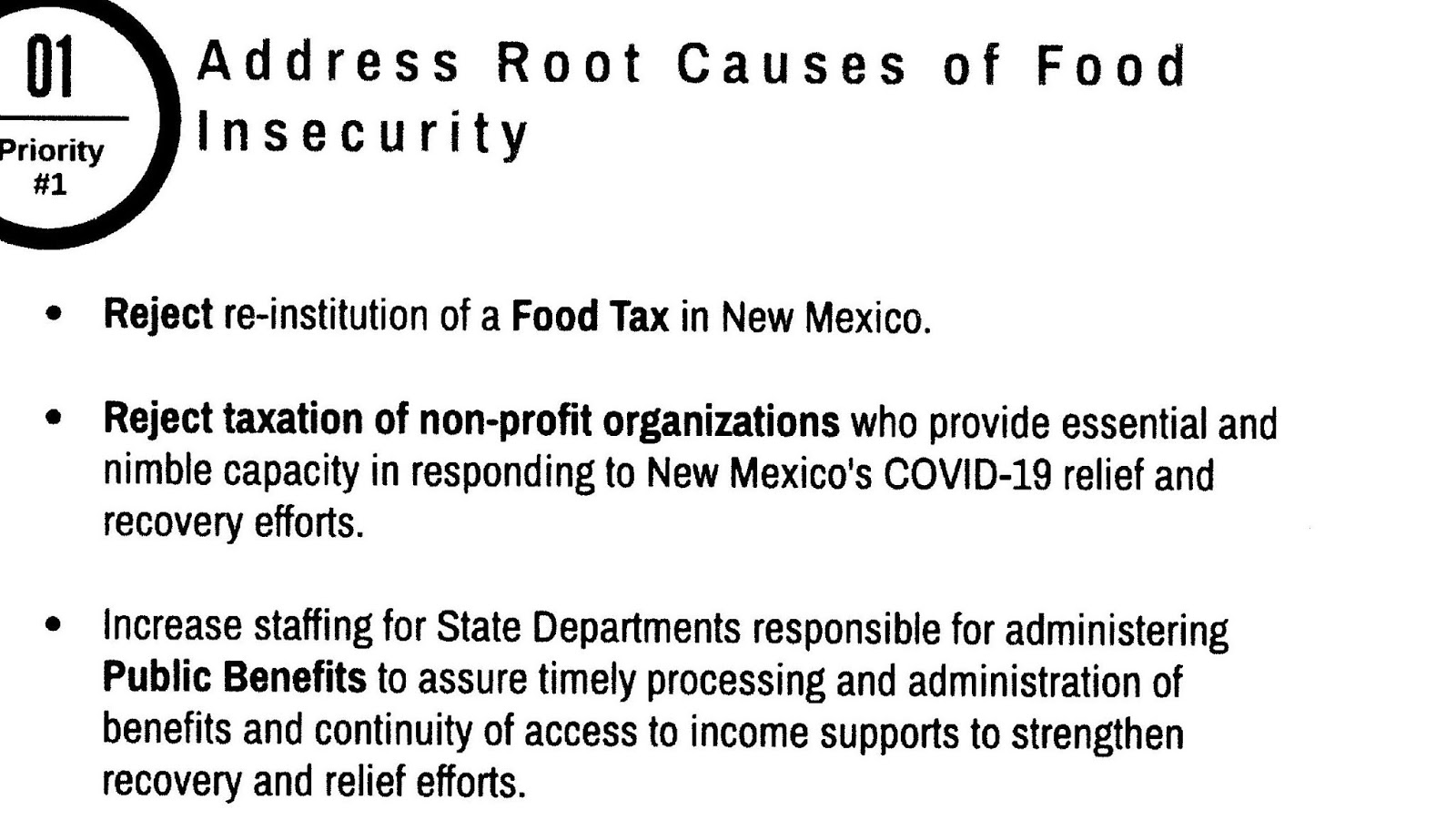
"We are urgently requesting that you prioritize policy and funding solutions create access to healthy food and water while strengthening our State's food system,  Addressing the root causes of insecurity, protecting and investing in the emergency food and water relief efforts, and bolstering local agriculture and food systems are critical needs.

Below are snapshots of a consensus-backed blueprint, compiled in consultation with the Legislative Hunger Caucus


*Maintain and expand investment to $500K in ALTSD to Support the Purchase of NM Grown Fruits and Vegetables for Senior Meals Programs.
The Food, Hunger, Water and Agriculture Policy Workgroup is comprised of a group of bipartisan policy makers, agricultural producers, the emergency food sector, faith leaders, researchers/academics, and public policy advocates.

The participating groups are Agri Cultura Cooperative Network, Center for Health Innovation, Delicious New Mexico, Farm to Table, Indigenous Life Ways, Interfaith Hunger Coalition, McKinley Collaborative for Health Equity, National Young Farmers Coalition, New Mexico Association of Conservation Districts, New Mexico Association of Food Banks, New Mexico Center on Law and Poverty, New Mexico Farmers' Marketing Association, New Mexico First, New Mexico Food and Agriculture Policy Council, New Mexico Social Justice and Equity Institute, New Mexico Voices for Children, South Valley Economic Development Center, The Montibon Company, Think New Mexico, Village of Los Ranchos de Albuquerque

Friday, May 29, 2020

Where You Can Find Grab and Go Meals this Summer

Beginning June 1, 2020, the Summer Grab and Go meals will be offered throughout the city of Albuquerque and Bernalillo County in partnership with Albuquerque Public Schools (APS).  At each site the schedule is Monday through Friday, 11:30 am to 1:00 pm  This web page has links to listings for all three programs. 
 
If you live outside of the Albuquerque area, the New Mexico Summer Food Service Program  site offers information from the Children, Youth and Families Department (CYFD) as well as the Public Education Department (PED). 

Meals are available to all children regardless of race, color, national origin, sex, age or disability.  No application or registration is required for children to participate.
 
For more information, contact 
(505) 841-4856 or (800) 328-2665

Wednesday, May 20, 2020

Online Purchasing Now Available for New Mexico SNAP Households

(Following a news release from the Human Services Department)

The Human Services Department is pleased to announce that New Mexico families who receive Supplemental Nutrition Assistance Program (SNAP) benefits are now able to use an Electronic Benefit Transfer (EBT) card to purchase eligible foods online starting today, May 20.

In early May, The USDA approved New Mexico’s application for the online program, Amazon and Walmart are the authorized online SNAP retailers for all states.

Getting Started
To get started with online purchasing, SNAP participants just need to connect directly with the online retailer. It is important to note SNAP benefits can be used to purchase eligible food items, however, benefits cannot be used to pay for other associated charges such as delivery fees.

Allowing SNAP households to purchase eligible foods online will relieve some of the stress New Mexicans face related to COVID-19,” said Human Services Department Deputy Secretary Angela Medrano. “It also means that more New Mexicans can stay home and help slow the spread of COVID-19.”

The Human Services Department applied for the new online purchasing program from USDA Food and Nutrition Service to strengthen food security for New Mexico families during the “stay at home” directives while the state fights the COVID-19 pandemic.

Many of our SNAP recipients are at risk and face tremendous difficulty finding and purchasing food and New Mexico is continuing to find better ways to serve them,” said Karmela Martinez, Income Support Division director.

Need Assistance?
New Mexicans in need of food assistance, cash assistance or health insurance can apply for benefits online. To check the status of your case on YESNM website, click “Check My Benefits” or call 1-855-309-3766. To speak to a customer service representative, you can call the Customer Service Center at 1-800-283-4465.

The Human Services Department provides services and benefits to more than 1 million New Mexicans through several programs including: the Medicaid Program, Temporary Assistance for Needy Families (TANF) Program, Supplemental Nutrition Assistance Program (SNAP), Child Support Program, and several Behavioral Health Services.

Thursday, May 14, 2020

How You Can Help Address Hunger During the Current Crisis

For many, keeping up with the rapid communication about food, hunger, water, and agricultural Covid-19 efforts has been challenging. New Mexico First has created this landing page on our website to help folks keep connecting the dots!  Many thanks to everyone who has provided information.  -Lilly Irvin-Vitela,  President and Executive Director, New Mexico First


Emergency Response Contacts
Emergency requests should be made through county and pueblo/tribal emergency managers. Please contact your emergency response manager to initiate a response to emergency food, hunger, and water needs. They are responsible for coordinating resources around food, water, and hunger and fair distribution of personal protective needs with front-line relief providers.

Link: Emergency Response Managers Contact Information- all counties, pueblo/tribal areas      

Community Resources
Community and non-profit responses to urgent needs around food, hunger, and water are not intended to be an alternative to government emergency response efforts.  
 
SHARE NM Website: COVID-19 Resources: Use our Free, open-source Resource Directory to find New Mexico organizations that are responding to a variety of basic needs. Also visit a library of resources by topic to help during the pandemic.

COVID-19 - Roadrunner Food Bank: Consider donating, contributing, and volunteering to support emergency food relief efforts. While our community has rallied, the need remains high with ongoing and expanding relief and recovery efforts.

The Food Depot-COVID-19: Consider donating, contributing, and volunteering to support emergency food relief efforts. While our community has rallied, the need remains high with ongoing and expanding relief and recovery efforts.

New Mexico Association of Food Banks: Consider donating, contributing, and volunteering to support emergency food relief efforts. While our community has rallied, the need remains high with ongoing and expanding relief and recovery efforts.

New Mexico Farmers' Marketing Association: Learn more about efforts to support and sustain New Mexico farmers and value-chain coordination efforts to link communities in need of food to local and regional sources of food.

New Mexico Out of School Time-COVID-19: To learn more about school-based meal options during extended closures, visit this site.

Whole Kids Foundation is dedicated to helping kids eat better—and enjoy it! We are a nonprofit 501(c)(3) founded by Whole Foods Market and guided by the same values, principles, expertise and standards for quality ingredients, food production methods and nutrition.

Funders Dedicated to COVID-19, Food, Hunger, and Water Relief 

The New Mexico Community Foundation is New Mexico’s philanthropic partner that is best positioned to identify and respond to needs in the Native American, Pueblo/Tribal communities. Read the press release to learn more. Contact JoAnn Melchor, President & CEO, 505.820.6860 ext. 7000.

Cantena Foundation is pleased to participate in efforts to help Native American communities in New Mexico. It is part of the New Mexico Community Foundation funding support for Tribes and Pueblo Communities in New Mexico and surrounding regions in responding to COVID-19. Contact name: Alex DeGolia,  Alex@cantenafoundation.org.

The Con Alma Foundation’s grants focus is on systemic rather than direct services. They are partnering with other funders to leverage resources towards relief efforts that reach rural and tribal populations, and are supporting efforts that create, strengthen infrastructures or that facilitate awareness of COVID-19 specific wellness webcasts, behavioral health/emotional support hotlines and journalism. Read their funding profile for more information: COVID 19: Con Alma Foundation

COVID-19 Resources for Native Communities: Visit this funding map developed by Roanhorse Consulting to help inform funding efforts in Native American communities across New Mexico.

The Grant Plant, Inc. is deeply concerned about our nonprofit community as we all navigate new challenges in response to the COVID-19 outbreak. This webpage is meant to provide grant-related resources for New Mexico nonprofits.

The McCune Foundation is considering all relief efforts, however, most of our 2020 funds have been distributed. Read their funding profile for more information: COVID 19: McCune Funding Profile
New Mexico Association of Grantmakers

Grantmaker Resources – Philanthropy’s Response for COVID-19

Sandia Labs is encouraging employee donations for, and awarding funding to, specific efforts/organizations including the UWCNM/Alb Community Fund Emergency Fund, Roadrunner Food Bank, and the Native American Relief Fund. We are opening our regularly scheduled Family Stability grant cycle on April 20 and anticipate that some grant requests will be to support COVID-19 relief efforts. Read their funding profile for more information: COVID 19: Sandia National Labs
Sacred Wind Communications Community Connect, Inc. Sacred Wind is pleased to participate in efforts to help Native American communities in New Mexico. An application for funds from our non-profit organization is on our website under the tab “SWC Fund”.

The Santa Fe Community Foundation has established the COVID-19 Response Fund to address the critical gaps in services during the unprecedented Corona Virus pandemic.

The Thornburg Foundation is providing funds to existing grantee/awardees who are addressing COVID -19 hunger relief. Read funding profile for more information: COVID 19: Thornburg Foundation

United Way of Central New Mexico is providing funds to the general public/501c3s/government. Priority will be given to any 501c3 nonprofit in central New Mexico. However, funding awards can be made elsewhere in the state. Apply: https://albuquerquefoundation.org/emergency-action-fund.aspx. Read their funding profile for more information: United Way of Central New Mexico Funding Profile

The W.K. Kellogg Foundation (WKKF) is providing funds to existing grantees that provide relief in NM in rural, tribal and frontier communities.However, they are working with their national office to request additional funds that would contribute to collective efforts/funds (versus specifically for our grantees). Read their funding profile for more information: COVID 19: W.K. Kellogg Foundation
COVID-19 Giving Guide: How To Donate To Reach The Most Marginalized Learn more about ethical giving practices to marginalized communities.

If you are a funder dedicated to hunger relief and would like to join the Food, Hunger, Water, Agriculture Policy Action Team, please contact Lilly Irvin-Vitela at lilly@nmfirst.org.

Search the free SHARE NM database to identify local food resources by entering your location into the database. Click here to get started.

Thursday, April 09, 2020

Urban Way of the Cross: Feeding Our Children

People were bringing little children to him in order that he might touch them; and the disciples spoke sternly to them. But when Jesus saw this, he was indignant and said to them, ‘Let the little children come to me; do not stop them; for it is to such as these that the kingdom of God belongs. Truly I tell you, whoever does not receive the kingdom of God as a little child will never enter it.’ And he took them up in his arms, laid his hands on them, and blessed them. Mark 10: 13-16
Reflection: 'A Partnership to Feed Our Children'


"In this moment, this room gives me hope because it makes me think of all the creative ways that we can feed our neighbors, even when we're trapped within four walls...Before our lives were changes, before anyone, or most of us, even really knew what a corona virus was, we here at First Presbyterian embarked on a new partnership with Longfellow Elementary, which is right across the street from our church. Since the beginning of the school year, every week we have been delivering 50 food bags full of healthy snacks like granola bars and apple sauce and all kinds of things for kiddos who over the weekend don't have access to free meals at school. "

Prayer from Social Justice Resource Center
God our sustainer, we ask you to pour your powerful Spirit into all who are empty this day: Fill the hearts of persons who are troubled. Fill the minds of men and women who are confused.

Fill the stomachs of your children who are hungry. Fill the souls of people who are feeling lost. Fill the lives of all who need you, but do not know you. May your Spirit fill us all to overflowing, dear Lord, and may we be inspired to share our abundance with others, so that there will be no more empty hearts and minds, stomachs and souls. We pray all this in the name of Jesus Christ, who fills lives with your endless grace.
[Rev. Stephanie Urban is Associate Pastor at First Presbyterian Church in Albuquerque]

Saturday, March 28, 2020

Responding to Food Challenges in New Mexico During a Health Crisis

Chart: House Speaker Brian Egolf's Office
The outbreak of the COVID-19 virus has created many challenges around the country. In an attempt to slow the spread of the virus, municipalities and state-governments (including New Mexico) have ordered residents to stay home and have closed down non-essential businesses, schools, churches and other places where large numbers of people tend to gather.

Gov. Michelle Lujan Grisham issued the stay-at-home order on March 23. As of March 27, the state had reported 191 cases  where patients have tested positive for COVID-19, according to the New Mexico Political Report

While the magnitude of the challenge is not as high here in New Mexico as it is in states like New York, Washington,  California, Michigan and Louisiana (among others), the need for social distancing is a necessary prescription to stem potential problems down the road, including the possibility of overtaxing our heath care system.

Finding Food
One of the biggest challenges for New Mexico and other states with high levels of food insecurity is ensuring that food is available to all residents. This is not necessarily an easy task. News of the crisis diminished food supplies around the state. The natural tendency to hoard food during a time of crisis means that items like canned goods and other non-perishables are not as readily available to the food banks.

“People are going out and purchasing a lot of the items that would typically come to the food bank.” Roadrunner Food Bank spokeswoman Sonya Warwick said in an interview with the Albuquerque Journal on March 22. 

Broad Coalition Discusses Strategy
Rep. Melanie Stansbury and New Mexico First have helped bring together a broad statewide coalition to help find solutions to our challenges and coordinate a response.

On March 27, Rep. Stansbury convened a meeting via telephone, in which about 50 people participated. Many participants were already involved in a broad movement  to craft and promote legislation to address hunger in our state in the near future and over the long term.

I won't name all the participants but want to note the participation of key players, including staff from Sens. Tom Udall and Martin Heinrich and Rep. Deb Haaland and several state government agencies (Health, Public Education, Human Services, Indian Affairs) as well as Gov. Lujan Grisham's office.

State Reps. Phelps Anderson (Chaves, Lea & Roosevelt), Joy Garratt (Bernalillo) and Rudy Martinez (Doña Ana, Grant & Sierra) and representatives from Speaker Brian Egolf offce, as well as officials from the City of Albuquerque, and Grant County (Silver City) took part.

The food banks from around the state were represented, including Roadrunner Food Bank, the Food Depot (Santa Fe), ECHO (Four Corners), The Community Food Pantry (Gallup), and the Food Bank of Eastern New Mexico (Clovis).  Other direct food providers also added their two cents to the conversation.

The rest of the participants included advocacy groups (New Mexico Appleseed and the New Mexico Center on Law and Poverty), agriculture-related groups (the New Mexico Farmers Marketing Association and the New Mexico Food and Agriculture Policy Council). Ellen Buelow and I represented the Interfaith Hunger Coalition.

(Thank you to Lilly Irvin-Vitela from New Mexico First for taking great notes)!

 
Logo for The Community Pantry (Gallup)
A Great Job of Coordination
How did we coordinate all the input?

First, it was important to get the big picture and the challenges. This information came from the food banks and others engaged in direct service.

In addition to tight food supplies, the state's network of food banks has reported other challenges, such as a loss of traditional volunteers (many of whom are vulnerable seniors) and a reduction in operations for food-providing agencies (who are trying to keep employees and the public safe).

Furthermore, there are increased costs for transportation, a lack of sufficient cold storage capacity, the potential increase in demand due to an economic downturn, among other challenges. 

Moving Forward
After getting the big picture, the participants decided to create four task forces: 1) Volunteer Mobilization 2) Food Supply 3) Funding Coordination. 4) Coordinated Communication  You will be hearing more on each of these areas in the near future

Additionally, multiple efforts will be occurring simultaneously, such as connecting producers with food providers, creating support systems for local and tribal communities, tracking and consolidating information on what advocacy and other groups are doing.

The statewide response will be led by Patty Keane, Gov. Lujan Grisham's coordinator for hunger initiatives, with help from many other people.

Photo: Roadrunner Food Bank
How You Can Help Now
While specifics are still in the works for the broader effort, there are existing volunteer opportunities in place. Here are a couple of suggestions. Please Note: This is only a partial list.
Roadrunner Food Bank
Meals on Wheels (Albuquerque and Rio Rancho)
Meals on Wheels (Santa Fe)
Food Banks: ECHO in Farmington (505-326-3770), The Community Food Pantry in Gallup (505-726-8068), Food Bank of Eastern New Mexico in Clovis (575-763-6130), The Food Depot in Santa Fe (505-471-1633).

Stay Informed
Check out Resource and Information pages from 
Share New Mexico
Catholic Charities
City of Albuquerque
City of Las Cruces (Youth and Senior Citizens)
City of Santa Fe
State of New Mexico