Showing posts with label hunger in the news. Show all posts

Sunday, March 04, 2018

Albuquerque Journal Editorial Criticizes SNAP-Food Box Proposal

Too many New Mexicans and Americans depend on SNAP to stretch their grocery dollars. Sending out boxes of packaged food nobody wants won’t help them or taxpayers. -Albuquerque Journal Editorial, March 2, 2018
On Friday, March 2, the editorial board of the Albuquerque Journal came out forcefully against a proposal in President Trump's 2019 Budget that would replace current benefits under the Supplemental Nutrition Food Assistance program with food boxes. The Journal joins a chorus of voices,  including SNAP recipients, the Food and Research Action Center, New Mexico Voices for Children, and many others in opposition to the proposal.

Here are the reasons that the Journal gave for opposing the measure. While we disagree that fraud is as big of a problem as the Journal states, we are pleased that the board recognizes the absurdities in the president's proposal.
  • The proposal does not solve the real problems with the $71 billion-a-year SNAP program, the most glaring one being fraud.
  • The proposal doesn’t factor in a family’s food allergies, medical needs or likes or dislikes.
  • The proposal creates an entire bureaucracy around manufacturing, supplying contents for, filling and shipping these food boxes.
  • The proposal uses half of recipients’ benefits for boxes of food that by definition can not be fresh.  The proposal cuts the amount local families spend on food, taking money out of the local economy and reducing the viability of proposals to address the need for more nutritious grocery options in so-called food deserts.
Read full editorial

Wednesday, December 20, 2017

Report. New Mexico Ranks First in Hunger Among Working Adults

The main cause of U.S. hunger is that people simply don't earn enough money to meet their living expenses.  -Hunger Free America

In November, the New York City-based organization Hunger Free America released a report pointing to the correlation between a low minimum wage and a hunger. The report, entitled Working America's Still Hungry, put New Mexico at the top of states with highest food insecurity among working adults. New Mexico's rate of 15.3% (where the minimum wage is $7.50) was almost one and half percentage points above the the two states with the next highest rate, Louisiana and Mississippi (both of which were at 14% and had a minimum wage of  $7.25). In contrast, food insecurity was recorded at 6.7% in the District of Columbia (which has a minimum wage of $11.50) and 6.1% in Massachusetts (where workers earn a minimum of $11.00 per hour).

According to the report, which which is based on an analysis of federal data, 15 million adults in our country lived in food insecure households with at least one person employed in the years 2014 to 2016,  Of this total, almost 131,000 food insecure employed adults live in New Mexico, which has a minimum wage of $7.50. 

"This shameful data is the latest evidence that the American dream is seriously at risk unless we change our current economic and political policies nationwide," Hunger Free America CEO Joel Berg said in a press statement shortly after the release of the report in mid-November.  "Low wages are still the top cause of U.S. hunger and malnutrition."

Governor's Veto
The minimum wage was one of the issues considered in the New Mexico State Legislature during the 2017 session. The Senate approved an initiative to raise the minimum wage to $9.00 per hour, while the House approved a measure to raise the rate to $9.25 an hour.  Gov. Susana Martinez vetoed the two measures, according to the online new site New Mexico Political Report.

Click on image to enlarge
We must note that some communities in New Mexico (Albuquerque, Bernalillo County, Santa Fe/Santa Fe County and Las Cruces) already have a higher rate than the state minimum wage, according to the graphic on the left provided by the New Mexico Restaurant Association's Employment Policy Institute and published in Santa Fe's The New Mexican newspaper in December 2016. I'm not sure how these numbers factor into the conclusions made by the Hunger Free America report.

Albuquerque Journal Coverage
The Hunger Free America report caught the attention of The Albuquerque Journal, which wrote an article on Dec. 18 quoting CEO Berg and a couple of business associations in the state. As Berg suggested, "The good news is this data proves that states that hiked their own minimum wages were less likely to have workers struggling against hunger."

Carol Wright, chief executive officer with the New Mexico Restaurant Association, pointed out that the minimum wage in Texas is $7.25 per hour, and the state has "fewer people living in poverty than there are in New Mexico.”  Wright, of course, misinterpreted the numbers, as Texas has1.4 million working adults who suffer from food insecurity, or about 11% of employed adults (a number that is still high).

Similarly, Jason Espinoza, president and CEO of the New Mexico Association of Commerce and Industry, suggested that increasing the minimum wage is not the answer to New Mexico's economic woes, but rather the promotion of initiatives to create jobs.  While I don't disagree with the second part of his statement, the first part is just as important.  It's not a question of "apples or oranges," but "apples and oranges."

While I commend Journal reporter Rick Nathanson for his effort to present both sides, quoting Berg on one side and Wright and Espinoza on the other side, he failed to get the perspective of organizations in New Mexico that directly track the challenges of the working poor in our state. Surely, someone from The New Mexico Center on Law and Poverty, New Mexico Voices for Children, the Lutheran Advocacy Ministry-New Mexico or the New Mexico Conference of Catholic Bishops would have wanted to make a statement on this issue.

The Interfaith Hunger Coalition advocates raising the minimum wage as one of the important elements to help address the problem of our high level of food insecurity in the state. The needs of the working poor should be  considered alongside programs targeted at children, seniors and rural communities.  At the End Hunger Summit in Albuquerque in October, we proposed the creation of some sort of committee or caucus in the State Legislature to take a broad view at hunger in our state in propose long-term and lasting solutions.

Sunday, October 16, 2016

Writing about the Crisis in Sub-Saharan Africa on World Food Day 2003

Food emergencies are dramatically compounded when large groups of people flee their homes to escape persecution, armed conflict, environmental degradation or famine, often in combination. 

In 2002, the World Food Program's entire $1.2 billion global budget was needed in Africa, largely because of the Ethiopian famine and the political crisis in Zimbabwe.  With escalanting conflicts in Liberia and the Democratic Republic of the Congo and food emergencies in Angola an South Africa, an appalling system of triage has developed. As hunger spreads, crises are weighed against one another, and contributions from donor governments are always behind the curve.
Image adapted from Open Clip Art
Who remembers Albuquerque's now-defunct afternoon newspaper The Albuquerque Tribune? This great newspaper, like many newspapers around the country, was a victim of the changing times: a decline in readership, rising costs and other factors. All of a sudden, there was no room for two newspapers in Albuquerque.

For Jack Ehn, editor of the Insight & Opinion section, the voice of the community was very important. He would often ask representatives of various community organizations to put together Op-Ed pieces on a variety of issues to publish every week.

Here is a joint piece that UNM Prof. Jennifer Moore and I wrote on World Food Day in 2003 Thirteen years ago, we addressed the famine in Ethiopia, a political crisis in Zimbabwe, and a refugee crisis in sub-Saharan Africa. "The needs of sub-Saharan Africa will be best served if we come together as a global community to find long-term solutions to multiple problems in the region," we said in the Op-Ed piece.

So has the situation changed in 2016?  Famine subsided in Ethiopia, but climate change and drought have once again put the East African country in peril. Zimbabwe remains in a state of economic and political crisis. What about the refugee situtation?  This piece in The Washington Post sheds light on the most recent refugee crisis in sub-Saharan Africa where refugees are fleeing from dire conditions in their country to dangerous places. According to the report,  43,000 South Sudanese refugees have fled to Darfur and 100,000 Ethiopians and Somalis traveled by boat to Yemen, and nearly 5,000 citizens of Congo were seeking refuge in the Central African Republic.

So let's repeat what we said in 2003.  "The needs of sub-Saharan Africa will be best served if we come together as a global community to find long-term solutions to multiple problems in the region.

Here is the Op-Ed that Jenny and I wrote in 2003. 


Wednesday, September 14, 2016

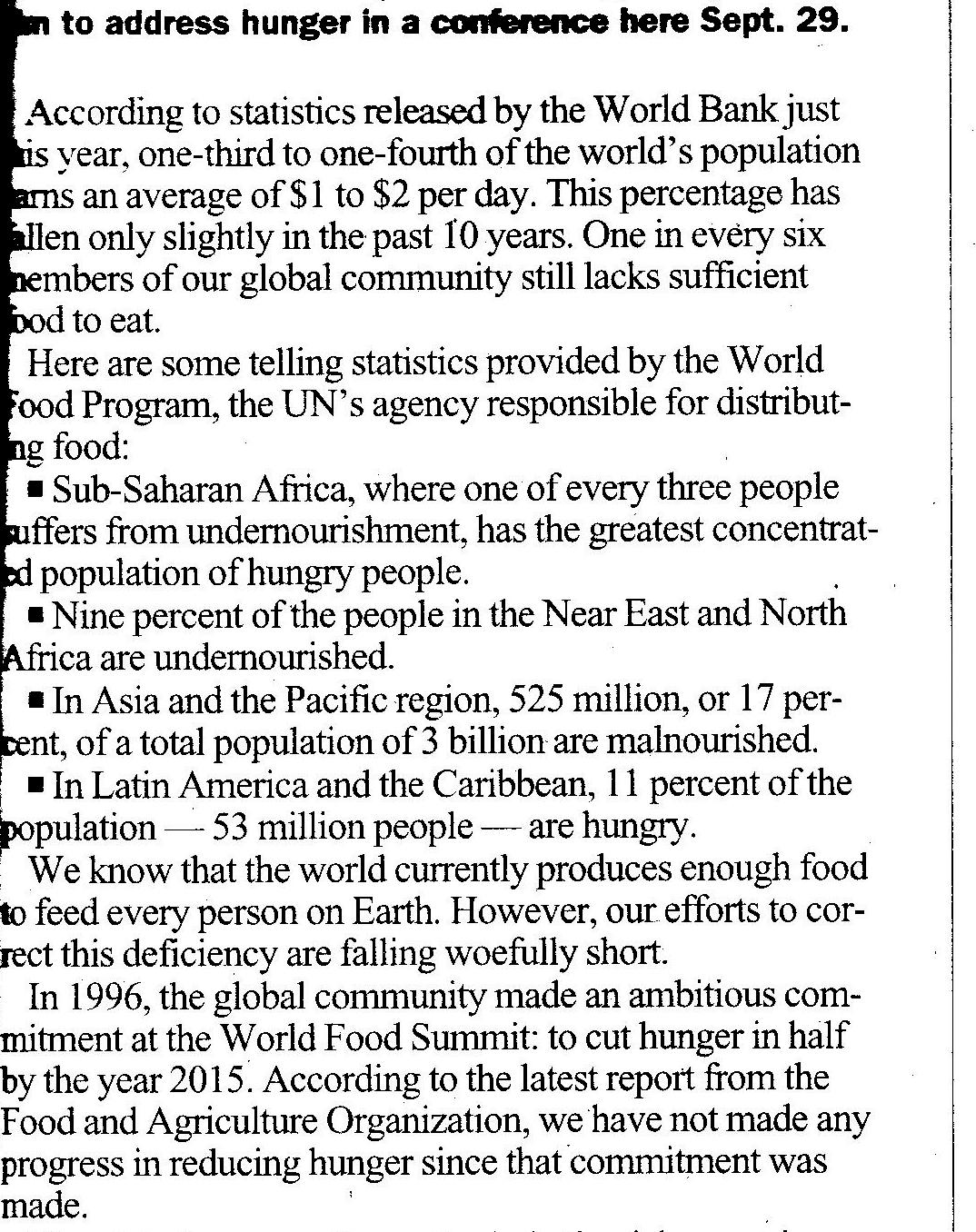
A Hunger Op-Ed Written Fifteen Years Ago in The Albuquerque Tribune

Even though we live in a country with an incredibly high standard of living, there are many in our communities, locally and globally, who do not share in this prosperity. They are nonetheless our neighbors and part of the fabric of our life together, and justice demands that we work both collectively and as individuals to ensure that all people can sufficiently meet the basic needs of life.
Who remembers Albuquerque's now-defunct afternoon newspaper The Albuquerque Tribune? This great newspaper, like many newspapers around the country, was a victim of the changing times: a decline in readership, rising costs and other factors. All of a sudden, there was no room for two newspapers in Albuquerque.

We remember some of the great attributes of "The Trib," including its Insight & Opinion section. For Jack Ehn, editor of this section, the voice of the community was very important. He would often ask representatives of various community organizations to put together Op-Ed pieces on a variety of issues to publish every week.

Here is a piece that Ruth Hoffman of the Lutheran Advocacy Ministry-New Mexico (then called the Lutheran Office of Governmental Ministry, LOGM) wrote exactly 15 years ago, on Sept. 14, 2001. We put together the piece, partly to promote a join conference on hunger sponsored by LOGM and Bread for the World on Sept. 29. The keynote speaker was Rev. Arthur Simon, founder of Bread for the World. Here are scanned images of the piece.


Friday, June 10, 2016

Ruth Hoffman Op-Ed: Human Services Department Could do Better Job

On June 9, the Albuquerque Journal published an opinion piece from Ruth Hoffman, director of the Lutheran Advocacy Ministry-New Mexico, about the state Human Services Department (HSD). The opinion piece was a response to recent and past coverage about how the HSD has not only failed to support low-income residents of New Mexico, but in many cases, prevented assistance from reaching those who deserve and need it. (A former HSD secretary once said "there was no hunger" in New Mexico).

Ruth Hoffman
"Here in New Mexico, we have long struggled with taking care of our most vulnerable families. Recent reports that state workers at the Human Services Department were being pressured into denying emergency SNAP (food stamps) to hungry people and families are very disturbing. For over two decades, a federal court has found HSD’s track record for basic processing of medical and food assistance benefits to be in violation of federal law.

Government is one of the ways that we can work together to address the needs of our communities, and it can make a positive difference in people’s lives. But when government doesn’t work or fails to do its job, it can cause a lot of pain. Just ask a family of four in Hobbs. State workers left them without Medicaid coverage for seven months because HSD had failed to send a renewal notice or to check information the family had already given them.

Or an elderly man from Alamogordo with no income who had his SNAP assistance terminated last August because state workers forgot to send him a legally required notice. After going three weeks without food assistance, his benefits were reinstated, but only after the man went to an Income Support Division office to submit a new application for food assistance.

Whether it involves Medicaid or SNAP, these stories and others point to an unacceptable problem at HSD of improperly denying families needed services and failing to notify recipients about delays. Seniors and low-income families are on their own to figure out how to resolve these issues. Indeed, according to a study by the New Mexico Center on Law and Poverty, HSD failed to send Medicaid clients the required renewal forms 50 percent of the time. Over 65 percent of the time, they failed to alert families about delays in their SNAP applications or about ways to resolve the delays."

Read the full Op-Ed in the Albuquerque Journal

Wednesday, July 22, 2015

Child Poverty in New Mexico Rose to 31 Percent in 2014


 "New Mexico’s child poverty rate was 31 percent, an increase from 29 percent in last year’s Data Book, and the percentage of children living in high-poverty areas increased to 24 percent, up from 22 percent."  -from the 2015 Kids Count Report

It’s disheartening to see New Mexico still ranked so low in child well-being...We’ve made progress in some areas and we’ve gotten worse in others but, when you look at the long-term trends, we’re simply not seeing enough change...,When our children aren’t doing well, it’s an indication that our whole state isn’t doing well. Our future workforce is being shaped now. Poverty really holds children back. We can help kids in poverty reach their full potential, but only if we take intentional action and we take it early...Veronica GarcĆ­a, New Mexico Voices For Children

I'm not a big fan of measuring our demographics and statistics against those of other states. While the comparisons are useful to provide some perspective, the more important measure is comparing our current situation against our past performance. 

If you look at the 2015 Kids Count report from the Annie E. Casey Foundation, you might notice that New Mexico experienced a slight improvement in the overall well-being for children. Our ranking improved to 49th in 2014 from 50th in 2013. And yet, our rate of child poverty increased to 31 percent from 29 percent the previous year.  However, our ranking improved only because conditions got much worse in Mississippi, the state that has the dubious distinction of ranking 50th in the 2015 Kids Count report.  

“Over the last several years we’ve seen 38,000 children fall into poverty in New Mexico. That is simply not acceptable. Poverty has very detrimental effects on children. If we want them to succeed in life—to be the next generation of doctors, entrepreneurs, teachers and leaders—we need to ensure that they have the opportunities that will put them on the right path early in life,” said Veronica C. GarcĆ­a, executive director of New Mexico Voices For Children.  See full statement from organization.

Rather than repeat other findings in the report, I'll pass on the following links

Tuesday, May 26, 2015

Hands Cross America: 29 Years Later

Kansas City held a Hands Across America event in solidarity with the national event
Remember last week's Red Nose Day campaign to raise money for 12 charities that work with children in our country and around the world?

Exactly 29 years ago (plus a day), on May 25, 1986, over 5 million Americans participated in another high-profile campaign. This campaign was not on television, and Facebook, Twitter and other social media did not yet exist.

On that date, participants linked hands to make a 4,125-mile human chain that stretched from New York City to Long Beach, including Albuquerque. Several communities that were not on the route held their own events in solidarity with the main chain.

At the time I was living in Kansas City, which was not on the route of the chain (although our other big city in Missouri--St Louis--was part of the chain).  And the chain went through Albuquerque, where I would eventually end up moving six years later.

Here is how Hands Across America worked: Each volunteer on the chain contributed $10 to $35 for the privilege of joining the line. There were also massive corporate contributions.  Actors Lily Tomlin and Harry Belafonte, Gov. Mario Cuomo, Mayor Ed Koch and Cardinal John O'Connor were part of the link of the chain that started n New York

In New Mexico, organizer Velia Silva said the state needed  50,000 volunteers were needed to make a solid chain across the state but, "calls have been coming in like crazy," said a United Press International article. Among the members of the task force was food activist and author Mark Winne, who is now a resident of Santa Fe, but at that time represented the Harford Food System.

The event not only raised $41 million but increased awareness about the growing problem of hunger in our country and the continuing crises of poverty and lack of food in parts of Africa and around the world (USA for Africa was a lead organizer of the event.

"They weren’t just big hand holding enthusiasts," said the online site Mental Floss on the 25th anniversary of the event. "They were participating in Hands Across America, a massive charity event and fundraiser that hoped to raise money for and draw attention to homelessness and hunger."

So what was the domestic situation regarding hunger in 1986?  According to the House Select Committee on Hunger, 13.9 million, or 41%, of the 33.7 million Americans eligible for food stamps were not receiving this assistance And more than 70% of the 20.4 million who are eligible for the Women, Infants and Children Supplemental (WIC) Feeding Program were not being served.

And who remembers this quote from then President Ronald Reagan? "I don't believe that there is anyone that is going hungry in America simply by reason of denial or lack of ability to feed them," Reagan said. "It is by people not knowing where or how to get this help."

So how do the numbers in 1986 compare with current times? "[Our] 2014 study reveals that each year, the Feeding America network of food banks provides service to 46.5 million people in need across the United States, including 12 million children and 7 million seniors,"  said Feeding America (which in 1986 was called America's Second Harvest). The methodology to address hunger in the US might have differed from 1986, and there are certainly more people aware about the programs.  Regardless, the increase in the numbers of hungry people is threefold in almost 30 years.

So what are politicians saying about hunger in our times? Stay tuned for blog posts about that issue as the presidential campaigns gear up. In the meantime, check out these videos from Barack Obama and Mitt Romney during the 2012 presidential campaigns.

Tuesday, December 02, 2014

Today is #GivingTuesday

Church World Service campaign
The past few days (Black Friday, Small Business Saturday and Cyber Monday) have centered on encouraging holiday purchases. 

Now we have Giving Tuesday before us.  Today, we are encouraged to give financial donations to non-profits that are making a difference in the lives of others. Catholic Relief Services, Oxfam America, Church World Service, and many other organizations feature on their home page the hashtag #GivingTuesday--an opportunity for folks to make a special donation on this day or to commit to buying products or donate a service that will help someone in a poor community across the globe.

The White House has also involved in promoting this day.“Some might choose to volunteer their talent, others might make charitable contributions and still others simply to connect with friends and loved ones. Through millions of online clicks and offline acts, we expect #GivingTuesday will take many forms, but all will be energized by a common impulse to make life better, especially for those in need,”said Jonathan Greenblatt, a Special Assistant to President Barack Obama and the Director of the Office of Social Innovation and Civic Participation.

Some communities around the U.S. and globally have even banded together to offer special #GivingTuesday events, in conjunction with the UN Development Programme

Food Donations are important
Roadrunner Food Bank photo
There is another type of giving that his ongoing today and during the rest of this holiday season, including the box at your local retailer to collect toys for underprivileged children. Then there are efforts to provide food for families in need. Many grocery stores give you the opportunity to acquire a meal for a family. And then there's the barrel at your local grocer, intended for patrons to drop non-perishable foods for the local food bank.

Which brings me to a recent post that was circulating on Facebook in recent weeks. The post was entitled 10 Things that Food Banks Need but Won't Ask For. The suggested list includes spices, feminine products, chocolate, toiletries, canned meats and jerky, crackers and tortillas, baby toiletries, soup packets, socks,canned fruit other than pineapple. The list appears to reflect the types of items needed by the agencies that obtain food from the food banks.

I asked my contacts at two of the largest food banks in New Mexico whether the list is accurate. Here is what they said.

"The non-food items are  hard for us to distribute as we really only deal in food," said said Alissa Barnes, Director of Community Initiatives at Roadrunner Food Bank in Albuquerque. To help donors determine what to give, Roadrunner Food Bank has drafted a list of items that are most needed.

The Food Depot in Santa Fe, which is a smaller operation than Roadrunner, could use almost all the items on the list. "We would happily take anything on that list except socks," said Sherry Hooper, executive director of  the Food Depot.  

"We just purchased some toiletries and have a Diaper Depot, which collects diapers for babies and adults," added Ms. Hooper.

Thursday, October 09, 2014

Attorneys Work to Protect SNAP Benefits for New Mexico Families

Sovereign Hager, Louise Pocock, and Jason Riggs
Sovereign Hager and Louise Pocock, staff attorneys at the New Mexico Center on Law and Poverty, were guest speakers at the October meeting of the Interfaith Hunger Coalition.

Ms Hager and Ms. Pocock specialize in providing support and education and protecting public benefits for New Mexico families, including the Supplemental Nutrition Assistance Program (SNAP), which is a federal program administered by the state government. 

The rules (and rule changes) and red tape required for families to obtain SNAP benefits can be complicated and daunting, and the state government often adds bureaucratic obstacles (sometimes rooted in political idealism).  These obstacles often prevent eligible families from participating in the program. For example, the New Mexico Human Services Department announced plans this past summer to limit food stamps available to adults by expanding mandatory job search requirements to include households with children and work requirements for all childless adults. Food stamps.would be terminated for up to one year for participants who do not comply with mandatory job search and up to three years for those who do not complete 20-hour work week requirements. This makes little sense in a state where unemployment is very high.

A presentation to the Interfaith Hunger Coalition
SNAP and (the lack of) jobs
Ms. Hager and Ms. Pocock provided an overview of the situation in presentation to the Interfaith Hunger Coalition in October. Some of the points that were presented are contained in a briefing paper that NMCLP put together  in August. (The faith community, including coalition member Lutheran Advocacy Ministry-New Mexico and the New Mexico Conference of Catholic Bishops, have also spoken out against the new state directive).

Ms. Hager addressed the issue at the end of  August in an Op-Ed published the Las Cruces News-Sun.

"Contrary to the Department's thinking, however, New Mexico families don't need to be told to find jobs or made to jump through hoops to be sure they are looking for work," wrote Ms. Hager. "They need job opportunities and assistance in making ends meet until a job is available. Research shows that the overwhelming majority of SNAP participants who can work do work. They use the program when a family member loses their job or faces other hardships."

"SNAP participants who are not working do not lead easy lives; 44 percent of participants live in deep poverty, earning less than $12,000 for a family of four," Ms. Hager added in the opinion piece. "Many live in areas like DoƱa Ana County, where unemployment is 7.1 percent, well above the national average and rising. These are the families most affected by the lack of opportunity in New Mexico. These people need jobs, not bureaucratic barriers."   Read Rull Op-Ed 

State tweaks original rule
The HSD and Secretary Sidonie Squier clearly did not consider the unemployment question when issuing the decree, which resulted in a huge outcry. As a partial response a month later, the HSD decided  to make exemptions in communities with high unemployment rates (such as Taos).

In an interview with The Albuquerque Journal in September, Ms. Hager expressed concern about HSD’s ability to administer the new regulations. She alluded to a May ruling by a federal judge that the agency was not processing food and health care benefits in a timely manner.
 
So what happens next? The state is still on schedule to phase in the new regulations on Nov. 1.  And the New Mexico Center on Law and Poverty, with  thesupport of the Interfaith Hunger Coalition and other faith-community groups, will continue to fight the changes proposed  by the state.

"It is certainly not time to make low-income families, their children and local businesses suffer because some policy makers wrongly believe that 27 percent of DoƱa Ana County residents are lazy or irresponsible because they accept food assistance," Ms. Hager said in her Op-Ed in the Las Cruces Sun-News in August. "Let HSD show data that job search and work requirements move SNAP participants into jobs."

Monday, August 25, 2014

National Geographic: The New Face of Hunger in America

Chances are good that if you picture what hunger looks like, you don’t summon an image of someone like Christina Dreier: white, married, clothed, and housed, even a bit overweight. The image of hunger in America today differs markedly from Depression-era images of the gaunt-faced unemployed scavenging for food on urban streets. “This is not your grandmother’s hunger,” says Janet Poppendieck, a sociologist at the City University of New York. “Today more working people and their families are hungry because wages have declined.” -article in National Geographic
 Where do you go to read about hunger in the United States? The Huffington Post? Time magazine? The Christian Science Monitor? The New York Times? Yes. They all have published very good pieces about this unfortunate situation afflicting our country. But did you know that one of the most comprehensive pieces written about the changing trends of hunger here at home was recently published in National Geographic?  It makes total sense. The magazine is not just about geography, culture and anthropology. Sociology and politics are also a big part of its coverage. And hunger in the U.S. is about sociology and public policy. 

We have  linked to other hunger-related pieces in National Geographic, including an article on how Lake Victoria had become clogged with water hyacinths, had severely hampered fishing for local villagers. National Geographic has put together more comprehensive pieces on global hunger, including a comprehensive piece entitled Feeding the World.

National Geographic's latest attempt to look at hunger, via a piece, entitled "The New Face of Hunger," addresses hunger in the United States, specifically the changing demographics of hunger in our country. The study contains very valuable pieces of information, such as a map of the United States illustrating levels of participation in the Supplemental Nutrtion Assistance Program (SNAP), and a video with stories of the newly hungry. Hunger is moving to the suburbs, which we wrote  in a three-part series in July of 2013. (Part 1 covered the book Confronting Suburban Poverty in America, Part 2 looked at the Urban Institute's Mapping Tool, and Part 3 examined hunger in Rio Rancho, N.M.)

"As the face of hunger has changed, so has its address. The town of Spring, Texas, is where ranchland meets Houston’s sprawl, a suburb of curving streets and shade trees and privacy fences. The suburbs are the home of the American dream, but they are also a place where poverty is on the rise. As urban housing has gotten more expensive, the working poor have been pushed out. Today hunger in the suburbs is growing faster than in cities, having more than doubled since 2007."

Tuesday, July 01, 2014

A 'Reverse Food Truck' in Albuquerque?

The food-truck culture has taken root in Albuquerque, thanks in part to a couple of programs supported by the city administration, including Truckin' Tuesdays and 1st Friday Food Trucks  On Tuesdays, residents of the Duke City who work or reside downtown or nearby neighborhoods have options for lunch (11:30 a.m.-1:30 p.m.). Trucks parked on 3rd and Marquette (just north of Civic Plaza) offer German, Caribbean, Japanese, Latin American and other types of food. Most of those  same options are available for dinner on the First Friday of the month on the corner of 1st and Central, starting at 6:00 p.m. Patrons can keep updated on food trucks in the city through a Facebook page entitled ABQ Food Trucks.or through Twitter (handle @ABQFoodTrucks).

A truck that collects, not sells, food
While the food-truck culture is very much a part of the Albuquerque dining scene, the city could use a reverse food truck. What is a "reverse food truck," you ask? In Minneapolis-St. Paul, Finnegan's brewing company has developed a food truck that collects nonperishable food items and cash donations from attendees at events in the greater Minneapolis–St. Paul area.
'Rather than serving food, our food truck does the opposite. It accepts food donations. Think of it as a food drive on wheels.'  -Finnegans
The company launched the  reverse food truck in March of this year through a partnership with the Emergency Foodshelf Network’s Harvest for the Hungry Program in the Twin Cities. The food truck fits well with the company's philosophy. Finnegan's CEO Jacquie Berglund--who previously worked for the Organization for Economic Development and Cooperation (OECD) in Paris, France--made social responsibility a strong component of Finnegan's business since the company was created in 2000. The companyy gives 100% of profits from the sale of two types of beer (Irish amber and blonde ale) to the non-profit community. To date, that has amounted to $100,000.  Read more about the company in a great piece published in the takepart Web site.

So while the City of Albuquerque has done a great job to promote the food trucks that dispense and sell food, wouldn't it be  great to see a public-privave-non-profit effort come together to create a reverse food truck locally?


FINNEGANS - Reverse Food Truck from FINNEGANS on Vimeo.

Tuesday, April 01, 2014

It's Nuts! Why is Good Peanut Butter Going to a New Mexico Landfill?

It's worse than an April Food's joke. It's the foolish reality.

Good food is being thrown away in New Mexico because of a business dispute.  And this is happening at a time when hunger is a huge problem in our state. It all started when the Sunland peanut plant in Portales, N.M., filed for bankruptcy protection late last year. Health violations were a reason behind the economic problems at the facility. There was an impasse when it came to auctioning off assets this year.

Rather than explain the problem in my own words, I'll share comments from the Albuquerque Journal in an editorial published today, entitled "Peanut butter dump hard to swallow in NM."
In a state that ranks No. 1 in child hunger, where 66 percent of public school students qualify for free and reduced-price lunch, where one in five people adjusts their eating patterns because their household lacks money and other resources for food, and 40,000 residents seek help from a free food pantry or food bank every week, it defies logic and compassion to throw 950,000 jars of nut butter – about 25 tons – into the dump.

Yet an impasse between the bankrupt Sunland peanut plant and Costco Wholesale, which supplied the nuts, means all that $2.6 million in peanut butter is landfill filler.
According to various reports, the peanut butter was tested and was found to be fully safe for human consumption   And yet, the editorial points out...
No donating it to food banks or repackaging it for sale to brokers who supply institutions like prisons. Instead, $60,000 will be spent to have the almost million jars hauled to the Curry County landfill in Clovis and covered with dirt. 

And considering New Mexico’s too-close relationship with hunger, that’s a decision that’s impossible to justify. 
When looking at the enormity of hunger in New Mexico, this is a relatively small matter. The Albuquerque Journal should be advocating for structural and economic changes that will address hunger in New Mexico.  That's for another time. For this particular situation, it is right to be indignant about this negligent waste of food.  After all, folks at food banks in the state (and around the country, for that matter) will tell you that peanut butter is one of the items most requested by food pantries and other providers that serve hungry clients,

Read the full editorial  (although this blog post contains the key points of the text). 

Tuesday, February 25, 2014

End Hunger Fast: Britain's 'Circle of Protection' Campaign

Half a million people have visited food banks since last Easter and 5,500 people were admitted to hospital in the for malnutrition last year. One in five mothers report regularly skipping meals to better feed their children, and ever more families are just one unexpected bill away from waking up with empty cupboards. We often hear talk of hard choices. Surely few can be harder than that faced by the tens of thousands of older people who must “heat or eat” each winter, harder than those faced by families who’s wages have stayed flat while food prices have gone up 30% in just five years.
Does this scenario sound familiar? While this situation easily applies to the United States, the description was written specifically about the United Kingdom. These words are part of a letter that a group of Anglican bishops, in partnership with Methodist, United Reform Church and Quaker leaders,wrote to oppose the British government's cuts in safety net programs.

In 2013, British authorities enacted multitude of changes to Britain’s welfare system, including a cap on the level of benefits that people who are employed are eligible to receive. Additionally, job, house and child-related benefits were merged into a single ‘universal credit’ initiative that sharply reduced the entitlements that the country’s lowest-income families are able to obtain.

In an effort reminiscent of the Circle of Protection campaign launched by religious leaders in the United States in 2011., British religious leaders have created  End Hunger Fast during the coming Lenten season and beyond. "On March 5th we will begin a time of fasting while half a million regularly go hungry in Britain," said the letter from the religious leaders, urging the faithful to join them in a fast during Lent.  "We urge those of all faith and none, people of good conscience, to join with us."  Here is the text of the letter

End Hunger Fast logo
"There is an acute moral imperative to act. Hundreds of thousands of people are doing so already, as they set up and support foodbanks across the UK. But this is a national crisis, and one we must rise to," said the campaign Web site. "We call on government to do its part: acting to investigate food markets that are failing, to make sure that work pays, and to ensure that the welfare system provides a robust last line of defence against hunger."

Prime Minister David Cameron disputes that the changes have created the levels of extreme hardship that the bishops suggest. "Mr. Cameron did emphasise his awareness that many families are struggling as a result of the programme, but continually highlighted that the measures were necessary in order to complete the economic recovery of the country and the transformation away from reliance on benefits," said  an article in Money Expert.com

The organizers of End Hunger Fast, point out that Britain is the world's seventh largest economy, and should not be cutting off support for the most vulnerable in society.  are urging the prime minister to take a closer look at the impact of the British government's policies.“We invite the Prime Minister to come and see for himself the foodbanks operating in places like Mansfield, for him to join us in a national day of fasting and reflection on April the 4th, and ultimately asking him to act to prevent the rise of hunger,” said Keith Hebden, End Hunger Fast campaign spokesman and Parish Priest for Mansfield

Tuesday, February 11, 2014

Michael Pollan Interview with Bill Moyers (Part 2)

In Part 1 of this series, we posted excerpts from journalist and author Michael Pollan about food justice in Truthout.  The post also included the first half of an interview of Pollan on the Bill Moyers Journal. We now bring you Part 2 below.  (And here are links to Pollan's interviews on the The Colbert Report (2006) and (2009)Real Time with Bill Maher, TED, and University of California-Davis. Or if you prefer, you can find these links and more on a single site).

Monday, February 10, 2014

Michael Pollan: Our Food is Dishonestly Priced (Plus Part 1 of Interview with Bill Moyers)

“When you buy cheap food, the real costs have been externalized. Those externalized costs have always included labor. It is only the decline over time of the minimum wage in real dollars that’s made the fast food industry possible, along with feedlot agriculture, pharmaceuticals on the farm, pesticides and regulatory forbearance. All these things are part of the answer to the question: Why is that crap so cheap? Our food is dishonestly priced. One of the ways in which it’s dishonestly priced is the fact that people are not paid a living wage to process it, to serve it, to grow it, to slaughter it.” 
-Michael Pollan,
Journalist Michael Pollan has written several thought-provoking books about our society's policies and attitudes toward food and eating. He is the author of In Defense of Food: An Eater’s Manifesto (2008), The Omnivore’s Dilemma: A Natural History of Four Meals (2006) and The Botany of Desire (which as been made into a PBS documentary). Pollan is also a regular contributor to The New York Times Magazine.

In an interview with Amy Dean of Truthout (reprinted by Moyers and Co.), Pollan addressed equitable food pricing, farm worker rights and industrial agriculture’s role in casting the food movement as elitist. In the interview, Dean asked  Pollan about the arguments from opponents of fair wages, who claim that increased farm worker pay will result in higher food prices.
 
 “That argument has been used to thwart all kinds of reform in the food industry,” Pollan replied. “If we clean up our act, in any way, we’re going to have to pay more at the register. There’s a kernel of truth. If you raised the price of wages to people in the food industry to, say, $15 an hour in fast food, no doubt it would add to prices — although the claims of how much it would add to prices are exaggerated. However, those people would be able to afford more. That’s why we need to pay people more so they can afford it. There’s a virtuous circle of paying people more so that they can afford better stuff.” Read full piece on Truthout and on Moyers and Co.

Below is Part 1 of an  interview of Pollan on Bill Moyers Journal, which aired in 2008.  Part 2 will follow in a separate post.  

Wednesday, November 20, 2013

The March on Washington and the Right to Food

Picture from the 50th Anniversary of March of Washington Web site
A litttle over a week ago,  I received an e-mail from my friend and fellow anti-poverty advocate Tom McDermott, a part-time resident Santa Fe. Tom's e-mail message came from Barcelona. The fact that Tom was in Barcelona  is not surprising, since his life's work has involved a lot of travel with the United Nations in Bangladesh, Nigeria, Ghana, Indonesia, Thailand, Sudan, Saudi Arabia, Somalia, India, Pakistan, and Bosnia, and previously with the Peace Corps  in India.

In his e-mail, Tom was passing on an article published in the Huffington Post's blog about the 50th anniversary of  The March on Washington. The  blog post/article, co-authored by Smita Narula and Rev. Jesse Jackson, is entitled A Dream Deferred: The Right to Food in America. "Smita is the daughter of two former UN colleagues. He was head of UNICEF's emergency office and she was the head of the UN Medical Service," said Tom Thought the piece might be of interest."

 Here is an excerpt:

"This year our nation commemorated the fiftieth anniversary of the March on Washington and Dr. Martin Luther King Jr.'s "I Have a Dream" speech, giving us all occasion to reflect on his civil rights aspirations and the extent to which they have been fulfilled. But the persistence of hunger in America today brings to mind Dr. King's other dream -- that of ending poverty and realizing the full spectrum of human rights, including the right to food.

The world over, freedom from hunger and access to sufficient, nutritious food are recognized as human rights. These ideas are not foreign to the United States; they were inspired by our government's commitment to ensuring "freedom from want" in the wake of the Great Depression. Now, more than ever, we must reclaim these values and ensure the right to food for all Americans. 

Last month, the USDA reported that 49 million Americans live in "food insecure" households, meaning they cannot afford adequate food for themselves or their families. In other words, nearly one in six individuals in the richest country in the world is struggling to put food on the table. Hunger in the United States is not the result of a shortage of food or resources -- it is the direct result of poverty perpetuated through policies that fail to prioritize Americans' fundamental needs. 

Read full article

Monday, October 21, 2013

Hunger, Poverty Need Public Policies (Ruth Hoffman's Op-Ed in Albuquerque Journal)

Many in the private and nonprofit sectors, as well as in faith communities, are working hard to address hunger through food banks, meal programs, food pantries and other direct service programs. Among the public programs working to address hunger are SNAP, WIC, school meal and senior meal programs. 

And yet, with all of these private and public efforts, New Mexico still has alarming numbers of people who regularly don’t have access to enough food. 

The private and nonprofit sectors, along with faith communities, will continue their work to help families to meet their food needs but their work alone cannot solve this problem. While public programs and policies are now part of the solution, there is more that public policy makers can do.

Excerpts from an opinion piece written by Ruth Hoffman,  director of the Lutheran Advocacy Ministry-New Mexico. in  the Albuquerque Journal on October 21, 2013

Read full Op-Ed, entitled Hunger, Poverty Need Public Policies 
(If you don't have a subscription, you can still see the full piece by answering a couple of questions from advertisers).

Monday, October 14, 2013

SNAP Cuts (Part 2): A Perspective from Two Members of Congress Who Opposed Drastic Cuts

(Editors Note: This is the second in a series about the ongoing discussions around funding for the Supplemental Nutrition Program. In Part 1, we posted links to Panera CEO Ron Saich's experiences taking the SNAP Challenge)

In a closer-than-expected 217-210 vote in September, the Republican-dominated House stripped $40 billion from the Supplemental Nutrtion Program (SNAP) over a 10-year period. Democratic representatives were united in opposing the drastic reductions to food stamps, but 15 Republicans joined them in casting a Nay Vote.

Here are a couple of perspectives from House members who voted against the cuts, one from Democrat Brad Schneider from Illinois and the other from Republican Jeff Fortenberry of Nebraska.

Brad Schneider (from his Deerflied Patch blog): "During the debate over SNAP cuts, there have been a number of distortions and misleading arguments used. To set the record straight: nearly half of SNAP recipients are children; in Illinois, recipients receive a miniscule $1.55 per meal, $4.65 per day; and more than 90 percent of SNAP recipients are households living below the poverty line."  Schneider represents a district in Illinois that includes rural and suburban communities and small towns.

Jeff Fortenberry: "We do need a broader discussion of social welfare policy reform to move people in vulnerable circumstances into work opportunities more quickly," he said in a piece quoted by the (Lincoln) Journal-Star. "But I do not think this should be done in isolation, targeting the food and hunger programs of this country."

Next: The Faith Perspective

Sunday, October 13, 2013

SNAP Cuts (Part 1): A CEO Takes the SNAP Challenge

I thought I knew a thing or two about hunger. I've met thousands of people who struggle to feed themselves and their families, visited dozens of soup kitchens, food pantries, homeless shelters and food banks, and worked closely with nonprofit organizations in trying to find new ways to end hunger. I really thought I understood the scope of the problem.  But let me tell you something -- I had no clue. My SNAP Challenge last week taught me that merely observing someone else's plight does not hold a candle to consciously altering your habits to better understand what it might be like to live someone else's life.  -Ron Shaich, founder and CEO of Panera Bread
Like dozens of members of Congress and countless other anti-hunger advocates, Ron Saich took the SNAP challenge, living on a food and beverage diet of $4.50 per day. I doubt many CEOs and captains of industry have set aside seven days to attempt to live on the average benefits of those who participate in the food stamp program. For Mr. Shaich, the decision to take the challenge was not as difficult; he was already an advocate of efforts to reduce hunger in our country. The great piece he wrote for CNN about his experience.

Better yet, you can hear from him directly in this video on The Huffington Post.


While the SNAP challenge is about saving vital funding for the food stamp program, the overriding message is that hunger and poverty exist in our country and should not be ignored. As Mr. Saich points out, "the debate we often hear in Washington leads to thinking that the issue can be seen in black or white, right or wrong, good or bad."  

By now, most of us have watched the documentary A Place at the Table  and have seen the reality of how hunger and poverty affects many families in our country. The movie not only exposes the problem, but also suggests that we can find a solution to hunger, malnutrition and poverty if we decide as a country that this should be a priority. "Watching the movie is a good start for people who want to see beyond political talking points about hunger, particularly in how it traces the near-elimination of hunger in America in the 1970s, as well as the increasing societal costs of dealing with food insecurity," Jason Dick wrote in the blog  Roll Call After Dark , which is published by Roll Call, a newspaper that follows the daily decisions of Congress.

Next: A Perspective from two House Members Who Opposed Cuts

Wednesday, October 09, 2013

Dulce Gamboa: Recortes en SNAP Sin Duda Van a Afectar a Comunidad Latina


Bread for the World's associate for Latino relations, Dulce Gamboa, speaks to CNN en EspaƱol about the nearly $40 billion in cuts to SNAP recently passed by the House of Representatives and the impact these cuts would have on the Latino community.

Read the piece she wrote for the Bread Blog