Showing posts with label Vintage Bread. Show all posts

Sunday, September 29, 2019

'An Instrument of the Lord's Peace'

Fifteen years ago, Bread for the World  celebrated its 30th birthday. There were commemorations in Washington and also in communities around the country. 

In 2019, as Bread celebrates its 45th birthday, we remember the special event that we put together 15 years ago.

Jesuit Father Bill Byron, who collaborated with Art Simon in forming Bread for the World in 1974, joined our celebration in Albuquerque in September of 2004.

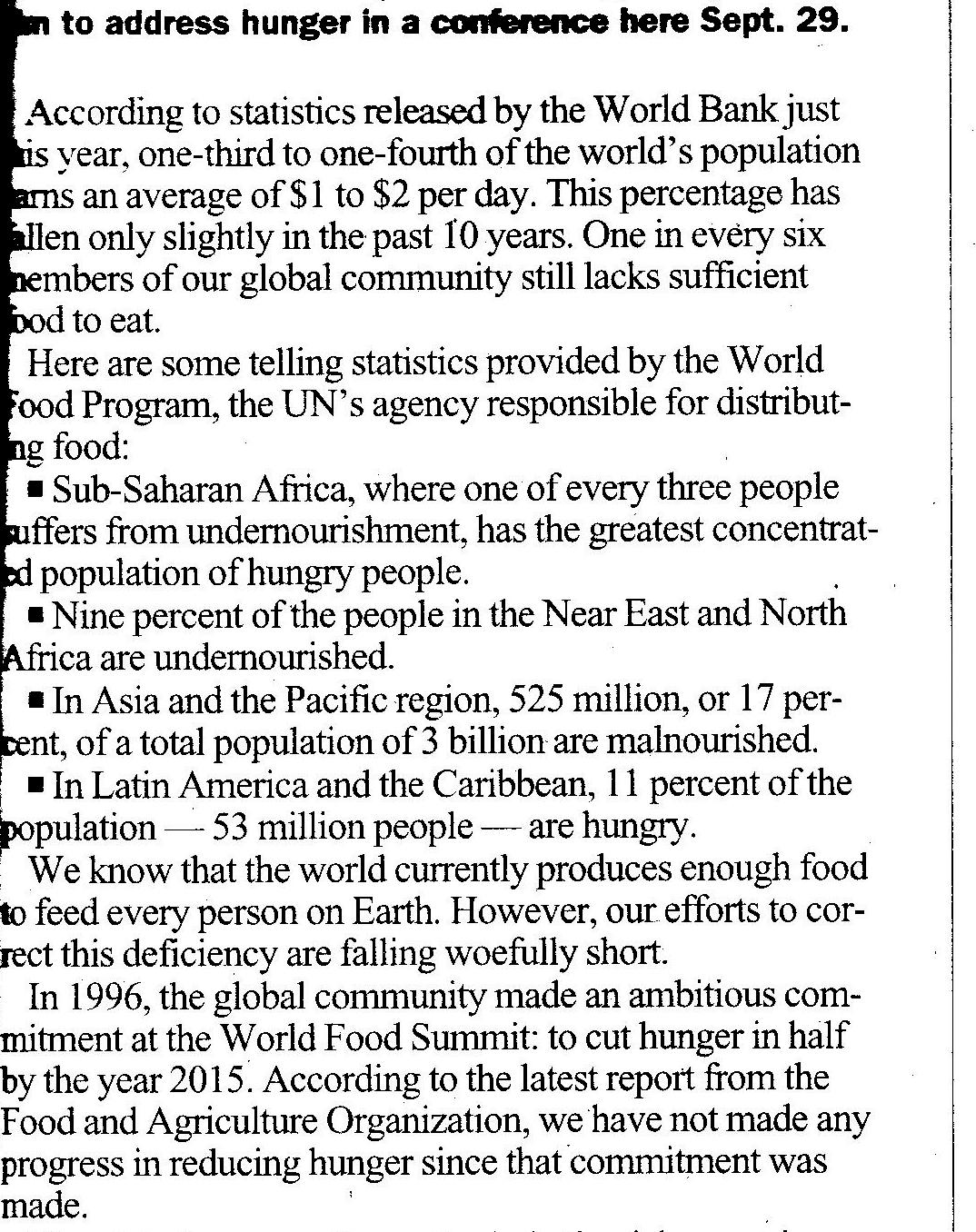
The Albuquerque Journal covered or event, interviewing Rev. Byron.  The full article is pictured in the left.

Here are some excerpts

Albuquerque Journal Reporter Paul Logan: Why does hunger exist in the world? 

Father Bill Byron, S.J.  replies: Because God chooses to work with human hands.

"And humanity's hands, including our own, have not applied themselves effectively to the task of eliminating hunger and balancing the worldwide scales of hunger," 

"Bread for the Word is, I'm convinced, an instrument of the Lord's peace."

In his article, Logan noted the misconceptions among the public that nutrition programs, welfare and foreign aid account for a large portion of the U.S. federal budget. This perception, said Father Byron, creates a challenge and a motivation for people of faith.

"Our legislative adovcacy work will defend against efforts to cut back on nutrition and other programs at home and abroad," said the Jesuit priest.

Celebrating Art Simon on Bread's 45h Birthday
Art and activist Kimball Forrester
Incidentally, on the 45th anniversary of Bread for the World, Art Simon launched his new book Silence Can Kill: Speaking Up to End Hunger and Make Our Economy Work for EveryoneBread members feted the book and Art's lifetime achievements with a modest celebration in Washington this summer.

In an interview with Religion News Service this past August, Simon spoke about the challenge before us to attain the United Nations Sustainable Development Goals established in 2015. The ultimate objective of the 17 goals is to end hunger on the planet by 2030.

"We’ve made tremendous progress in recent decades. But the last few years have actually set us back a little bit. So the goal of the U.N. Sustainable Development Goals, getting us to the end by 2030 — possible but a very steep hill. It will take some extraordinary efforts to make that happen by 2030."

Sunday, October 16, 2016

Writing about the Crisis in Sub-Saharan Africa on World Food Day 2003

Food emergencies are dramatically compounded when large groups of people flee their homes to escape persecution, armed conflict, environmental degradation or famine, often in combination. 

In 2002, the World Food Program's entire $1.2 billion global budget was needed in Africa, largely because of the Ethiopian famine and the political crisis in Zimbabwe.  With escalanting conflicts in Liberia and the Democratic Republic of the Congo and food emergencies in Angola an South Africa, an appalling system of triage has developed. As hunger spreads, crises are weighed against one another, and contributions from donor governments are always behind the curve.
Image adapted from Open Clip Art
Who remembers Albuquerque's now-defunct afternoon newspaper The Albuquerque Tribune? This great newspaper, like many newspapers around the country, was a victim of the changing times: a decline in readership, rising costs and other factors. All of a sudden, there was no room for two newspapers in Albuquerque.

For Jack Ehn, editor of the Insight & Opinion section, the voice of the community was very important. He would often ask representatives of various community organizations to put together Op-Ed pieces on a variety of issues to publish every week.

Here is a joint piece that UNM Prof. Jennifer Moore and I wrote on World Food Day in 2003 Thirteen years ago, we addressed the famine in Ethiopia, a political crisis in Zimbabwe, and a refugee crisis in sub-Saharan Africa. "The needs of sub-Saharan Africa will be best served if we come together as a global community to find long-term solutions to multiple problems in the region," we said in the Op-Ed piece.

So has the situation changed in 2016?  Famine subsided in Ethiopia, but climate change and drought have once again put the East African country in peril. Zimbabwe remains in a state of economic and political crisis. What about the refugee situtation?  This piece in The Washington Post sheds light on the most recent refugee crisis in sub-Saharan Africa where refugees are fleeing from dire conditions in their country to dangerous places. According to the report,  43,000 South Sudanese refugees have fled to Darfur and 100,000 Ethiopians and Somalis traveled by boat to Yemen, and nearly 5,000 citizens of Congo were seeking refuge in the Central African Republic.

So let's repeat what we said in 2003.  "The needs of sub-Saharan Africa will be best served if we come together as a global community to find long-term solutions to multiple problems in the region.

Here is the Op-Ed that Jenny and I wrote in 2003. 


Saturday, October 15, 2016

Peace Pilgrimage Lay the Groundwork for Other Interfaith Work

Communities of faith have banded together in Albuquerque and Santa Fe on a variety of issues, including climate and environment concerns (New Mexico Interfaith Power & Light), immigration and refugees (New Mexico Faith Coalition for Immigrant Justice), networking and dialogue (Interfaith Dialogue), community issues (Albuquerque Interfaith), worker rights (Interfaith Worker Justice-New Mexico), local social justice issues (Santa Fe Interfaith Leadership Alliance), and hunger and poverty in New Mexico (Interfaith Hunger Coalition).

All of us owe a debt of gratitude to the late John Leahigh, then a deacon at St. Charles Borromeo Parish in Albuquerque, who set the stage for us in the 1980s and 1990s. Every year, John and his wife Joan worked with the Interfaith Council of Albuquerque to bring people of faith and conscience for a peace pilgrimage in Chimayó and Los Alamos.

San Juan Pueblo singers at Ashley Pond in Los Alamos
Starting at Santuraio de Chimayó
The event included participants of several Christian and Jewish traditions from Albuquerque, Santa Fe and nearby communities and members of San Juan, San Ildefonso and other Pueblo communities, who came together at the Santuario de Chimayo, a site that is holy for Catholic and Christian pilgrims on Good Friday.

The starting point at Chimayó was significant.  In addition to the annual Christian pilgrimage at the end of Holy Week, this is the site where people from all over the world come to gather samples of dirt for physical and spiritual healing. Spaniards built the shrine in 1813 on a site that the nearby Pueblo communities already considered holy ground.

The morning always featured an interfaith celebration with prayers, songs anda variety of breads  (a symbol of communion among our faith traditions and cultures). There was also a Mass, sometimes presided by then Bishop Donald Pelotte of Gallup (a member of Pax Christi).

 'A prayer, not a protest' in Los Alamos
After the morning events in Chimayó, participants would then walk, run or ride a bus from Chimayó to Los Alamos, a location that is home to the national labs that manufacture nuclear weapons. Pilgrims would gather together in a prayer circle at Ashley Pond and then and listen to prominent speakers, including Helen Prejean and others. "We will journey more in peace than in protest," Leahigh told The Springer-News Bulletin in 1987. "Runners will carry soil from the Santuario de Chimayó and the flame."
Beginning outdoors with an interfaith celeration
Leahigh also helped us plan an anti-hunger  conference in 1994 co-sponsored by Bread for the World and the Lutheran Office of Govermental Ministry (now the Lutheran Advocacy Ministry). The featured speaker at the event was Bread for the World President David Beckmann.

While Leahigh did a lot of the direct organizing and planning work on the pilgrimage, his wife Joan would handle a lot of the behind-the-scenes tasks. At that time, Joan was the director of the social justice office (now the office of Social Justice and Respect Life) at the Archdiocese of Santa Fe.  John passed away in 2001 and Joan in 2007. 

Pilgrims in Chimayó
The pilgrimage does not take place any more, as no one stepped up to take on the extensive organizing roles that John and Joan played in putting together this annual event.

On this weekend in 2016, when the New Mexico Interfaith Power and Light and the Interfaith Hunger Coalition have brought together members of Jewish, Christian, Muslim, Budhhist, Hindu, Baha'i, Sikh, Native American traditions to commemorate World Food Day, we remember John and Joan Leahigh, who showed us by example and deed that different faith communities can work together on issues that are common and important to all of us.

Wednesday, September 14, 2016

A Hunger Op-Ed Written Fifteen Years Ago in The Albuquerque Tribune

Even though we live in a country with an incredibly high standard of living, there are many in our communities, locally and globally, who do not share in this prosperity. They are nonetheless our neighbors and part of the fabric of our life together, and justice demands that we work both collectively and as individuals to ensure that all people can sufficiently meet the basic needs of life.
Who remembers Albuquerque's now-defunct afternoon newspaper The Albuquerque Tribune? This great newspaper, like many newspapers around the country, was a victim of the changing times: a decline in readership, rising costs and other factors. All of a sudden, there was no room for two newspapers in Albuquerque.

We remember some of the great attributes of "The Trib," including its Insight & Opinion section. For Jack Ehn, editor of this section, the voice of the community was very important. He would often ask representatives of various community organizations to put together Op-Ed pieces on a variety of issues to publish every week.

Here is a piece that Ruth Hoffman of the Lutheran Advocacy Ministry-New Mexico (then called the Lutheran Office of Governmental Ministry, LOGM) wrote exactly 15 years ago, on Sept. 14, 2001. We put together the piece, partly to promote a join conference on hunger sponsored by LOGM and Bread for the World on Sept. 29. The keynote speaker was Rev. Arthur Simon, founder of Bread for the World. Here are scanned images of the piece.


Friday, September 26, 2014

For Bread for the World members in New Mexico, 40 is Also Really 30

Local members celebrated Bread's 20th birthday in 1995
You might have seen reports that 50 is America's favorite age. And some entertainers and other prominent personalities  have gone as far as to suggest that 50 is the new 30. Bread for the World is not quite 50 yet, but our beloved organization turned 40 this year. And I wouldn't try to make Bread any younger! Our milestone birthday means that we have a 40-year track record of advocating for policies to reduce hunger and poverty in our country and around the world. That is really a major source of pride!

A state coordinator in 1984
Brother Jim Brown at local 35th anniversary celebration
For Bread for the World members in New Mexico, however, 40 is really 30. In this case, we are celebrating both 40 and 30 (and not 30 instead of 40). You might not know that Bread for the World has been around in New Mexico for at least 30 years. There were Bread members here since the the 1970s, but 1984 was the first year we had any organized presence. Jim Brown, a member of the Christian Brothers from Santa Fe, agreed  to coordinate Bread activities shortly after he returned to New Mexico from Louisiana in 1984. In this role, Brother Jim encouraged groups in New Mexico to communicate and gather where possible. (That was a more difficult task in the days before Smartphones, Facebook and the current sophisticated versions of email).

An organized group in Albuquerque in 1989
Howard Corry (third from left) moderated candidate forum
The first recorded organized gathering of Bread members in Albuquerque took place on Saturday morning, April 15, 1989, when a group  of Bread members decided to form a chapter in the First Congressional District. According  to Lutheran Campus Pastor Howard Corry, a former campus pastor at the University of New Mexico and the first district coordinator for the Albuquerque area, local members started to gather monthly at Central United Methodist Church to write letters and discuss Bread-related issues. The meetings were  a launching point for an even more important task. " Everyone was urged to get their local church to conduct an offering of letters," said Rev. Corry.

Please join us on Saturday, October 25, to learn more (and see pictures) of how Bread for the World evolved in Albuquerque and elsewhere in New Mexico since 1984 and 1989. Below are details of our event, which like the national celebration in June will also highlight the Bread Rising campaign.  Please be sure  to register.


    Bread Rising 40th Anniversary Booklet

       Mark Your Calendars!
Bread Rising in New Mexico
Saturday, October 25
St. Andrew Presbyterian Church
5301 Ponderosa Ave. NE (Map)
3:30 p.m.

Click Here to Register 

Program
Prelude Song: Bread for the World (by Marty Haugen)
Welcome- Patty Emord (St. Andrew Presbyterian Church)

Call to Prayer  Rev. Gene Gries (Norbertine Community)
Song: Praise God from Whom All Blessings Flow

Bread History/Flickr Slide Show -Carlos Navarro
Song: Pan de Vida

Reflection on Pray
Isaiah 55:6-11
Anne Morawski  (Luther House)
An Invitation to Continue to Pray
 (David Miner, Bread board member from Indianapolis)
Song Prayer of St. Francis

Reflection on Act
Matthew 25:34-40
[With contributions from Brother Jim Brown (Christian Brothers) and others]
An Invitation to Continue to Act
Ellen Buelow (Our Lady of the Most Holy Rosary Catholic Community)
Song Here I Am

Reflection on Give
Luke 9:12-17
John Foley (Mesa View United Methodist Church)
An Invitation to Continue to Give
Joanne Nazarian (Bread Staff)
Song: Now Thank We All Our God 

Reflection on Looking Forward/Ending Hunger by 2030
Psalm 145
Erik Medina (First Congregational Church)
Song: Lift Every Voice  and Sing

Closing Song Bread for the World (by Marty Haugen) 

Benediction: Karen Cobb (St. Michael and All Angels Episcopal Church)

Short Reception

(Musicians: Rev. Steve Miller, Terese Bridges, Erik Medina, Sister Joan Brown and others) 

Saturday, June 14, 2014

A Collage of Bread for the World Birthday Celebrations

Cake courtesy of  Beth Nygaard
Just Past the Teen Years
I have celebrated a handful of Bread for the World birthdays over the years.The first one was very low key, and it was not in Washington but in Albuquerque. As part of our joint conference with the Lutheran Office of Governmental Ministry (which is now Lutheran Advocacy Ministry-New Mexico), we decided to observe Bread's 20th birthday with a cake. We honored many long-time Bread members, including Brother Jim Brown, who had been a Bread member since the organization was founded. David Beckmann, who was relatively new to Bread at the time, gave the keynote address.

Hunger Heroes (Photo Bread for the World)
At Age 30: The Hunger Heroes
Fast forward 10 years to Bread 's 30th birthday. This is one of the most memorable ones for me personally.  I was among one of 30 hunger heroes who were honored that year. How awesome to have one's name mentioned in the same breath as Bono, George McGovern, and Bob Dole.? Alas, none of those VIPs was there. But it was truly awesome to share the day with Bread co-founder Bill Byron, S.J., and fellow advocates Elaine VanCleave, Cathy Brechtelsbauer and Ed Payne.

And we had our own 30th birthday celebration in Albuquerque that year, and Father Bill Byron was gracious enough to join us at Immanuel Presbyterian Church. He delivered a wonderful keynote address. This celebration was a joint activity with the New Mexico Conference of Churches.


Marty Haugen sings to Bread
A Song for Bread on its 35th
One of the highlights of Bread's 35th birthday was the presence of. singer-composer Marty Haugen wrote a special song in honor of Bread for the World. And  Bill Moyers (who couldn't be with us in person) spoke to us via a recoded message.  And we honored two anti-hunger, anti-poverty advocates who helped build up Bread: former board members Maria Otero and Eleanor Crook. These types of milestone celebrations also offer opportunities for a reunion.  Among the folks I saw were ex-government relations director Barbara Howell and former organizer Bob Schminkey.


Participants Welcomed
A Bread Rising Campaign for the 40th
Which brings me to Bread's 40th birthday. This celebration is fresh on my mind because it just happened less than a week ago. And a prominent individual joined us for this celebration: travel writer and television host Rick Steves. A big highlight was the opportunity to hear Bread for the World founder Art Simon.  Even though I see him often at Bread board meetings, it's always very good to hear his input on the ways that the organization has remained true to its core mission and yet adapted to modern realities over the past 40 years.

Another highlight was the opening sermon by my friend Derick Dailey, who set the tone for the gathering with a wonderful reflection. And, again, it was a time for reunions. I saw Kim Bobo, one of Bread's first directors of organizing. I hadn't seen her since the 1980s!   (We hope to have our own Bread 40th birthday celebration n Albuquerque sometime this fall. More info to come soon)

What makes this year's birthday celebration important is that it marked the launch of our new campaign Bread Rising: Working Together to End Hunger by 2030.  There are three components to the campaign:
  • Pray -Commit yourself to ongoing prayer for the end of hunger
  • Act -Redouble your commitment ot adovacy
  • Give- Provide the resources to leverage big changes
(Stay tuned for more specific information)

Rather than spend a lot of words describing the gathering, I would like to share a handful of pictures here.  (And feel free to view my album on Facebook via this link. You do not have to have a FB connection with me to view the album).

Rick Steves & board chair Sandra Joireman


Timeline 1974-2014
Advocates Megan Marsh & Derick Dailey
Daniel Erdman, Ellen Buelow, Carlos Navarro, Larry Buelow, David Beckmann

Monday, May 19, 2014

Searching for Bread for the World--and Finding a (gasp!) Cassette Tape!

Display, National Workshop on Christian Unity-Albuquerque
Our display table at the National Workshop on Christian Unity conference in Albuquerque at the end of April was overflowing with materials from Bread for the World. We got many compliments on the variety of topics that we had on display, including  The 1,000 Days Toolkit, the Biblical Basis for Advocacy, Offering of Letters 2014 bulletin inserts, Discussion Guide: How a Global Network of Farmers Can Help End Hunger, and much more. 

These are among the hundreds of great materials that Bread for the World and the Bread for the World Institute have published over the past 40 years. We've seen many brochures, books, reports, booklets and other informational items.  One of my favorites is this brochure from the 1980s.


Bread's Identity
To commemorate Bread for the World's 40th birthday, I decide to conduct a search of  materials that that helped shape the organization and its mission and gave the movement its identity. Would you believe those early materials are found a libraries around the country? Many of these libraries are located at universities and seminaries, but sometimes you can find Bread publications and cassette tapes (what are those???) at public or private libraries.

To assist me with the search I used the online library research site OCLC WorldCat, which connects you to the collections and services of more than 10,000 libraries worldwide. WorldCat libraries are dedicated to providing access to their resources on the Web, where most people start their search for information.  To conduct an effective search, I created a free account

I started by conducting an Advanced search with the key word Bread for the World, for the period between 1974 and 2014. I found a lot of good material, but first I had to sift among more than 11,000 entries, and the overwhelming majority were not directly relevant to Bread for the World.  Since most of us are already familiar with the last decade of Bread's history, I focused this search on the first 20-30 years. The searches for the early years turned up items like Eat Less Bread, a poster used in a campaign by the Ministry of Food in Britain designed to encourage the populace to respect food rationing during World War I.

The first relevant entry  was not produced by Bread, but was a general resource guide entitled Who's involved with hunger : an organization guide, published by the American Freedom from Hunger Foundation and World Hunger Education Service, ©1976-

The next entry was  the very first edition of Bread for the World, the book that introduced people of faith around the country to the mission of our ourganization. The book was given to anyone who became a Bread for the World member and/or donated to the organization.  This particular copy is found at the Mennonite Historical Library in Goshen College (Goshen, IN)

Art Simon visits Kansas City in 1980s
A Sampling of Other Findings
I selected the items in this sampling at random.  There are many, many more entries. (I included some photos from my personal collection or from other long-time Bread members in this post)

 1. (1977) Feeding the Hungry, an audio cassette, featuring Bread for the World founder Art Simon. "Lecture describes the work of  Bread for the World and confronts Christians with their responsibility to the hungry people of the world. you're looking for a good way to celebrate the work of your beloved organization."  The session was recorded during the Christian Life Commission Seminar on "Priorities" held in Jackson, MS, on March 21-23, 1977.  The cassette is found at SBTS Library James P. Boyce Centennial Library (Louisville, KY) and Clear Creek Baptist Bible College Brooks Memorial Library (Pineville, KY)

2. (1978)  Lord, make us hungry -- : make us bread. by Bread for the World (Organization); Book Found at United Library (Evanston, IL), and Gordon-Conwell Theological Seminary Goddard Library (South Hamilton, MA)

Bread banner at Indianapolis CROP Walk in 1980
3. (1980) When I Was Hungry. A Hunger Course for High School Students. Teacher's Manual [and] Action Packet. by Washington DC Bread for the World Educational Fund,

Designed to accompany a student activity packet on issues related to world hunger, this teacher's manual provides 12 units of study at the high school level. Materials are presented from a Christian perspective. Found at Baylor University Libraries Moody Memorial Library (Waco, TX)


 4. (no year provided)  Bread for the world in Louisiana Author: Bread for the World (Organization). New Orleans Chapter. Journal, magazine : Periodical : English Found at Wisconsin Historical Society ( Madison, WI)

5. (1982) The ministry of Bread for the World, Kathy Guy; Seminary Consortium for Urban Pastoral Education. Audiobook on Cassette
Stahlstown, PA : Thompson Media, 1982
Found at North Park University Brandel Library (Chicago)

6.  (1982) The Causes of world hunger,
Father Byron in Albuquerque
William J Byron (a Jesuit who collaborated with Art Simon to create Bread for the World)  Publisher: New York : Paulist Press, ©1982. Found at University of New Mexico (Albuquerque, NM), Eastern New Mexico University (Portales, NM), Wayland Baptist University (Plainview, TX) Texas Tech University (Lubbock, TX), Denver Seminary Carey S. Thomas Library (Littleton, CO), Iliff School of Theology (Denver, CO).

7. Bread for the World newsletter.
(1989- ) Found at  Southwestern Baptist Theological Seminary- Roberts Library (Ft Worth, TX), Fuller Theological Seminary Library (Pasadena, CA), University of California-Santa Barbara, Luther Seminary Library (St. Paul, MN), Bethel Seminary Library (St. Paul, MN), Wartburg Theological Seminary (Dubuque,IA)
Second entry (1994- )  Found at Fuller Theological Seminary Library (Pasadena, CA); Lutheran Theological Seminary (Gettysburg, PA), and University of Connecticut (Storrs, CT)

8.(1987) Lazarus : Bread for the world's musical on hunger and poverty Author: Joel Underwood; Samuel Vance Nickels; Louise F Carlson [Washington, D.C.] : Bread for the World Educational Fund, ©1987. Found at Messiah College-Murray Library (Mechanicsburg, PA) 

9. (1987) Hunger in a land of plenty : a study and action guide. Washington, D. C. : Bread for the World Educational Fund, ©1987. Found at United Library (Evanston, IL), and Columbia University Libraries (New York, NY)

10. Bread for the World Institute's Hunger Reports 

Author: Bread for the World (Organization). Institute on Hunger & Development.
Hunger 1990
Hunger 1992 : second annual report on the state of world hunger : ideas that work.  
Hunger 1993 : uprooted people : third annual report on the state of world hunger.
Hunger 1994 : transforming the politics of hunger : fourth annual report on the state of world hunger.

Some of the libraries where the report might be found:  Baylor University Libraries (Waco, TX) University of Texas Libraries (Austin, TX) Claremont School of Theology Library (Pasadena, CA), University of Nebraska (Lincoln, NE) University of California-Los Angeles, Kansas City, Kansas, Community College, University of Colorado (Boulder, CO), Dixie State University (St. George, UT), University of Oklahoma (Norman, OK), Bethel College (North Newton, KS), University of Arizona Libraries (Tucson, AZ)

Social Media and Information Flows 

Back in the 1970s and 1980s, the early days of Bread for the World, there was almost no social media and the Internet was in its infancy  So printed materials were extremely important.  We used audio and video back then.  I remember having to make sure that the image on the film strip matched the audio on the cassette tape on a presentation about Bread for the World narrated by Steve Allen.  And yet, in these days of tweeting, blogging, instagramming, blogging and downloading from Web sites, we still rely significantly on printed materials and audio and video.

The difference is that we now get the information that we need now instantly, allowing us to take immediate actions. Even when we access information online for research or as a tool for our worship or other activities, we rely on something that is written and (semi-permanent).

Sometimes it's more useful to have a printed copy. It's still more useful to have a booklet and bulletin inserts for an Offering of Letters. A case in point is the Bread for the World Institute's Hunger Report. The report is available for downloading (in PDF format) on the Institute's Web pages. But it is a different and more complete experience to read a hard copy of the report.  There is a different appreciation of the interaction between the narrative, the pictures and the data tables. 

Wednesday, November 21, 2012

Remembering Bread New Mexico Advocate Laura Richard

Paul and Laura Richard at Bread picnic in Bataan Park in Albuquerque
Paul and Laura Richard were among the first Bread for the World advocates I met when we moved to New Mexico in 1992.  Not only were they regulars at the monthly meetings we had back in the 1990s, but also participated in special activities, such as the Bread for the World picnic at Bataan Park.  (The above picture was taken at the picnic).

Laura and Paul were also very dedicated to the fight against hunger and poverty at the state level, as evidenced by their strong involvement with New Mexico Lutheran Office for Governmental Ministry, (LOGM), which is now the Lutheran Advocacy Ministry, (LAM).


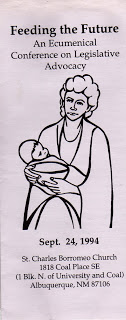
The Richards  used their joint involvement in Bread and LOGM to help us plan a great joint conference in 1994, which featured Bread President David Beckmann and Father Richard Rohr of the Center for Action and Contemplation.  Laura and Paul conceived of the title for the conference (Feeding the Future) and helped design the brochure.  Our planning team consisted of then LOGM director Nima Ward, LOGM volunteer Steve Werner,  and Paul and Laura. 

After a few years, Paul and Laura left our community for Colorado and lived there many years before returning to Taos, in northern New Mexico.   

As Thanksgiving approaches, I would like to offer thanks for having known  Laura.   It was with great sadness that I recently learned about Laura's death in April of this year from injuries sustained in a motorcyle accident up in Taos.  Here is an obituary from The Canyon Courier

Paul still lives in Taos.  Let me know if you would like to drop him a note, and I'll send you his e-mail address.

Sunday, November 11, 2012

Jack Nelson Pallmeyer: Existence of Hunger, Poverty a Sign of a Deep Spiritual Crisis

Author and theologian Jack Nelson-Pallmeyer was the keynote speaker at a conference sponsored jointly by the Lutheran Office of Governmental Ministry (now Lutheran Advocacy Ministry) and Bread for the World New Mexico exactly 17 years ago.  Here are some excerpts from his thought-provoking address on November 11, 1995.  Even though he made these comments almost two deacades ago, they are more relevant than ever in today's political environment.

Chatting with conference participants

To ground us Biblically I want to share a few points.

I've always found the Biblical writers very helpful in reminding us that hunger and poverty are signs of a dual crisis.  From a Biblical perspective, the existence of hunger and poverty are signs that economies aren't functioning, but they're also signs of a deep spiritual crisis.  I think that we can say with confidence in our present setting in this country that we are in a midst of an economic and spiritual crisis.

Hunger is an indictment of our faith, it's an indictment of our politics, it's an indictment of our economic priorities. Hunger is like the biggest signpost most brightly lit that you've ever seen, screaming at us.  What it's screaming at us to do is to rethink everything.  It's my own view that Newt Gingrich and the politics of meanness won't save us.  That Bill Clinton won't save us.  That Colin Powell won't save us.  The crisis is much, much deeper than that.

The third brief point is also grounded in the Bible, and this is very important for us living in this country right.  The way that we're to judge whether or not an economic system is working is based on what is happening to the poor, not on what is happening to the rich.  It's on what is happening to the most vulnerable in the society, not on what's happening at the stock market level--what's happening in therms of income gains for a few.  So our lens as people of faith is a different lens, and it's one that we must bring to the public debate.
Hunger is like the biggest signpost most brightly lit that you've ever seen, screaming at us.  What it's screaming at us to do is to rethink everything. 
Human beings are created by God as part of the created order.  We are part of and responsible to the broader creation.  And this has all kinds of implications.  Our economic systems and priorities and personal choices must all be evaluated on whether or not they contributed to present justice as well as the viability of life on the planet in the future.  So we should be asking ourselves questions like these: Is how we've organized our  economic and political life good for the people? Is it empowering to the poorDoes it break down inequalities Does it shatter the cycles of poverty and despairIs it sustainable? Do the economic policies and priorities and visions we have leave space for the future? Do they renew the Earth, or do they in fact, contribute to the Earth's destruction?  Is the way we organize economic life, and the political choices we are making, offer hope and possibility of a different future?

A fifth Biblical grounding point for me is that we should ask if our assumptions of economic life contribute or block authentic spirituality.   What is our vision of economic life?  What is the promise? What are all the goods and services that we produce setting out to do?  Let me offer you a quote from Victor LeBeau, retail analyst after World War II, laying out the foundations of our society, determined by market morality.   He said: "Our enormously productive economy demands that we make consumption our way of life, that we convert the buying and use of goods into rituals, that we seek our spiritual satisfaction, our ego satisfaction in consumption. We need things consumed, burned up, worn out, replaced and discarded at an ever increasing rate."  Do our very assumptions of life and economic life contribute to an authentic spirituality, or do they lead us down paths that promise and promise and promise, and fail to deliver on almost every count?

One of the themes that you'll pick up in my talk this morning is that the transformations that are called for in our time are very deep and very profound,. 

Saturday, September 22, 2012

Eighteen Years Ago, Father Richard Rohr Said....

It was exactly 18 years ago, on Sept. 22, 1994, when Bread for the World and the Lutheran Office of Governmental Ministry (now called the Lutheran Adocacy Ministry) co-sponsored a great conference. (Thanks to great technical work from Bread member Mike Sims, we have the audio preserved on a cassette tape).

A few weeks ago, I reprinted comments from Bread for the World President David Beckmann from that same conference. Now, I would like to share a few words from Father Richard Rohr from that same event. (This is only an excerpt of his full talk, which lasted about one hour). 

Three Levels of Ministry
We've always said to our folks at the Center for Action and Contemplation that there are three levels of social ministry.  

First there's that hands-on level, that soup kitchen level--people who are clearly gifted to make eye contact and heart contact with the person right in front of you.  The Mother Teresas of this world, if you will.  The people who know how to let the flow happen immediately between them and other people.

The second level is what I call the healing, the teaching, the rehabilitation of persons--helping people learn how to survive, helping people to overcome that tension, that tragedy, that dark side, within. 

And thirdly, there are those who are gifted and called to the advocacy and change of systems
"I believe people at the third stage are quite simply building a dam to stop the swollen stream--building a dam against the "corrupt, dirty rotten system," as Dorothy Day called it--so it would stop drowning and destroying people.
The important thing, brothers and sisters, is that all three of those levels of social ministry in the church--and I believe that every good parish has to have some who represent all three--is that those people at the different levels respect and honor and reverence one another, and that none of them say, "I am the whole Christ...I am the eye, and I don't need the hand. I am the foot, and I don't need the ear."

The swollen stream
And all of us must recognize what I believe is a much more humble position, that most are one little part of the body.  I guess we can call the hands-on people the ones who are picking people out of the swollen stream.  The pain is right in front of you, and there is no time to ask who is worthy and who is unworthy.  The important thing is that the heart be opened and converted to see Christ is in the least  of the brothers and sisters.  There are some many Bread for the World people who are precisely those kind of people, who stopped asking the question of worthiness and merit, which only leads to ego and control.  

There's s a second group of people who aren't picking them out of the stream.  They're helping people how to survive in the swollen stream by teaching them how to swim, teaching them how to build boats, how to float, or maybe throwing other people life preservers. These are people involved in education, in medical care, in affirmation skills.  I work here at the jail with several people who spend the whole week doing just that--teaching those guys and gals that they are reflective of the divine image.  A lot of the past ministry of the church was very much on that second level.  We thought that by educating people, by giving people a sense of themselves, they would not be eaten up by the pain and the sin and the self-hatred of this world.  

What we've come to recognize in the last 20 years especially is that third level.  It still does not have for many people, the kind of credibility that it should have among Christian people.  For many folks, especially good middle class Christian folks, they still think that those who work for advocacy and legislative change are somehow tainted into "dirty politics" and are somehow involved where Jesus was not involved.

I believe people at the third stage are quite simply building a dam to stop the swollen stream--building a dam against the "corrupt, dirty rotten system," as Dorothy Day called it--so it would stop drowning and destroying people.  We have to admit that the least amount of people are gifted and qualified to work at that level.  It takes special skills, it takes special self-confidence, it takes a special kind of extroversion to learn how to work at that third level.  

What I think what is so wonderful about a day like today is that you're people who are willing to address legislative advocacy.  And how can we work for change at that level?  How can we build some dams, so that we don't just keep doing this mop-up work.

I'm so grateful for folks like you, who are willing to say, "How can we change the name of the question itself?" And therefore, hopefully, change a bit of the answer.  

Monday, August 13, 2012

David Beckmann's Visit to Albuquerque in 1994


Almost  18 years ago, in September of 1994, Bread for the World President David Beckmann was a featured speaker at a joint conference we organized with the New Mexico Lutheran Office of Governmental Ministry, or LOGM, (now Lutheran Advocacy Ministry, or LAM).

David Beckmann & Richard Rohr
The other featured speaker was Father Richard Rohr, a Franciscan priest who founded the Center for Action and Contemplation in Albuquerque.  Emily Bauermaister Abbott was our Bread regional organizer, and I had recently taken the grassroots leadership role in Albuquerque from Rev. Howard Corry, Lutheran campus pastor at the University of New Mexico.  Nima Ward was the LOGM director. Ruth Hoffman has since replaced her as director of this very effective state legislative adovcacy organization.

David Beckmann talks to KOB-TV
I can't remember how many people attended, but my guess is that we must have had at least 100 participants, and possibly more.  Most were from Albuquerque, but some folks drove here from Santa Fe, Farmington and Las Cruces.

We put together several great workshops on very interesting topics, including migrant worker rights, world hunger, advocacy, etc..

Our team did such a good job promoting the conference that the local NBC affiliate, KOB-TV, came out to interview David for the early newscast on Saturday afternoon.

I happened to find a cassette tape (YES, a CASSETTE TAPE!) with David's keynote address during lunch.

Below is an excerpt from September 24, 1994.
I've been struck that Bread for the World in New Mexico has had a real influence on your delegation.  On this year's main campaign, A Child is Waiting, which is a campaign to get guaranteed full funding for the WIC program as part of health care reform, Sen. Jeff Bingaman and Rep. Bill Richardson are cosponsors of the legislation.

Sen. Pete Domenici doesn't always vote with us, but he has repeatedly shown up at Bread for the World events. He makes it his business to get to these receptions.  He knows about the Bread for the World presence  in New Mexico. And we're not talking about a lot of people--I' think it's 200 members in New Mexico or something like that.

And there's a little group that meets once a month, so that they remind each other to write letters.  But even though it's just a little group, Sen. Domenici knows you're there, and because of that, he's a real leader on international child survival issues.  He's a fan of the WIC program, and he came to WIC's 20th Birthday Party on Capitol Hill.  He knows that Bread for the World in New Mexico is a real presence to deal with.  
Read More Excerpts

Saturday, December 31, 2011

Vintage Photos: Anti-Hunger Events in Kansas City

As we begin 2012, we mark the occasion with a new format for the Bread New Mexico blog.  

I also thought it would be fun to begin the new year with some pictures from the past, specifically the 1980s.  These photos are from anti-hunger activities in Kansas City. 

I joined Bread for the World in 1983 when I was still living in the Midwest (even though I had heard about the organization back in New Orleans). A couple of years later I became volunteer grassroots coordinator in Missouri Fifth Congressional District. I held that post until we moved to New Mexico in 1992.  Here are some photos from that era..

Bread event at Visitation Parish


The Missouri CROP WALK folks
V.G. Cuppy and Kathy Rivers wear their Bread shirts
Hands Across America
CROP Walk
Crop Walk
Sister Stephanie Mertens