Showing posts with label human rights. Show all posts

Monday, September 04, 2017

Labor Day, May Day and the Eight-Hour Workday

In the United States, we celebrate Labor Day on the first Monday of September, marking the unofficial end of summer. Everyone else around the world celebrates Labor Day on May 1, an event that marks the unofficial beginning of spring

On both days, most business comes to a halt to celebrate the work of ordinary people. (There are a few more parades on May 1 than on the first week of September).

The irony is that even though we don't celebrate May Day here as an official holiday, the global commemoration is based on a workers' strike that  occurred right here in the U.S. in May 1886, when some 200,000 U.S. workmen engineered a nationwide strike for an eight-hour day.

Here is more information from an article in Time magazine
"The May 1, 1886, labor action wasn't just any strike—it was part of what became known as the Haymarket affair. On May 1 of that year, Chicago (along with other cities) was the site of a major union demonstration in support of the eight-hour workday. The Chicago protests were meant to be part of several days of action,  Read full piece

So, on this Labor Day, I raise a toast to May Day and the creation of the Eight-Hour Workday.

Wednesday, August 16, 2017

Isaiah 61, Amos 5 and Tweets from a Mass Revival

The spirit of the Lord God is upon me,
because the Lord has anointed me;
he has sent me to bring good news to the oppressed,
to bind up the broken-hearted,
to proclaim liberty to the captives,
and release to the prisoners.
Isaiah 61:1
Albuquerque was just the second stop in the Poor People's Campaign:  A National Moral Mass Revival Meeting.  Central United Methodist Church was packed to capacity. "There are people listening in the parking lot," said Rev. Dr. .William Barber, a renown Civil Rights leader and founder of Repairers of the Breach. This evening was not all about Rev. Barber's inspirational words. We learned about different ways that people in New Mexico are oppressed by the economic system, by the military-industrial complex, by the corporate sector.  And yet, the overflow crowd was hungry for Rev. Barber's words. They heard about Isaiah 10 and Amos 5

Here are some Twitter messages from a few of the folks in the pews.


Wednesday, May 25, 2016

Turning Swords into Plowshares (Shovels) in the South Valley

He'll settle things fairly between nations. He'll make things right between people. They'll turn their swords into shovels, their spears into hoes. No more will nation fight nation; they won't play war anymore... Each man will sit under his own shade tree, each woman in safety will tend her own garden.   from Isaiah 2:4 and Micah 4:3-4 (The Message version) 
A coalition of churches, community organizations and businesses are coming together in the South Valley on Saturday, June 18, to turn swords into plowshares and spears into hoes. Working with the organization RawTools, the coalition will take weapons seized by the Albuquerque Police Department and convert them into gardening implements.

 The event, "From Guns to Gardens," will include food, music, poetry and testimonies from gun violence victims and shooters. Albuquerque Mennonite Church, American Friends Service Committee, Immanuel Presbyterian Church, Swan Kitchen, Veterans for Peace, New Mexicans to Prevent Gun Violence, Everence, and Southwest Organizing Project are sponsoring the event, which will be held at La Plazita Institute, 831 Isleta Blvd. SW (map), 10:00 am. to 3:00 pm.


Monday, September 21, 2015

Observing International Peace Day

Although it may seem hopelessly distant, the dream of peace pulses in the lives of people everywhere.  UN Secretary-General Ban Ki-moon
Each year the United Nations and member nations observe International Day of Peace on the 21st of September. The theme of this year’s commemoration is “Partnerships for Peace – Dignity for All” which aims to highlight the importance of all segments of society to work together to strive for peace.

"Non-governmental organizations, faith-based groups and corporations all have a role to play in fostering social progress, protecting the environment and creating a more just, stable and peaceful world. The value of this collaboration is our theme for the Day: “Partnerships for Peace – Dignity for All,” said the UN.

Here are excerpts from a speech by UN Secretary-General Ban Ki-moon to commemorate this year's International Day of Peace, which is held in conjunction with the 70th anniversary of the UN.

"I call on all warring parties to lay down their weapons and observe a global ceasefire. To them I say: stop the killings and the destruction, and create space for lasting peace. Although it may seem hopelessly distant, the dream of peace pulses in the lives of people everywhere....

We live at a moment of peril – but this is also an era of great promise. In a matter of days, leaders from across the globe will gather at the United Nations to adopt the 2030 agenda, our 15-year plan to achieve sustainable development. This is fundamental to ushering in a life of dignity for all, where poverty is history and peace is paramount.

On the International Day, as we mark the 70th anniversary of the United Nations, let us seize the opportunity achieve the Organization’s founding purpose: to save succeeding generations from the scourge of war."   Read full address

Saturday, April 18, 2015

Author of 'Tatoos on the Heart' to Speak in Santa Fe on Wednesday

Jesuit Priest Greg Boyle, author of  Tatoos on the Heart: The Power of Boundless Compassion, is the featured speaker at Jobs Not Jails, a discussion sponsored by Santa Fe ¡Youthworks! on Wednesday evening April 22, 7:00 p.m. at the Lensic Performic Arts Center, 211 W. San Francisco St. Santa Fe (map). Long-time local Judge Michael Vigil will also speak.  Tickets are $12 and are available here.

For twenty years,  Father  Boyle has run Homeboy Industries, a gang-intervention program located in the Boyle Heights neighborhood of Los Angeles, considered the gang capital of the world. "In Tattoos on the Heart, he distills his experience working in the ghetto into a breathtaking series of parables inspired by faith," said a description of the book by a national online bookseller.

"Homeboy Industries, which Boyle calls the United Nations of gangs, serves as an employment agency, counseling center and tattoo-removal service, as well as in various other social service capacities," Valerie Weaver-Zercher wrote in The Christian Century. 

Homeboy Industries offers alternatives to gang members
"It’s a non-profit organization of several businesses, including Homeboy Bakery, Homeboy Silkscreen, Homeboy/Homegirl Merchandise, Homeboy Diner, Homeboy Farmers Markets and Homegirl Café, created to provide training and work experience for gang members–sometimes from rival gangs, working side by side. In fact, the most remarkable aspect of Father Boyle’s efforts is his preaching “God’s call to peace” in this battle-weary neighborhood," said in an article published in the Los Angeles Times. 

Tattoos on the Heart has been one of the texts that JustFaith Ministries has used as part of its curriculum on themes of social justice.

Here is a 20-minute TED talk featuring Father Boyle


Friday, February 06, 2015

One Thousand Bloggers to Write about Compassion and Social Justice on February 20

Social justice is an underlying principle for peaceful and prosperous coexistence within and among nations. We uphold the principles of social justice when we promote gender equality or the rights of indigenous peoples and migrants. We advance social justice when we remove barriers that people face because of gender, age, race, ethnicity, religion, culture or disability.  

Eight years ago, the United Nations General Assembly proclaimed February 20 as World Day of Social Justice.  In issuing this declaration, the UN invited all member states to promote national activities in accordance with the objectives and goals of the World Summit for Social Development, whose guiding principle is to put people at the center of development. The International Labor Organization (ILO), working with the UN, has taken this principle a step further, developing the link between the rights of workers and communities with the increasing trend toward globalization.  In June 2008, the ILO released the Declaration on Social Justice for a Fair Globalization.

The World Day of Social Justice has also given a group of bloggers an opportunity to come together on a single to post a piece about compassion. One Facebook group called 1000 Voices for Compassion has recruited 1000 bloggers to write posts about compassion, kindness, support, caring for others, non-judgement, care for the environment and other similar issues exactly two weeks from today. The number 1,000 is a target, not a limit. As of February 6, 1,107 people (including yours truly) had signed up for the group.  This means there could be 1,107 blog posts with the Twitter and Facebook hashtag #1000Speak on that day. 1000 Voices for Compassion also has a Facebook Page.
We do not often seem to think of social justice and compassion as compatible. Our thoughts about social justice are often about righting a wrong or fighting inequality. Those actions are often identified with angry protests by the oppressed and those who advocate for the oppressed against an oppressive economic system. February 20 is not about protests (even though they are certainly justified in most cases). By setting aside our anger about global inequalities (at least for a day), we are best able to enter into dialogue about the principles that should underlie economic and social relations within each country and among countries.

Here is a quote from the ILO's Declaration on Social Justice for a Fair Globalization.
The Declaration provides leaders and decision-makers with a balanced approach that connects with people and productive solutions at home, while also offering a common platform for governance at the international level. It contributes to policy co- herence for sustainable development in national policies, among international organizations and in development cooperation, bringing together social, economic and environmental object- ives. In this regard, it highlights that international and regional organizations with mandates in closely related fi elds can play an important role in the implementation of the integrated approach required and invites them to promote decent work. 

Stay tuned for 1,000 or more blog posts about compassion on February 20.

Saturday, January 10, 2015

Interfaith Worker Justice New Mexico to Host Rev. Dr. James Forbes

"The church perhaps is the only institution in the nation that can ask: Okay, how are your policies squaring up, not only with the principles of the Bible, but with the principles found in the Constitution and the Bill of Rights? Everybody else is scared to do it. The Church had better be afraid not to do it." -Rev. Dr. James Forbes, Senior Minister Emeritus of The Riverside Church in NYC, and President of the Healing of the Nations Foundation.
Tuesday, January 20, 2015, is the day that the New Mexico State Legislature begins its 60-day session for this year.This is also the day after the national commemoration of Rev. Dr. Martin Luther King's birthday, 

Therefore, it is very appropriate that one of the  most prominent prophetic voices of our time will speak at the Roundhouse Rotunda in Santa Fe at 3:00 p.m. that day. Rev. Dr. James Forbes, known as the preacher's preacher in national and international religious circles, is coming to New Mexico to help commemorate Dr. King's birthday, to speak truth to power, and to offer a prayer for our legislators.  His visit is sponsored by Interfaith Worker Justice-New Mexico.

In 1996, Newsweek magazine recognized Forbes as one of the twelve "most effective preachers" in the English-speaking world. This pastor, educator, community activist and interfaith leader was designated as one of America's greatest Black preachers by Ebony magazine in 1984 and 1993. He won the Alumni Charter Day Award of Howard University for Distinguished Post Graduate Achievement In Ministry. In 1995 he emerged in the Baylor University Survey as one of twelve remarkable and most effective preachers in the English-speaking world.

He was the keynote speaker at the Children's Defense Fund National Conference in Cincinnati in 2012 during the Multi-Faith Children's Sabbath Service with an audience of 3,000 advocates, organizers, researchers and young leaders. He stated "If there's no justice, there's no righteousness." He ended by urging everyone to take action and agitate until justice is the law of the land.

Dr. Forbes. minister emeritus at Riverside Church in New York City, was the featured speaker at the 2011 Interfaith Worker Justice Conference in Chicago.  His the founder and president of the Healing of the Nations Foundation.
 
For more information, contact Rev. Holly Beaumont at Interfaith Worker Justice-New Mexico

2015  Witness for the People
"Where there is no vision, the people perish."
- Proverbs 29.18

Tuesday, January 20
3:00 PM
 in the Rotunda of the Roundhouse

Guest Speaker:
The Reverend Dr. James Forbes
Minister Emeritus, Riverside Church, NYC
Founder and President of the Healing of the Nations Foundation

Music: The Choir Unitarian Universalist Congregation of Santa Fe

Saturday, October 25, 2014

Lutheran Pastor to Speak in Albuquerque about Faith Community's Response to 2008 Immigration Raid in Postville, Iowa

Photo: Chicago Religious Leadership on Latin America
On May 12, 2008, federal immigration officers dressed in  riot gear raided the Agriprocessors meat packing plant in Postville, Iowa, and arrested nearly 400 people for alleged immigration violations.

The raid--which at the time was the largest single-site immigration operation in the country--affected many families in this community of slightly more than 2,000 residents in northeast Iowa. The raid left women, children and other dependents  without their principal breadwinner. "Leaders of the relief effort reported the workers' paychecks have stopped, and their families' greatest need now is cash to pay basic household expenses and medical costs," Decorah (Iowa) Newspapers said in an article published on May 18.
 
The faith community reacted with sense of outrage about the raid, both protesting the move and mobilizing  to help the families. Among those involved in the relief efforts was Rev. David Vázquez, then campus pastor at Luther College in Decorah, Iowa, who joined members of other faith communities in the area to form the Postville Response Coalition. Rev. Vázquez worked in areas of coordination, advocacy and legal support. The Postville incident became a symbol of the excessive punitive nature of our immigration laws and a rallying point for immigration reform.

Keynote Speaker at Lutheran Advocacy Ministry Conference
Rev. Vázquez will be the keynote speaker at the Advocacy 2014 conference in Albuquerque, sponsored by the Lutheran Advocacy Ministry-New Mexico. The half-day event will be held on Saturday, November 8, 9:00 a.m. to 1:00 p.m., at St. Timothy's Lutheran Church,  211 Jefferson NE (Jefferson & Copper) Map  Registration cost is $15 per person, including lunch. Session topics will include advocacy basics, hunger, immigration and more. 

To register or for more information, send your name and contact information to info@lutheranadvocacynm.org  The Registration Deadline is November 4.

Originally from Guatemala, Rev. Vázquez has served in places as diverse as rural Indiana, working for refugee resettlement in Canada, and an international community in southern Germany. He has spoken at various regional and national events around issues of immigration as well as youth and young adult culture, and focuses his research work on immigration as a central image in sacred texts.

Rev.  Vázquez, who was recently selected as the new president of Pacific School of Religion, has developed Bible studies from the perspective of  immigrants and refugees. His writings include Out of the Waters: Resisting the Power of Fear, a Bible study on the book of Exodus, published by the Lutheran Immigration and Refugee Services and 1 and 2 Samuel from the Books of Faith Bible Study Series by Augsburg Fortress Publishers and co-author with Diane Jacobson of Ruth, published under the same series.

He has also served as consultant on two documentaries related to the Postville raid, “abUSed: The Postville Raid” by Luis Argueta (see Vimeo below) and Vivian Rivas and "Guatemala: A Tale of Two Villages," by Greg Brosnan and Jennifer Szymaszek. 


Luis Argueta: "Postville Raid: U.S. immigration enforcement and the effects on immigrant children and families" from Fairhaven College, WWU on Vimeo.

Thursday, June 05, 2014

Albuquerque to Observe World Refugee Day on June 21

The United Nations High Commissioner for Refugees (UNHCR) observes World Refugee Day every year on June 20. The special day was established by the United Nations to honor the courage, strength and determination of women, men and children who are forced to flee their homes under threat of persecution, conflict and violence. Actress Angelina Jolie tells you more in this short video.


In Albuquerque, the American Red Cross, Catholic Charities and Lutheran Family Services are planning a commemoration on Saturday, June 21, 11:30 A.M.-3:00 P.M., at the César Chávez Community Center, 7505 Kathryn SE.  The theme this year is "Everyone Under the Sun."  There will be music, story telling, art displays, soccer, art projects, and information booths for community services. See the flier below for more information:

Wednesday, April 09, 2014

The Legal Right to Humanitarian Assistance (Two Online Discussions Sponsored by Doctors Without Borders)

THURSDAY, APRIL 10 at 1:00 PM EDT
Is Humanitarian Law Still Fit for Purpose?
Implications for Protection and Humanitarian Effectiveness

View the Live Webcast  

From Syria to the Central African Republic and South Sudan, today's conflicts remain characterized by appalling violence against civilians and recurrent obstruction to the delivery of humanitarian aid with blatant disregard for international humanitarian law (IHL). Paradoxically, IHL is one of the most widely accepted bodies of international law and has seen dramatic developments over the last decades, not least with the creation of international criminal jurisdictions, such as the International Criminal Court.

Moderator: Jérémie Labbé, Research Fellow for Humanitarian Affairs, International Peace Institute
Speakers: Françoise Bouchet-Saulnier, Legal Director, Doctors Without Borders/Médecins Sans Frontières (MSF)
Hansjoerg Strohmeyer, Chief of Policy Development and Studies Branch, UN Office for the Coordination of Humanitarian Affairs
Gabor Rona, International Legal Director, Human Rights First

MONDAY, APRIL 14 at 8:00 PM EDT
 

Current Challenges in International Humanitarian Law: An MSF Field 
Perspective
Join a panel of experts for an in-depth look at how applications of international humanitarian law impact MSF's responses to current emergencies in South Sudan, Central African Republic, Chad, and other conflict areas around the world.

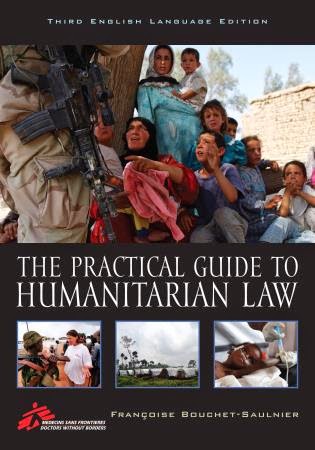
MSF invites you to participate in a live webcast on Monday, April 14 at 8pm EDT to mark the release of the third English language edition of The Practical Guide to Humanitarian Law.  

This online panel discussion will feature the book's author and MSF legal specialist, Françoise Bouchet-Saulnier, and two experienced MSF aid workers.  Drawing on their experiences from some of today's most violent conflict zones, the panelists will explore the challenges of ensuring armed groups respect international humanitarian law (IHL) and the safety of patients, health care workers, and medical facilities. They will also examine some of the tensions arising from the legal status accorded certain war-affected populations—whether refugees or internally displaced persons—and how this status affects their access to humanitarian assistance.

Register Here
(Viewer participation is encouraged via a chat feature available during the webcast).

Featuring:
Françoise Bouchet-Saulnier, Doctor of Law and magistrate, is the legal director of MSF and former research director at the Foundation Médecins Sans Frontières. She is the author of The Practical Guide to Humanitarian Law. 
Timothy Harrison, RN, recently completed a four-month mission with MSF in Malakal, South Sudan—one of that country's most contested areas in the ongoing civil war. Harrison, a Boston-area based nurse, will reflect on this experience and provide insights gained from his eight previous missions with MSF.
Anthony Thouvenin is the Logistics Supervisor for MSF operations in Chad, Ethiopia, South Sudan, and Sudan. He recently returned from the border of Chad and the Central African Republic (CAR), where he coordinated MSF's emergency project providing aid to those fleeing violence in CAR.

Monday, April 07, 2014

WFP Director Etharine Cousin: Touched by the Faces of Extreme Hunger

Photo: World Food Programme
Etharin Cousin, who was appointed as 12th executive director of the World Food Programme in April 2012, was the keynote speaker at a conference sponsored by the Institute of  International and European Affairs in Dublin, Ireland, in March 2014. Ms. Cousin talked about a visit to an exhibit about the Great Irish Famine, which shows some of the faces of the approximately 1.5 million Irish men, women and children died of starvation or related diseases.

"The expressions of those faces was very, very similar and familiar to me. They were faces I've seen in too many places today around the world...whether it's in a refugee camp in Dadaab...a mother in a refugee camp in Jordan who fled the Syrian conflict...or it's in The Philippines...talking to a mother or father who lost everything because of  [Typhoon Haiyan] because of the food that we are bringing.

While we are all thankful that the famines that created the history and have become a part of the history of this country are rare today, the reality is the challenge of lack of food, lack of access to nutritious food still exists.  And, unfortunately, in 2014 babies still die because of lack of access to food. 

So, people as, Is there a hunger crisis? Of course, there is a hunger crisis/  If 842 million people are food insecre  and 165 million children are chronically malnourished, that is a crisis. It is particularly a crisis because we know the answers on how to overcome food insecurity. "   

 
London newspaper The Telegraph has a great article about the WFP executive director.
Ertharin Cousin often wakes up at night, haunted by things she’s seen. It’s part of her job, as the executive director of the United Nations’ World Food Programme (WFP), to travel to some of the poorest countries in the world, and one particular experience has stuck with her: seeing two children in Somalia, the age of her own grandchildren, who were so malnourished they couldn’t move.  Read full article

Crisis in Central African Republic

(Note: The World Food Programme is providing assistance to refugees affected by an extreme crisis in the Central African Republic. The situation, which we wrote about in this blog a few weeks ago, has worsened. Here an update from The Telegraph

Click here to see how you can help the WFP respond to the crisis).

Saturday, March 29, 2014

An Argument for Including Freedom of the Press in Follow-up Plan to Millennium Development Goals

Cover picture for CPJ report
I attended a very interesting conference on freedom of the press in the Americas at Florida International University this past week. One free resource available to participants was a book published by the Committee to Protect Journalists entitled Attacks on the Press: Journalism on the World's Front Lines.

Several chapters in the book caught my attention, but one in particular had relevance to my anti-hunger and anti-poverty efforts. The chapter, written by CPJ deputy director Rob Mahoney, suggested that work of journalists was to look at the important issues affecting a country, and if this work was hampered, this would affect the most vulnerable members of society.
  
Mahoney used the example of Umar Cheema, a Pakistani journalist, who won the CPJ's International Press Freedom Award in 2011. Despite continued harrassment and intimidation from the Pakistani military (including a brutal assault in 2010), Cheema has continued the work of exposing corruption in Pakistan--which directly affects the well-being of the poor. 

In the chapter entitled  "Putting Press Freedoms at the Heart of Anti-Poverty Efforts," Mahoney points out that other journalists are doing similar work in their own countries (and are facing similar harrassment).  Here is an excerpt
There are Umar Cheemas in most countries, ferreting out land titles, company accounts, and public records, in an effort to hold governments and businesses accountable and serve the public interest. But many are under-funded and exposed. They are harassed, threatened, or lose their jobs. An increasing number are imprisoned, and many are simply murdered.

Their work and the broader role of journalists and media organizations as a voice for the poor and powerless, a provider of information and ideas, a forum for politics and culture, and an engine of change is acknowledged by economists and political scientists as vital to economic development and democracy.

But multilateral institutions from the United Nations to the World Bank, along with individual Western donor nations and agencies, have a mixed record in providing the sustained support, protection, and investment that journalists in repressive or impoverished countries or regions require. At the dawn of this millennium, world leaders vowed to improve the health and welfare of much of humanity by 2015 and agreed on eight goals for doing so. Press freedom was not among them. Neither were democratic governance and accountability, which press freedom underpins
That a free press and democratic governance go hand in hand is now well established in the development community. But it was not always so, as made evident by the glaring omissions in the first set of UN goals in 2000.
Here is the full text of  Putting Press Freedoms at the Heart of Anti-Poverty Efforts

Should peacemaking be part of the global anti-poverty plan too? 
While, Mahoney raises some interesting points, the global anti-poverty plan might have ommitted other important areas of work. For example, peace activist and author John Dear once suggested strongly that disarmament and peacemaking should have been included when the eight Millennium Development Goals were negotiated.

"If we want to discover the blessings of peace, we have to renounce war and dedicate ourselves to a new world without war. Every human being has to join this global campaign for peace if we are to lead ourselves away from the precipice of global catastrophe. We need to rediscover our shared humanity and reclaim the higher principles of love, justice, compassion and equality. We need to demand food, clothing, housing, education, healthcare, and dignity for every child on the planet. We need to give our lives for a future of peace," Rev. Dear wrote in The Vision of Peace in November 2004.

I agree that freedom of expression and peacemaking are essential partners to the fight against global poverty. But so far, they have been unspoken goals and not specific targets. So as the global community moves to follow up on the MDGs, perhaps the next global anti-poverty plan should include language where these two important human rights are spelled out in a more direct manner.

Sunday, February 02, 2014

Prayers and Actions on Behalf of the People of the Central African Republic

The Central African Republic is almost 8,000 miles from where I sit in Albuquerque. The huge distance makes it very easy not to be aware of the crisis that has developed in the former French colony, a landlocked country of more than 4.4 million.

As an anti-hunger advocate, I try to stay on top of the important issues. But chances are the CAR would not have crossed my mind this Sunday were it  not for a recent article by Rev. Jim Wallis in Sojourners, who said, "as I have followed the reports coming from Central African Republic (CAR), I am heartbroken over the suffering of a people the world seems to have forgotten."

To be fair, there has been some media coverage of the conflict in the CAR, but in this day of information overload, the crisis might have become just one of many revolving issues on a ticker-tape menu of coverage. 

Mega Crisis
Speaking to the BBC in the capital, Bangui, John Ging of the UN Office for the Co-ordination of Humanitarian Affairs (OCHA) said the country was in a "mega-crisis". Mr Ging said that many in the population were living in fear because of religious and ethnic attacks. He said the concern now was that matters could worsen further. Last week the UN warned that the country faced disaster because of people fleeing the conflict to pack into overcrowded camps with poor sanitation. BBC on Jan. 15

So who are these armed rebels and why are they attacking innocent civilians? An AP article (in  The New York Times) offers an explanation: 

Christians and Muslims have lived peaceably in Central African Republic for generations, but political struggles between former President François Bozizé and Michel Djotodia, who ousted Mr. Bozizé last year with the backing of Muslim militias, have engendered sectarian strife. Mr. Djotodia’s departure this month and the installation of an interim president, Catherine Samba-Panza, have not brought relief to civilians. United Nations officials continue to warn of the risk of genocide. Children have been recruited to fight. Roughly one in five people have fled their homes, and the World Food Program estimates that a majority of the country’s 4.6 million people are eating one meal a day.

A Prayer from CRS
Is this a religious or political strife? Can you claim to be a devout Muslim or devout Christian and commit murder in the name of self- (or group) preservation?

I offer excerpts this prayer from Catholic Relief Services.

Archbishop Dieudonne Nzapalainga and Imam Omour Kobine of Bangui pray together during a tour promoting tolerance and reconciliation in Central African Republic. (Photo by Sam Phelps for CRS)
Loving God,

We ask that your spirit touch the peoples of the Central African Republic.
That brother no longer turn against brother.
Nor sister against sister.
May your children learn to live side by side:
To forgive
To reconcile
To build and not tear down.
And so may we all.
Lord, who calls all peacemakers blessed,
Empower all peacemakers inside and outside the Central African Republic:
To stand up for the vulnerable
To harbor the refugee
To aid the afflicted
To comfort the frightened
To work and advocate for justice
To say “No more!” to violence.
 (download full prayer in PDF)

Rev. Jim Wallis on Why We Should Care
And here is some perspective from  Rev. Wallis:
So what can we do? And why should we care? CAR does not have in-demand exports. Even before the crisis began, CAR ranked 180th out of 187 on the UN’s Human Development index. There is no economic or political reason why the suffering in CAR should capture our hearts.

But that is why, as people of faith and followers of Christ, we should care. Jesus said, “whenever you failed to help any of my people, no matter how unimportant they seemed, you failed to do it for me.” (Matthew 25:45, CEV). It violates our deepest moral principles when we fail to speak out for the common good for all — not just our particular groups, tribes, or sects.

The example of our sisters and brothers working for peace in CAR should inspire us to advocate for a resolution to this crisis. We should contact our members of Congress and ask that our embassy be reopened — not only as a sign of our support, but because its closure impedes the work of peace in the country. And we should remind our elected representatives that our best values tell us that children — no matter what country they’re from — should be protected from war, not recruited to fight it.

So on this Super Bowl Sunday, when we are distracted by many other things, I urge us to keep the people of the CAR in our hearts and in our minds.

Friday, March 16, 2012

A New Book from Bread Member Jenny Moore on Humanitarian Law in Africa

Moore and two women from The Centre for Development and Peace Education in Sierra Leone in October 2010
It's not often that you hear the words "humanitarian" and "law" in the same sentence, but Bread for the World member Jenny Moore manages to find a thread that ties the two concepts together in three countries in sub-Saharan Africa that recently faced internal strife. Jenny, a Regents Professor at the University of New Mexico School of Law, offers case studies in Uganda, Burundi, and Sierra Leone, in her recently published book Humanitarian Law in Action within Africa.

"[The book] makes a compelling argument that durable peace with justice is possible - even in the aftermath of brutal armed conflicts," said Karen Musalo, Clinical Professor of Law & Director, Center for Gender & Refugee Studies, University of California-Hastings College of the Law.  

"It will be of interest to anyone searching for a conceptual understanding of international law norms relevant to periods of armed and post-conflict. But perhaps, more importantly, Humanitarian Law should be required reading for anyone who wants to read a persuasive argument that a better world is possible." 

Moore has had ample experience working with refugees in sub-Saharan Africa, having served on the staff of the Office of the United Nations High Commissioner for Refugees in West Africa. “I was in Rwanda after the genocide (in 1994) with the U.N., and that was very impacting, as you can imagine,” she said in a recent interview with The Albuquerque Journal.  
Secondary school students in Bombali District, in Sierra Leon’s Northern Province, greet Jenny Moore in October 2010.
The Journal recently published a great article about Jenny and the impact she has on the students who take her classes. As the article points out, Moore inspires students to use their degrees to advance human rights.  

Moore, a member of St. Andrew Presbyterian Church in Albuquerque, is a very down-to-earth and compassionate person.  Jenny has a passion for any efforts to address global poverty, and is generous with her time when given an opportunity to talk about this subject.  She has spoken on several occasions at Bread for the World gatherings about the Millennium Development Goals.

Friday, August 05, 2011

How You Can Help with the East Africa Crisis

There is a crisis 8,000 miles from us.  While the situation in the Horn of Africa is extremely urgent, this is a crisis that is not causing havoc with the global economy, so world leaders are not responding appropriately.

For those of us who are people of faith and citizens of the United States, it is important to respond.  Here are some suggestions..

Learn 
This great background section from Bread for the World has a lot of resources, including a timeline and a video.  And here are a couple of background pieces from Doctors Without Borders.
Dadaab, Kenya: Somalis Fighting For Survival
Somalis in Kenya: From One Desert to Another

Pray
We must hold every man, woman and child affected by the crisis in our hearts through prayers.  Each in our own way, can find the best way to do this.  Here is an excerpt from  a great prayer by Mark Koenig, Presbyterian Ministry at the United Nations

O God,
the ground is parched,
the food is limited and costly,
and your children,
our brothers and sisters,
hunger, sicken, and die
in the Horn of Africa.

O God, strengthen our sisters and brothers who hunger;
comfort our brothers and sisters who grieve;
accompany our sisters and brothers who leave their homes.
Read full prayer

Advocate
ONE: Parts of Somalia, Kenya and Ethiopia are facing one of the worst droughts in 60 years, and more than 12 million people are desperately in need of food, clean water and basic sanitation. Despite the urgency of the situation, most world leaders are responding too slowly. Immediate aid is essential. Yet at the same time we must not let them drop the ball on long term solutions as has too often happened in the past. Sign On-Line Petition to World Leaders.

Donate
I'm sure you know of many worthy organizations involved with relief efforts in the Horn of Africa.   Rather than offer a long list, I'll mention three very worthy groups.

CARE: An ongoing civil war and a severe drought in Somalia is driving tens of thousands of people to seek refuge across the border in the Dadaab refugee camps in Kenya. However, Dadaab is extremely beyond capacity and the influx of new arrivals is straining already-limited resources.

The refugees are exhausted, weak and dispirited — and they are not alone. There are 11 million people in the Horn of Africa facing the most severe food crisis in the world today and the worst drought to affect the region in 60 years. There is little likelihood of the food crisis and drought letting up until 2012.
Donate to CARE

Catholic Relief Services: This is being called the worst humanitarian crisis in the world. CRS and our partners are responding to this disaster at the refugee camps near Dadaab and elsewhere in the most affected areas in Ethiopia and Kenya. Shelter, water and food are stretched to the limit, and we urgently need your help. Donate to  Catholic Relief Services' East Africa Emergency Fund.

Doctors without Borders/Medicins sans Frontiers (MSF)/: Somali refugees continue to arrive at the overcrowded camp complex in Dadaab, northeastern Kenya, every day. They are fleeing the violent conflict in Somalia and the devastating effects of ongoing drought and lack of food. The third week of July alone brought 5,117 new refugees, pushing the total number of people in and around the Dadaab camp to 387,893. The three camp sites—Ifo, Hagadera and Dagahaley—were originally built to hold a combined 90,000 people.   Support MSF's Lifesaving Work

Saturday, November 20, 2010

A Journey to Sierra Leone


Kyra Ellis-Moore, a student at Albuquerque High School, traveled with her mother, Jennifer Moore, a Professor at the University of New Mexico School of Law, to Sierra Leone in West Africa in October 2010.  Jenny Moore, who once worked with United Nations High Commissioner for Refugees, was in West Africa to conduct research for a book she is writing on conflict resolution in Africa.  The book spotlights three countries emerging from civil war, including Sierra Leone.  We hope to highlight Jenny's research at some point in the future, but this post is all about Kyra.

You might remember Kyra as the young lady who organized an Offering of Letters at Albuquerque High School. She has also participated in several Bread for the World and ONE Campaign activities through St. Andrew Presbyterian Church.

Kyra wrote about her experiences in a blog called New Mexico Word: Speaking Out.  The blog was created by Youth Radio especially for youth in New Mexico to write about a variety of topics and experiences. The organization promotes intellectual, creative, and professional growth for young people through education and access to media. Youth Radio’s media education, broadcast journalism, technical training and production activities provide unique opportunities in social, professional and leadership development for youth, ages 14-24.

Kyra's posts are very insightful and informative and provide a wealth of background along with keen observations.  I have included excerpts from each of her posts.  These are real pleasure to read. Click on the headline to read each  full piece.


After 26 hours spent on planes and in the airports and on the runways of Washington DC, Brussels, Belgium, and Dakar, Senegal, and the five hours spent in a taxi, SUV racing along island highways, parked on a packed-to-the-gills ocean ferry, and stuck in a perpetual traffic jam on the streets of the city -- my mother and I finally arrived at our hotel in Freetown, Sierra Leone at 11 p.m. on Friday, Oct. 8, 2010.

On Saturday night (Oct. 9) we walked down the hill from our hotel to the headquarters of the United Nations in Sierra Leone, and the one-time headquarters of the largest UN peacekeeping mission in history, during the Sierra Leonean civil war.  There we met with Michael Schulenburg, the Special Representative of the Secretary General for Sierra Leone.

Although my mother’s main interest for the interview concerned peace keeping and transitional justice, I was able to ask him some questions specifically on the subject of youth.
But now, [the youth] are being reached out to by political parties, and with a voting age of 18, these youth hold huge political clout, which will most like determine the outcome of the upcoming 2012 presidential election.
Sierra Leone youth are defined as people who have not yet found their roots, goals, or role in society.  These youth have been largely left behind by the war:  they are uneducated, unemployed, alienated from traditional backgrounds, and normally to not belong to any community or social groups.   Schulenburg believes this election is a turning point and will determine the country’s future, and if it begins going in a direction of development and sustainability, it will be time for the UN to begin their exit, and give the nation a chance to be self-sustaining.